Physical Security Compliance: Frameworks and Controls
Learn which frameworks govern physical security compliance, what controls auditors examine, and how to build documentation that holds up under review.
Physical security compliance governs how organizations protect facilities, equipment, and people under regulatory and standards-based frameworks. The stakes are practical: controls are assessed not only by how they function in the field, but by whether an organization can show they are defined, maintained, and documented.
Key Takeaways
- Physical security compliance centers on documented controls that protect facilities, equipment, and people.
- Strong programs treat access, monitoring, environmental protection, and media handling as connected control areas.
- Audit readiness depends on records that are current, organized, and easy to review, not only on controls operating in the field.
- Effective teams maintain evidence as part of daily operations rather than waiting for a scheduled review.
What Physical Security Compliance Covers
Physical security compliance refers to an organization's adherence to regulatory, legal, and standards-based requirements governing the protection of facilities, systems, and the people within them. It applies wherever a framework imposes obligations on how physical spaces are secured, who can access them, and how that access is documented.
The scope extends well beyond locks and cameras. A compliance program must address access authorization, visitor tracking, environmental protection, media handling and disposal, equipment siting, and surveillance monitoring. Each of these areas carries documentation obligations that auditors verify independently.
Across the frameworks discussed here, documentation plays a central role in compliance. Controls still have to operate in practice, but auditors also look for organized, current, and reviewable records.
Key Frameworks That Impose Physical Security Requirements
Multiple regulatory and standards frameworks impose physical security obligations on enterprise organizations. They differ in prescriptiveness, enforcement, and scope, but they overlap in the control domains they address.
NIST SP 800-53 PE Family
The Physical and Environmental Protection family in NIST SP 800-53 Rev. 5 covers access authorization, monitoring, power, environmental systems, and facility siting. Federal agencies must implement these controls, and private-sector organizations often use them as a reference architecture. The PE family is a prescriptive general-purpose physical security control framework, with baseline assignments that influence minimum implementation thresholds.
ISO 27001 2022 Annex A Section 7
ISO 27001:2022 includes a Physical controls section covering perimeters, entry, monitoring, equipment, and media. It also requires monitoring of premises in and out of normal business hours.
HIPAA Physical Safeguards
The HIPAA Security Rule at 45 CFR §164.310 establishes standards for facility access controls, workstation use, workstation security, and device and media controls. Some implementation specifications are required and others are addressable. Addressable does not mean optional. It means the covered entity must assess whether the specification is reasonable and appropriate and document its decision.
PCI DSS v4.0.1 Requirement 9
PCI DSS Requirement 9 governs physical access to systems housing cardholder data. The standard places emphasis on documented physical access controls, monitoring of sensitive areas, and defined inspection practices for relevant devices. Entities without a documented inspection schedule can face compliance problems.
NERC CIP-006 and CIP-014
NERC standards CIP-006-6 and CIP-014-3 address physical security for the Bulk Electric System. They require documented physical security plans for relevant perimeters and designated facilities, along with threat and vulnerability assessment responsibilities.
SOC 2 Trust Services Criteria
Physical security falls under CC6 in the AICPA Trust Services Criteria. SOC is principles-based rather than prescriptive. The organization defines its own controls, and the auditor evaluates whether those controls achieve the criteria.
ITAR Physical Security
ITAR requirements for defense articles are embedded in the compliance program framework under 22 CFR Parts 120 through 130. Physical security obligations focus on controlling unauthorized access to defense articles, managing foreign person visitors, and securing mobile devices. Classified defense articles must meet additional requirements under separate national security rules.
Control Domains That Overlap Across Frameworks
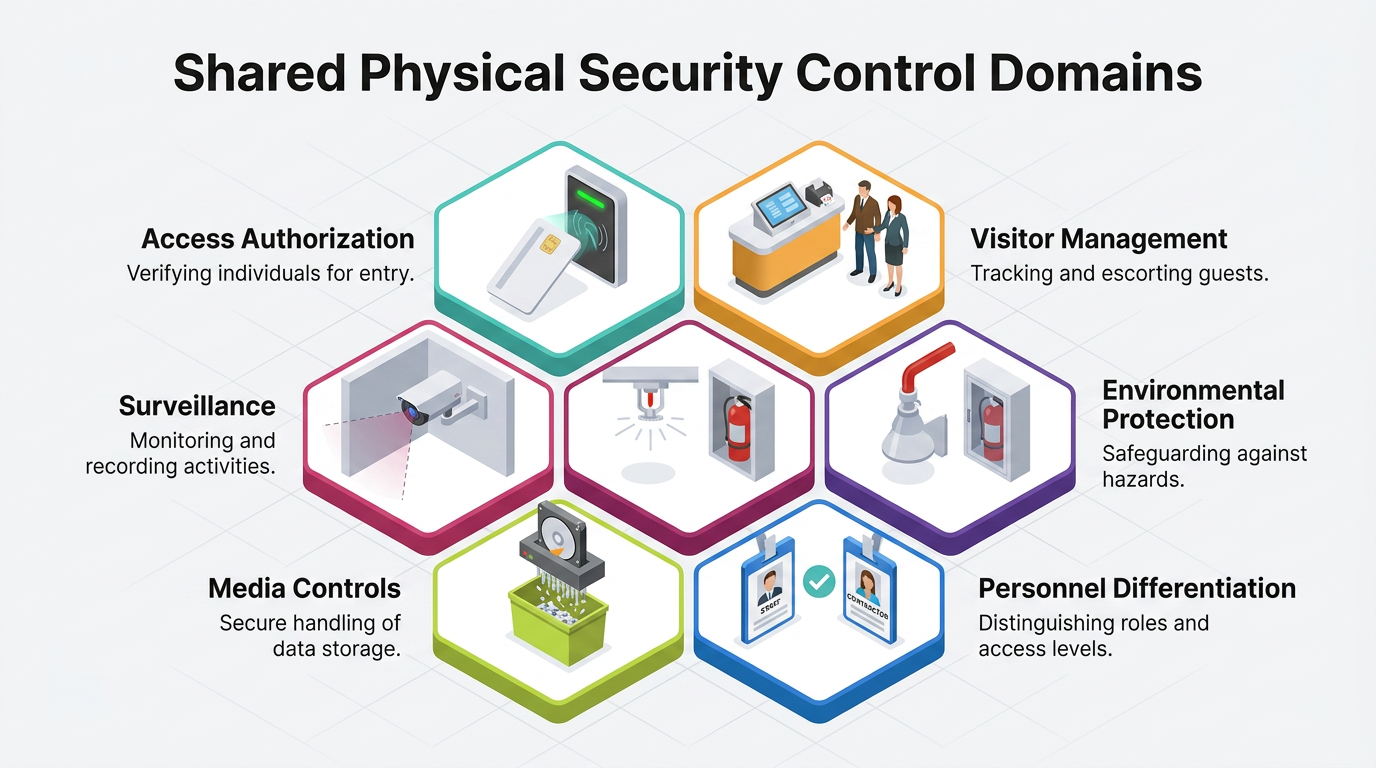
Despite differences in structure and enforcement, several control domains appear in nearly every framework. Security directors managing compliance across multiple standards can organize their programs around these shared domains rather than treating each framework as a standalone project.
- Physical access authorization and control. Major security frameworks generally require defined processes for managing physical access authorization, including granting, periodic review, and revocation, though they do not all use the same wording.
- Visitor management. Visitor identification, logging, escort requirements, and access revocation upon departure appear repeatedly across physical access control frameworks.
- Surveillance and monitoring. Multiple frameworks require monitoring physical access and premises to detect unauthorized entry and support incident response.
- Environmental protection. Fire, water, power, and climate-related protections are commonly addressed in physical security requirements.
- Media and device controls. Disposal, re-use, and tracking of media containing protected data are recurring compliance requirements.
- Personnel differentiation. Some frameworks require clear distinction between authorized personnel and visitors in sensitive areas.
What Auditors Actually Examine
Knowing what a framework requires is half the challenge. Knowing what an auditor looks for during a site visit often determines whether a program passes.
Access Control Evidence
Auditors often review badge system records, credential issuance and revocation logs, key control documentation, and records related to inactive or unexplained credentials. They may also review whether access credentials, keys, or combinations are updated when personnel changes create risk, not only on a routine schedule.
Surveillance Documentation
Auditors may examine whether video surveillance is used in defined areas, whether recordings are reviewed at a defined frequency, and whether retention periods are formally documented. Technical retention alone is insufficient. The retention period should appear in policy text that an auditor can review.
Visitor Records
Visitor access records are often expected to capture core identifying and visit details, including who visited, when they entered and departed, why they were there, and whom they visited. Visitor logs that omit these elements can create audit problems.
Environmental and Safety Records
Physical security reviews often include written records tied to facilities safety and maintenance, such as fire alarm maintenance logs and fire extinguisher service records. These responsibilities often sit with facilities management, but they still affect physical security compliance.
The Continuous Monitoring Gap
Some frameworks impose ongoing monitoring expectations as part of broader security or compliance programs. Organizations that rely only on business-hours staffing need to address after-hours monitoring before an audit.
Building an Audit-Proof Compliant Physical Security Program
Physical security compliance requires governance structure, risk assessment methodology, gap analysis, continuous monitoring, and organized documentation at every stage.
The Pre-Audit Documentation Checklist
Auditors evaluate both the documentation package and the security operation through review, observation, interviews, and testing. The package includes:
- Security program charter with leadership approval and organizational accountability structure
- Current risk register with a Plan of Action and Milestones specifying owners, budgets, and target dates
- Facility survey records with building plans, gap analysis results by site, and completed checklists
- Access control logs, credential records, and key control documentation
- Camera coverage maps tied to facility drawings, retention policy documentation, and maintenance logs
- Visitor logs, contractor access records, and escort policy documentation
- Control-to-requirement crosswalk documents mapping internal controls to applicable frameworks
Tailoring rationale, the documented reasoning for which controls were applied, scoped out, and why, is itself an auditable artifact.
Testing Cadence
Testing cadence varies by control type. Device health checks typically run daily, while panic buttons, door alarms, and access logs follow a weekly or monthly schedule. End-to-end scenario drills happen less often, and a full risk assessment usually lands on an annual cycle or follows a major operational change. Whatever the interval, corrective actions generated by any test must be documented and tracked. That paper trail is what auditors read as evidence of program responsiveness.
Sector-Specific Requirements That Go Further
General frameworks set a baseline. Sector-specific regulations add obligations with no general equivalent.
Healthcare organizations under HIPAA face device and media control requirements, including disposal and media re-use safeguards. Physical security obligations under HIPAA can also affect business associates and subcontractor relationships where protected health information is involved.
Electric utilities under NERC CIP must develop and implement documented physical security plans for covered facilities, with requirements that vary by standard. Some requirements also call for outside review as part of the process.
Defense contractors operating under national security rules may need formally assigned security responsibilities within the company. In that environment, facility, personnel, and information security responsibilities are often closely connected even when broader frameworks address them separately.
Privacy Obligations That Intersect with Physical Security
Compliance does not stop at the security framework. The same cameras, biometric readers, and visitor systems that satisfy access and monitoring requirements also collect personal data, which brings them under privacy law. Security directors who treat the two tracks as separate often discover the overlap only after a deployment is already live.
State video surveillance laws are the clearest example. Recording consent rules, notice and signage requirements, restrictions on audio capture, and limits on where cameras can be placed vary significantly across jurisdictions. Organizations operating in Florida and California face different obligations even when the underlying camera system is identical.
Biometric access control introduces a second layer. Statutes governing fingerprint, facial, and palm vein data impose notice, consent, retention, and destruction requirements that sit outside the security frameworks discussed above. Visitor data and employee monitoring add further constraints, including written notice rules in several states.
A physical security program that satisfies NIST or ISO can still fall out of compliance with a state privacy statute. Mapping camera placements, retention schedules, and biometric workflows against the privacy laws of every operating jurisdiction belongs in the same compliance package as the security framework crosswalk.
The Shift from Periodic Audits to Continuous Monitoring
Several current regulatory instruments and assurance programs now emphasize continuous monitoring rather than periodic assessments. PCI DSS includes more explicit ongoing monitoring expectations. Other programs are also moving toward more continuous evidence-sharing and monitoring workflows.
Security directors building compliance programs should design around continuous monitoring architectures rather than annual assessment cycles.
Organizations deploying AI-enabled surveillance or biometric technologies may also face additional legal and regulatory obligations depending on where they operate and how those systems are used. Security directors expanding biometric access control should treat the decision as a regulatory compliance project requiring legal review.
Staying Compliance Ready
Physical security compliance holds up when controls and records stay aligned. Access control, surveillance, environmental protection, media handling, and visitor management all require documentation that is current, organized, and easy to review. Teams that build evidence into daily operations are better prepared for audits, operational changes, and frameworks that expect ongoing monitoring.
Frequently Asked Questions
What is the difference between 'required' and 'addressable' implementation specifications under HIPAA physical safeguards, and what documentation is needed if you decide not to implement an addressable specification?
Required specifications must be implemented. Addressable specifications require formal assessment to determine if the control is reasonable and appropriate. If not implemented, document the decision rationale and identify any alternative equivalent measures adopted instead.
How do you build a control-to-requirement crosswalk document when your organization must comply with multiple physical security frameworks like NIST SP 800-53, PCI DSS, and ISO 27001 simultaneously?
Start with a shared control taxonomy for domains like access authorization and visitor management. Map each internal control to all applicable framework citations in a matrix, identifying where one control satisfies multiple standards, reducing duplication and revealing coverage gaps.
What does a continuous monitoring architecture for physical security compliance look like in practice, and how does it differ from preparing for periodic annual audits?
Continuous monitoring integrates automated evidence collection from security systems into centralized compliance platforms, streaming logs, alerts, and sensor data for real-time review. This contrasts with periodic audits, where teams manually compile historical records retroactively, often creating documentation gaps.
