How Enterprise Security Risk Management (ESRM) Works: Best Practices
Learn how Enterprise Security Risk Management ties physical security to business strategy, assigns risk ownership, and builds governance that earns board-level trust.
Enterprise Security Risk Management (ESRM) treats physical security as a business discipline, tying protective decisions to the organization's mission and placing final risk-acceptance authority with the business leaders who own the assets rather than with the security team. That shift reframes security spending as a business investment and gives the board a consistent way to measure both risk exposure and program value.
Key Takeaways
- ESRM is a strategic, repeating cycle that connects security activity to organizational mission and treats security risk as a business risk owned by asset owners, with security in an advisory role.
- The model follows a repeating lifecycle that prioritizes assets, evaluates risks, selects treatments, and improves through ongoing governance.
- Effective programs depend on governance structure and cultural change far more than on technology, and the security leader advises asset owners as a trusted business partner.
- AI shifts monitoring from reactive review toward proactive detection while introducing new governance demands around bias and oversight that practitioners must manage deliberately.
What ESRM Actually Means for Security Leaders
ESRM is a strategic approach that ties an organization's security practice to its overall strategy using globally accepted risk management principles. Authority changes under ESRM. Traditional physical security operates reactively and by discipline, with separate teams handling physical access, loss prevention, investigations, and related duties, and with security professionals defining and enforcing policy on their own.
ESRM changes that arrangement. Security risk is handled as a business risk comparable to financial and operational exposure, as well as regulatory exposure. The security leader advises. The asset owner decides. ESRM applies the same risk logic across security domains. It covers physical security, executive protection, workplace violence, brand protection, and travel safety through a single approach.
Four pillars hold the model together:
- Risk management across all security types. All security risk types are considered together rather than handled discipline by discipline.
- Stakeholder partnership. Security professionals position themselves as advisors to the asset owners who carry the risk decisions.
- Transparency. The program communicates the nature of identified risks and the process used to prioritize them.
- Governance. A committee holds decision authority rather than a single individual.
The partnership pillar carries the main cultural burden: security teams accustomed to setting policy directly must adjust into a trusted-advisor role.
The Core Ownership Principle Behind Everything
Whoever owns the asset owns the risk. The asset owner, defined as the person most accountable for an asset's productivity and operation, is also the risk owner. The security manager serves as subject matter expert, guiding the decision while leaving the final call with that owner.
Security frames choices for the people accountable for outcomes and ties spending to business risk. The security leader educates business partners on the realistic impact of risks to their assets, presents mitigation options, and enacts the chosen path within the organization's risk tolerance.
The ESRM Lifecycle Phase by Phase
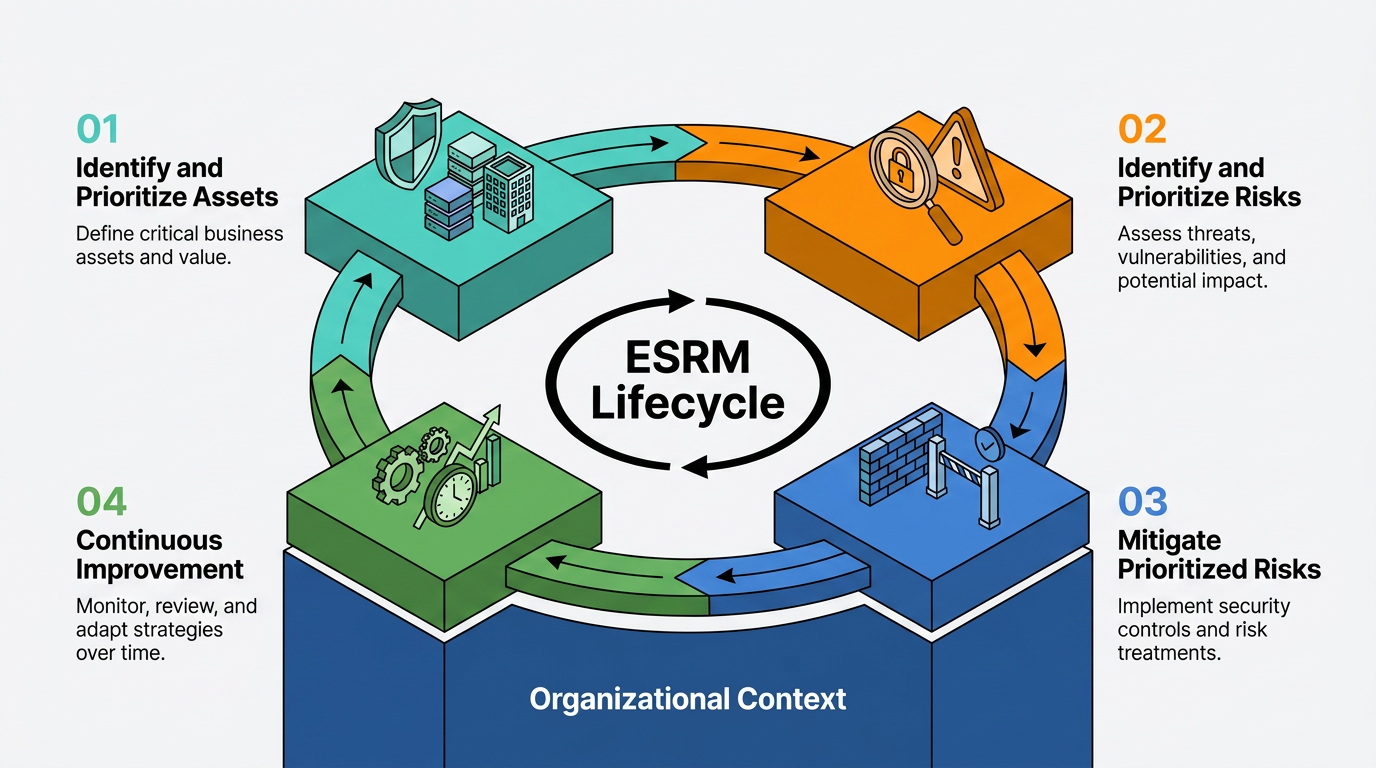
The ASIS ESRM Guideline builds the program on a foundation and a repeating cycle set inside organizational context. Context comes first and sits outside the repeating loop. Before adopting ESRM, security professionals establish the program's grounding by understanding the organization's mission and vision, its core values, its operating environment, and its stakeholders. That grounding gives asset prioritization its reference point.
The cycle itself moves through sequential phases that repeat continuously.
Phase 1: Identify and Prioritize Assets
The program begins with understanding what the organization's assets are, where they sit, and why they matter to the mission. Mission impact drives prioritization by accounting for each asset's effect on the organization's ability to execute that mission.
This phase produces a ranked list of assets. The asset owner relationship is established during this phase because each prioritized asset needs an accountable owner who will later carry the risk decisions tied to it.
Phase 2: Identify and Prioritize Risks
With assets understood, security professionals examine the probable areas of concern and how each might affect those assets. Security professionals rank risks by their potential impact on mission execution. The prioritized risk list maps against the asset list. This phase requires cross-discipline sharing.
ESRM frames risk assessment as part of a strategic, holistic approach, so assets and risks are evaluated in connection with organizational objectives and the broader security program. A threat surfaced by an investigations team becomes input for the executive protection team and vice versa.
Phase 3: Mitigate Prioritized Risks
Here security professionals develop mitigation strategies for the prioritized risks against the prioritized assets. Combining the lists into a matrix clarifies where the highest-impact intersections sit.
Decision authority governs this phase directly. Security coordinates with asset owners to develop treatment options and recommendations, the asset owner actively affirms a treatment option, and the resulting security risks land on the enterprise risk register alongside other business risks. The asset owner's affirmation transfers accountability and keeps security in its advisory role.
Phase 4: Continuous Improvement
The fourth phase turns the cycle into a loop. Operational tasks such as incident response and investigations generate intelligence that feeds back into the program. That intelligence surfaces new and emerging risks. At higher maturity, risk monitoring activities are performed and shared across all disciplines and used to identify emerging risks proactively, with open, real-time communication flowing between security, top management, and asset owners.
The Standards Underneath ESRM
ESRM draws on globally established risk management principles and the same enterprise-risk logic used across other business functions.
ESRM applies those principles by judging security risk against mission objectives and emphasizing senior management involvement. It assigns authority, responsibility, and accountability at appropriate levels. A mature ERM program makes ESRM adoption easier because the two share stakeholder partnership and risk management across security types as common concepts. ESRM can be adopted independently of an ERM program. The shared philosophy means an organization with established risk culture has less ground to cover.
Governance Structure That Makes ESRM Work
ESRM requires a clear answer to who decides, and that answer flows from the ownership principle.
Security as Advisor
Under ESRM, governance requires the advisory posture. Tying security risk decisions to organizational strategy turns security into a business enabler, while the ownership principle keeps decision authority with the business leader accountable for the asset.
The Security Council
A security council aligns the security program with business requirements. Its form varies by organization. It can be a loose, informal group that provides input as needed, or a board-level initiative with formal roles, meetings, charters, and documented responsibilities for ensuring security compliance.
The council is composed of senior management from business areas responsible for monitoring and protecting against security risk. It acts as the central management and information clearinghouse for any catastrophic security-related incidents and facilitates communication among security risk stakeholders, escalating key risk decisions to senior management and the organization's board of directors when appropriate.
Three Defined Roles
ESRM assigns three roles across the organization:
- Top management. The highest level of leadership, the C-suite or executive committee that sits above the security function's leader.
- Asset owners. The business-unit leaders accountable for specific assets and their risks.
- Security professionals. Advisors and implementers with subject-matter expertise who guide asset owners through risk decisions.
The program succeeds only when security identifies, engages, and aligns with these stakeholders and asset owners across the organization.
At higher maturity, governance becomes formalized. A documented security governance charter exists, the security council is aligned to the organizational structure, members understand their roles, and the maturity of that alignment is reported regularly to the governing group and to enterprise executives. ESRM outcomes are discussed at recurring meetings and shared with organizational leadership.
The Challenges Security Directors Face Implementing ESRM
The framework is well developed. Adoption lags well behind it. Recent ASIS research found that fewer than a quarter of organizations fully implement ESRM, and a comparable share are unfamiliar with it or have no ESRM practice. The majority sit somewhere in transition.
- Siloed systems and cross-departmental friction. ESRM depends on partnership across the organization, and disconnected systems between risk and security teams create blind spots that make related risks harder to correlate and board reporting slow and error-prone.
- Alert fatigue and data overload. A single GSOC operator may be tasked with monitoring hundreds of camera feeds, and there are too many feeds for any operator to absorb simultaneously, forcing analysts to context-switch and manually correlate events that should connect automatically.
- The executive buy-in paradox. ESRM builds security's organizational influence once it lands, but security leaders need that same influence to secure approval for the program in the first place. Breaking the deadlock takes a phased rollout anchored to at least one executive sponsor and a cross-functional security council that carries the case forward with peer business leaders.
- Risk quantification. Translating physical security risk into financial terms a board can weigh against other enterprise risks remains the weakest link, and without credible metrics, security leaders struggle to justify capital investments and ongoing operational spending.
- Cultural change and scale. Repositioning security professionals as advisors is a cultural shift met by resistance from leadership or staff, and scaling that shift across a large, multi-site organization compounds the difficulty of reaching mature implementation.
How AI Is Reshaping ESRM Risk Assessment and Monitoring
AI changes ESRM in two directions at once. It gives security teams a faster, more accurate way to detect threats, and it introduces a new class of risk the program itself must govern. Both belong inside the ESRM framework, not alongside it.
From Static Monitoring to Event-Based Detection
Traditional monitoring asks operators to watch banks of live feeds and catch incidents as they unfold. That model breaks down at scale. AI-powered behavioral detection and predictive modeling let security teams move toward real-time risk detection, where systems continuously scan live video, compare what they see against learned patterns of normal activity, and flag anomalies before they become incidents.
The result is an event-based model. Instead of asking operators to find threats inside a wall of feeds, AI surfaces a verified event and routes the operator's attention to it. Human judgment stays in the loop, but it is applied to a small number of validated signals rather than spread thin across hundreds of simultaneous streams.
The Governance Burden AI Introduces
AI systems create risks of their own, and those risks belong on the ESRM register alongside physical threats. Two categories matter most.
- Model bias. AI models learn from the sample data they are trained on. If the data reflects skewed populations, environments, or behaviors, the model inherits those gaps and can misfire in ways the security team may not immediately detect. Bias is itself a risk the ESRM program must register, monitor, and treat.
- Autonomous decision-making. Agentic AI does not just report events, it takes actions and adjusts as conditions change. That behavior shifts the governance question from monitoring discrete actions to governing decisions the system makes on its own. It also creates a secondary risk: leaders who lean on automation without maintaining team skills lose the ability to critically evaluate what the tools report.
The security council carries the governance work. It decides which AI systems belong on the risk register, what oversight each one requires, how algorithmic bias will be tested and reported, and how privacy and biometric compliance obligations will be met. Human oversight is treated as a named risk control, not an assumption.
Where ESRM Compliance Touches Physical Security
Several external compliance obligations intersect with a physical ESRM program.
OSHA's General Duty Clause, Section 5(a)(1) of the Occupational Safety and Health Act, requires employers to provide a workplace free from recognized hazards likely to cause serious harm. Once an employer becomes aware of threats or indicators of potential violence, that hazard belongs inside the ESRM program's prevention work. This makes workplace violence prevention a direct ESRM concern.
NIST SP 800-53 provides a catalog of security and privacy controls. The catalog includes physical and environmental protection controls. These external references shape the controls a mature program maintains.
Best Practices for ESRM Implementation
The framework describes what ESRM is. The practices below describe how mature programs operate it, each addressing a recurring adoption pattern documented in the ASIS maturity work.
Start With the Asset List
The asset inventory precedes everything else in the lifecycle. Programs that skip it spend later phases arguing about scope instead of ranking risk. A durable inventory documents what the organization owns, where each asset sits, how it ties to mission execution, and who owns the operating outcome. That last element matters most: each prioritized asset needs a named business owner to carry the risk decision. Without that assignment, the ownership principle collapses back into the traditional model.
Anchor the Rollout to an Executive Sponsor
Adoption depends on top-management alignment before tooling or process. An executive sponsor gives the program authority to convene asset owners, resolve cross-departmental friction, and elevate risk decisions to the right level. The sponsor also breaks the buy-in deadlock, since security needs influence to advocate for ESRM and ESRM builds influence once it lands. A phased rollout shows progress against defined milestones rather than converting the entire enterprise at once.
Build Cross-Discipline Risk Sharing Into the Lifecycle
Every discipline's risk assessments feed the shared program view. Investigation findings, executive protection intelligence, workplace violence indicators, and travel safety data belong in one register, reviewed against one prioritized asset list. Isolated assessments defeat the model's purpose because a threat surfaced by one team may be the top risk facing another. A consolidated view also strengthens risk quantification, giving the board metrics to weigh security against other enterprise risks.
Register AI Capabilities and Biases as Program Risks
Autonomous systems introduce new decisions the enterprise must govern. Registering algorithmic bias, privacy exposure, biometric compliance, and human-oversight requirements alongside physical risks keeps AI adoption inside the ESRM framework. The security council should decide which systems belong on the risk register, what oversight each requires, and how to detect model drift over time. Treating AI as a governed capability lets the board weigh its value against its exposures in the same language applied to other enterprise risks.
Building a Program That Earns Its Place at the Table
ESRM succeeds when governance turns security risk into a shared business discipline tied to the organization's mission. The framework is mature, the standards beneath it are settled, and the adoption gap is the real opportunity for security leaders willing to work the practices deliberately. Sequencing matters as much as the practices themselves. Assets first, then owners, then governance, then the risk cycle, then the AI layer that now runs on top of all of it. Programs built in that order earn a seat at the table and keep it.
Frequently Asked Questions
How do you convince asset owners to accept risk decision authority when they have no security background and are reluctant to take on that accountability?
Frame risk decisions as extensions of responsibilities asset owners already carry. Present options with clear trade-offs between cost, operational impact, and residual risk. Translate security language into business impact they understand and document their choice.
What specific metrics or frameworks can security leaders use to quantify physical security risk in financial terms for board-level reporting under ESRM?
Security leaders can apply annualized loss expectancy calculations, combining single loss expectancy with annual rate of occurrence, or adopt factor analysis of information risk to model threat event frequency and probable loss magnitude using Monte Carlo simulations.
How should a security council structure its oversight of AI-powered detection systems to manage algorithmic bias without slowing down real-time threat response?
Set acceptable false-positive thresholds by asset criticality, automate bias testing through periodic audits of flagged events, and maintain governance where detections run continuously while quarterly reviews evaluate accuracy and adjust model parameters without disrupting operations.
