Duress Alarm Systems: What They Are and Where They Fit in a Security Program
Learn how duress alarm systems work, where they fit in a security program, and what placement, testing, and compliance requirements apply across industries.
A duress alarm system gives someone in danger a way to summon help without saying a word. A bank teller handed a threatening note, a triage nurse cornered in an exam room, or a receptionist facing an agitated visitor may not be able to safely pick up a phone or shout for help. A discreet signal to a monitoring point can bring response without provoking the threat.
Key Takeaways
- A duress alarm should send a silent request for help without alerting the aggressor.
- At staffed workstations, fixed devices belong within reach; mobile employees need wearable coverage validated throughout the intended coverage area.
- Integrating activations with video, access control, and response workflows gives operators actionable context.
- For commercial holdup alarms, operators should skip confirmation calls and regularly test the full response path.
What Is a Duress Alarm System
A duress alarm is a manually triggered, silent request for help from someone already inside a facility and under threat. Underwriters Laboratories (UL) 636, the standard for holdup alarm units, covers devices in banks, stores, and cashiers' cages that signal for help during an interior robbery. The alarm annunciates at a remote monitoring station or guard post, and the initiating device stays unobtrusive so activation does not endanger the user.
Manual initiation separates a duress alarm from an intrusion alarm, which trips automatically on unauthorized entry. UL lists holdup systems as a separate product category from burglar alarms, and NFPA 731, the National Fire Protection Association standard for premises security systems, dedicates a chapter to holdup, duress, and ambush systems. The International Association for Healthcare Security and Safety (IAHSS) guideline points to common alarm locations, such as cash-handling areas, pharmacies, reception desks, and administrative offices.
How Duress Alarm Systems Work
Once a user activates the device, a panel-based system follows one path: a button or keypad duress code changes a circuit or software state, the panel classifies it as a duress event, a communicator sends it to an off-premises monitoring point, and that monitoring point acts. When the duress code is entered, the panel disarms as if nothing happened while signaling that the user is acting under duress.
American National Standards Institute and Security Industry Association (ANSI/SIA) CP-01, the Security Industry Association control panel standard for false alarm reduction, gives standard intrusion zones an abort window and a communicator delay so a user can cancel a mistake. Duress zones get neither. The panel also suppresses the post-alarm display of violated zones, so nothing on the keypad reveals that a signal left the building.
Communication paths can be supervised through regular communication check-ins. The panel and the receiver exchange periodic messages, and a missed check-in raises a trouble condition. UL's line security guidance requires short supervision intervals for high-risk applications. NFPA 731 requires independent power supplies for holdup, duress, and ambush systems, with secondary power available after a primary failure.
Duress Alarms vs. Panic Alarms vs. Mass Notification Systems
The covert behavior of a duress alarm distinguishes it from systems designed to alert people at the activation point. A panic alarm is typically overt, producing an audible or visible signal so nearby occupants know something is wrong. Panic devices are typically sited in schools, courts, manufacturing floors, and public spaces where a local alert helps rather than endangers. Common duress-alarm placements include cash-handling, pharmacy, reception, and administrative areas, where an in-room alert could provoke the aggressor. These typical distinctions are reflected in the IAHSS alarm guideline.
A mass notification system (MNS) communicates in the other direction. Under NFPA 72 Chapter 24, it delivers instructions from a central point to a large campus population or multi-building site, and it can seize control of fire alarm notification appliances to do so. A duress alarm lets one person signal inward to a monitoring point; an MNS lets the organization broadcast outward. MNS control units are listed to UL 2572.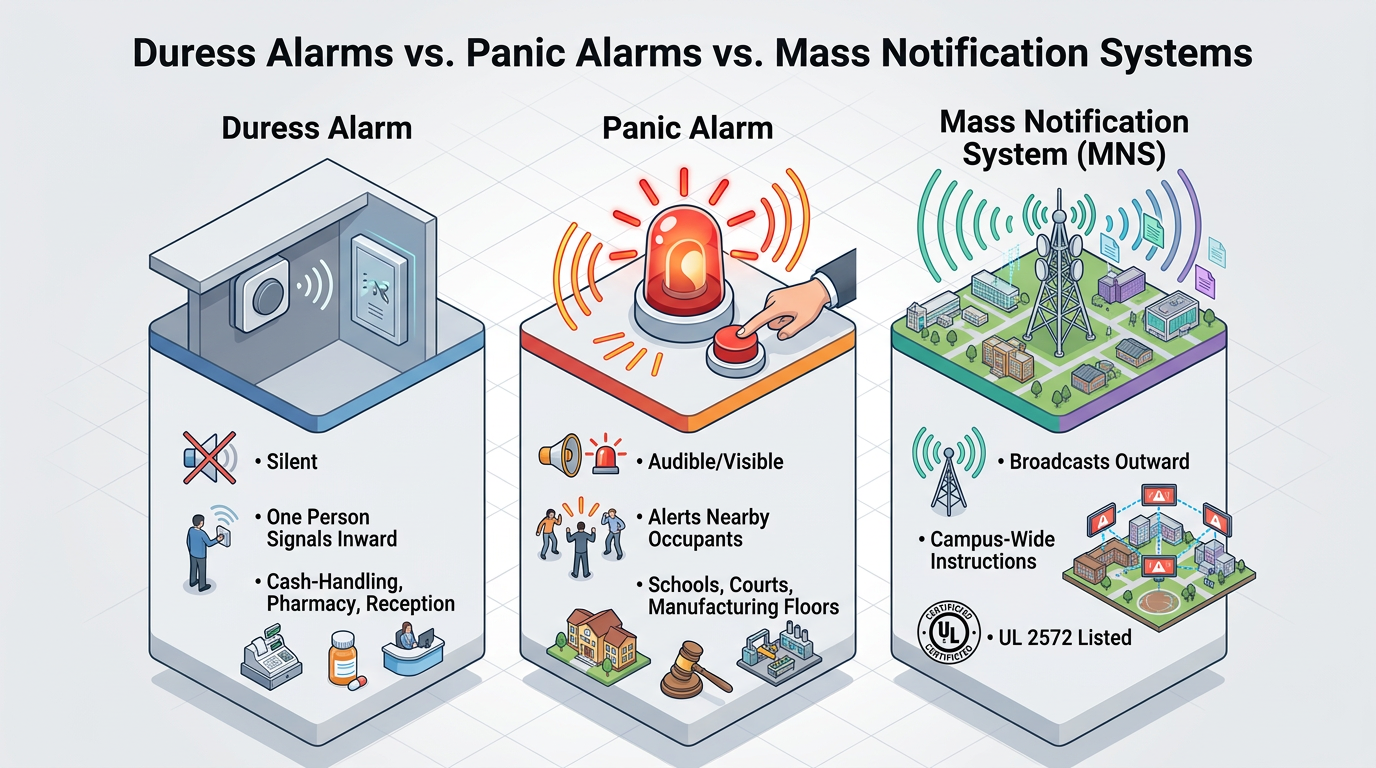
Types of Duress Alarm Devices
The need for covert activation shapes the available device types. UL 636 divides fixed devices into three fixed device classes: bandit-resisting enclosure alarms, semiautomatic alarms, and manual alarms. Wall-mounted buttons, under-desk buttons, and foot rails are manual; a foot rail lets a teller signal during a note-pass robbery without moving a hand. Operators should treat fixed-device activations as identifying the configured alarm point rather than tracking a moving user.
Wearable pendants and badges carry the trigger with the person, and a real-time location system (RTLS) supplies the position. The positioning technology shapes what the operator sees:
- Infrared and radio frequency (IR/RF) tags typically resolve to a broader zone and can report the wrong floor.
- Bluetooth Low Energy (BLE) tags support indoor positioning performance that varies by system configuration.
- Ultra-wideband (UWB) can provide precise positioning in line of sight, but obstacles make non-line-of-sight measurement substantially harder, as reflected in National Institute of Standards and Technology (NIST) indoor-ranging research.
GPS can be unreliable indoors because building materials can block indoor GPS signals. Smartphone panic apps therefore depend on available Wi-Fi or cellular service and the phone's battery. App-based activation generally requires deliberate user interaction.
Where Duress Alarms Fit in a Security Program
A duress alarm is one control inside a broader workplace safety program, sitting alongside physical barriers, access restrictions, staffing, monitoring, and reporting. Coverage decisions should follow program risks, not the device alone. Three layers determine whether the button delivers on its purpose:
- Engineering-control layer. OSHA 3148 lists personal alarm systems as an engineering control, and Cal/OSHA's Title 8, California Code of Regulations (CCR), § 3342 places that control beside protected workstation controls such as shatter-resistant glazing. The button covers the moment those barriers fail.
- Program layer. IAHSS Guideline 04.08 calls for a duress program addressing location, activation, response, maintenance, and testing. The Joint Commission's workplace violence requirements for hospitals cover leadership oversight, reporting, data analysis, post-incident strategies, and training without mandating any device.
- Operations layer. Monitoring software routes the signal to the physical security operations center (PSOC) or global security operations center (GSOC) alongside intrusion, access, and video events, so operators dispatch, verify, and document from one console.
Integrating Duress Alarms with Video Verification and Access Control
Integrated systems can give operators more than a bare zone number. A physical security information management (PSIM) layer or unified platform can bring duress, camera, and access-control events into centralized security operations. This reduces interface switching and the need to correlate separate event records while the incident develops.
Operators also use video differently for duress than for intrusion. For intrusion, video verification gates dispatch and the ANSI/TMA AVS-01 alarm levels help agencies prioritize the call. Where policy exempts a duress activation from verification, video can provide responder context without delaying notification. On a behavioral health unit, footage of two staff escorting a patient to a room while one adjusts a badge clip may indicate an accidental press that still gets a check-in call. Footage of a lone staff member backed against a wall with a patient's hands raised gives the operator critical context about what security is walking into.
Regulatory and Compliance Considerations
Each site's response procedures must reflect its applicable obligations. Federal OSHA guidance recommends personal alarm devices as an engineering control for healthcare workplace violence, while binding device obligations vary by state, sector, and accreditor. A multi-state employer can therefore face several requirements at once.
Healthcare has several specific obligations. Cal/OSHA 8 CCR § 3342 has long listed personal alarm devices as an engineering control.
State and sector mandates layer additional obligations on top of federal guidance:
- State versions of Alyssa's Law can establish silent school alarms linked to emergency response systems.
- New Jersey law covers hotel employee panic devices for staff working alone in guest rooms.
- New York's Retail Worker Safety Act requires a silent response button for large retail employers operating statewide.
- Banks operate under a long-standing federal mandate: Title 12 of the Code of Federal Regulations (CFR), Part 21, requires an alarm system for promptly notifying law enforcement of a robbery, burglary, or larceny.
Industries and Use Cases for Duress Alarm Systems
Those obligations are concentrated in industries where workers face frequent public contact or isolation. The settings below share one feature: a worker exposed to a member of the public with limited backup nearby.
- Healthcare facilities. Programs commonly consider emergency departments, behavioral health units, and pharmacies, where clinical staff manage agitated patients and controlled substances at close range.
- Home healthcare and convenience retail. Convenience store cashiers and home healthcare workers face documented lone-worker risks when no coworker is present to assist.
- Hospitality. Hotel housekeepers work alone inside guest rooms, out of sight of the front desk and other staff.
- Schools. Classroom teachers can be isolated with students and visitors far from an administrator or resource officer.
- Government service counters. Public-facing counters place a single employee across from members of the public with grievances against the agency.
- Banks. Tellers remain the original UL 636 use case, handling cash across the counter from customers.
Placement and Coverage Standards for Duress Devices
Placement has to follow the worker's movement rather than a generic floor plan. A fixed device only helps the person able to reach it, so placement rules start at the workstation. NFPA 731 sets the baseline through workstation placement requirements: install the initiating device near the workstation and within reach from the normal working position, and place any signaling appliance where the person at the initiator can see it.
General Services Administration (GSA) policy identifies federal duress locations, including front desks, cash or public transaction areas, and other at-risk areas, whatever the Facility Security Level, and directs facilities to conceal the devices from the public. The University of Connecticut's physical security design standards establish camera coverage requirements for every panic or duress button, with recording triggered by activation.
Wearables cover mobile staff, but staff should validate coverage throughout the intended area. NFPA 731 also requires portable devices to meet CP-01's accidental-activation design rules, which can be implemented through a double-press or press-and-hold trigger. A site RF survey and a walk test of every coverage area before acceptance find the gaps before a real activation does.
Testing, Maintenance, and Battery Management
Administrators establish initial coverage through placement, then use testing to confirm that coverage still works over time. Off-premises transmission equipment follows transmission testing requirements, including periodic testing unless the system performs automatic tests, and repair must begin promptly after a defect appears in a test or supervision signal. The system user, the premises security system provider, or the owner's designated representative is responsible. Under the official testing requirements, records should identify when and where testing occurred, who performed the work, and which devices were tested.
The receiver should flag communication check-in failures when a transmitter stops reporting. The latest edition of NFPA 731 adds requirements for lithium-ion replacement batteries because of thermal runaway risk. Central station requirements also include communication-path testing for any unsupervised path, with the result logged.
Before a walk test, administrators should coordinate with the monitoring center to prevent an unintended dispatch and then check each signal for the correct zone label. Banks add their own cadence: 12 CFR Part 326 requires the security program to cover testing security devices and to be reviewed annually.
Measuring Duress Alarm Program Performance
Program metrics show whether people and processes perform as intended. Published duress program evidence provides limited benchmark data for acknowledgment time, dispatch time, accidental-activation rate, or device uptime. Programs build their own baselines from measures they can influence:
- Acknowledgment time from the press to the operator's first action on the alarm.
- Time to responder arrival at the activation point.
- Ratio of valid to accidental activations across each zone and device type.
- Badge-wearing rates for staff issued wearable devices.
- Completion of annual tests and drills across every device and coverage area.
The Department of Defense threshold in Manual 5200.01, Volume 3, sets a limit of one per 30 days for false or nuisance alarms in each zone and offers a usable target for fixed zones. Every metric needs the after-action report beside it; a program that logs activations without reviewing them cannot tell whether a slow response came from the device, the network, or the responder.
Common False Alarm and Staff Adoption Pitfalls
Program managers reviewing performance data often discover a more basic problem: employees may not use the device. A few pitfalls recur across programs, and each calls for a different fix.
Non-use of issued devices. One emergency-department study documented staff alarm non-use, finding that the majority of clinical staff did not wear the duress alarm. Tracking badge-wearing rates and pairing them with staff feedback surfaces the reasons behind non-use, from uncomfortable form factors to unclear expectations about when to press.
Accidental activations and alarm fatigue. Single-press activation can produce mistaken presses, and repeated non-actionable alarms can erode responder attention. Research on alarm fatigue effects describes desensitization from repeated non-actionable alarms, to the point that responders may disregard a signal that turns out to be genuine. Designs that resist accidental activation, such as double-press or press-and-hold triggers, cut mistaken presses while staying usable under stress.
Hesitancy to activate. Healthcare workers may avoid reporting violence because they see it as part of the job. Others fear that reporting reflects poorly on them or have seen no meaningful action after earlier reports. A written no-penalty activation policy and training for every employee, including janitorial staff, on where the buttons are and how a press is handled counter that hesitancy. Periodic staff re-education with process review reinforces those measures.
Building a Duress Program That Survives Its First Real Activation
A duress program earns its value in the seconds after someone presses the button, and that moment is too late to discover a broken link in the chain. Security directors who walk the full path from device to panel to monitoring station to responding officer, and who treat every activation as a live rehearsal, give their people a system worth reaching for when it counts.
Frequently Asked Questions
What is the difference between a duress alarm and a panic alarm, and how do you decide which one to install in a specific location?
A duress alarm signals silently to avoid alerting an aggressor, while a panic alarm produces audible or visible warnings. Use duress in cash-handling or isolated patient-care areas. Use panic where broadcast alerts help bystanders respond, such as manufacturing floors or public spaces.
How should organizations handle duress alarm testing to avoid triggering an actual emergency response while still validating the full signal path?
Organizations should coordinate with the monitoring center to place the system in test mode, preventing dispatch while verifying signal paths. Walk tests confirm zone labels and transmission success. After testing, restore normal monitoring status and document that all devices returned to active service.
What are the best practices for improving staff adoption of wearable duress devices in healthcare settings where non-use rates are high?
Address non-use through structured feedback sessions identifying friction points, then rotate device models until staff find a comfortable form factor. Pair adoption campaigns with supervisor spot-checks treating badge-wearing as a performance expectation, and tie recognition to consistent use rather than penalizing lapses.
