Alarm Management Explained: Verifying, Prioritizing, and Escalating Security Alerts
Learn how to verify, prioritize, and escalate security alarms effectively. Covers AVS-01 classification, false alarm reduction, and access control correlation.
A disciplined alarm-management process helps a physical security team spend less time chasing noise and more time stopping intrusions. Every alert competes for limited response time, and the quality of the management process determines whether credible threats receive attention soon enough.
Key Takeaways
- Most alarm activations are non-actionable, so verification under standards like ANSI/TMA CS-V-01 is what separates credible threats from noise before dispatch.
- Prioritize alarms by the severity of the credible consequence and the time available to intervene, with AVS-01 providing a repeatable classification scheme.
- Escalate confirmed threats through standardized protocols so PSAP dispatchers receive the alarm validation score along with consistent event data.
- Pairing access control events like Door Forced Open with the camera covering that door gives operators cause and context in a single view, cutting noise without new hardware.
What Alarm Management Means in Physical Security
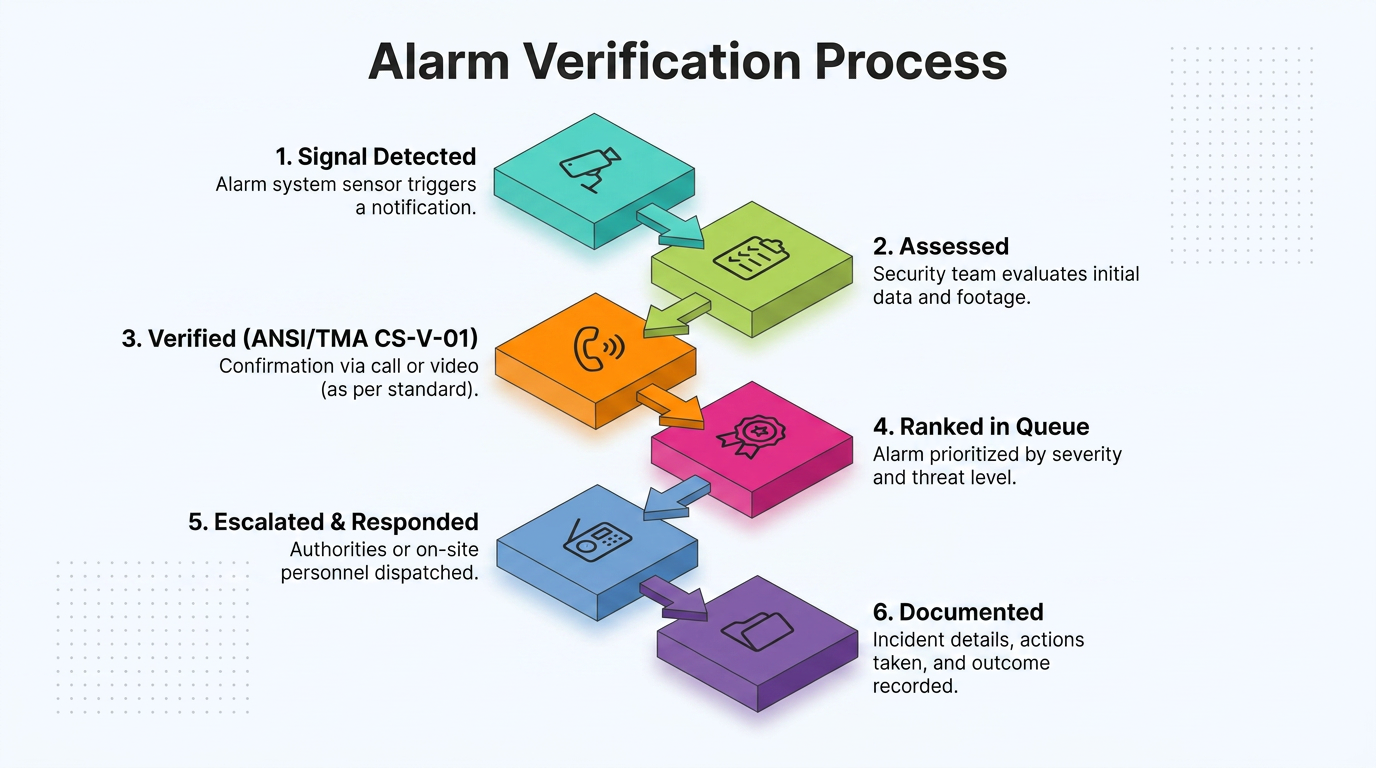
Alarm management is the structured process by which operators in a monitoring center or physical security operations center (PSOC) receive signals from video surveillance and from intrusion sensors and access control hardware, then classify and act on them. A signal is detected, assessed, verified, then ranked against everything else in the queue. Operators then escalate and respond to the alarm, document its resolution, and retain the record for trend analysis.
Power and communication problems go to maintenance. Component failures follow the same route, while known nonthreatening triggers such as wind, rain, animals, or skipped arming procedures go to tuning or training.
Why Most Alarms Turn Out to Be False
Most burglar alarm activations never turn out to be intrusions. False alarm rates across security operations exceed 98%, enough volume to strain even well-staffed monitoring rooms and bury credible incidents underneath the noise.
Most of what fills the queue is non-actionable, split between false alarms from technical faults and nuisance alarms driven by user behavior. A wrong keypad code, a door left unsecured at arming, or an employee who was never trained on the system will each trip the same alert an intruder would.
Hardware and the environment account for much of the rest. Poorly placed request-to-exit sensors generate spurious door alarms, and a site review is often the fastest way to catch them.
Sensitivity is the other lever, and it cuts both ways. Tune a sensor tighter and it catches more of what matters, but wind gusts, rainfall, and temperature swings start showing up in the queue alongside real events.
Verifying Alarms Before Anyone Is Dispatched
Because sensitivity alone cannot distinguish a credible event from noise, operators need a defined verification process. The American National Standards Institute (ANSI) and The Monitoring Association (TMA) publish ANSI/TMA CS-V-01, which defines alarm verification as the process a supervising station uses to confirm whether an alarm signal reflects genuine unauthorized activity before notification or dispatch:
- Audio confirmation
- Video review
- Multiple-attempt call confirmation
- Biometric verification
- Multi-trip notifications
The procedure now called ECC, formerly ECV, requires calls to the premises and a responsible party before any request for response. If the person on site gives no passcode or the wrong one, the operator dispatches; that person may be under duress, so the operator does not provide another passcode attempt.
Video verification pairs footage with the alarm event; the operator looks for human presence or physical evidence such as a broken window. CS-V-01 defines a discernible image as one clear enough to view and identify objects within the camera's view.
Prioritizing Alarms by Consequence and Response Time
Operators use verification to determine whether an alarm is credible, then prioritize it according to how quickly someone must act. The ANSI/TMA Alarm Validation Standard (AVS-01) gives monitoring centers a standardized scoring method for alarm calls, so law enforcement can prioritize dispatch using validated information.
Its five-level AVS-01 scale runs from no call for service to an apparent threat to life: Level 0 (no call for service), Level 1 (alarm without visible threat), Level 2 (unauthorized presence), Level 3 (property damage or criminal activity), and Level 4 (apparent threat to life requiring priority dispatch):
| Classification | Meaning |
|---|---|
| Canceled | No call for police response; alarm canceled or confirmed as no threat |
| Limited information | Response requested with no or limited additional information |
| Human presence | Confirmed or highly probable human presence with unknown intent |
| Property threat | Confirmed threat to property |
| Life threat | Confirmed threat to life |
Internal tiers can borrow a process-control principle: set priority from the severity of the credible consequence and the time available to intervene, with most alarms assigned to the lowest priority. A low-priority event such as a denied credential can provide useful context when reviewed alongside later activity, including loitering or a tailgate.
What an Auditable Alarm Benchmark Looks Like
Ranking alarms assumes someone is counting how many each zone produces. The Department of Veterans Affairs (VA) sets device-level ceilings in its intrusion detection standards specification: no more than one false alarm per sensor zone each month, along with a tighter nuisance-alarm review cadence during the initial period after installation and acceptance.
The Department of Energy (DOE) requires mandatory system review when a system exceeds its allowed false-alarm rate while detection sensitivity is held at specification. Neither ceiling is auditable unless records carry a zone tag and a period. A review team can measure each zone against the published ceilings and use the alarm history to identify doors for examination.
The Human Limits Alarm Programs Must Design Around
Exceed those ceilings and the monitoring room absorbs the difference. Operators split limited attention across a bank of monitors, and every added feed takes a smaller share of it. Security teams may not consistently meet their own service-level agreements for response time and alarm processing.
False alarms compound the problem. When a system floods the queue with alerts that keep proving empty, operators slow their responses to the next alert, a response pattern known as the cry-wolf effect. It reflects learning from experience: operators recalibrate to the evidence their systems give them. Adversaries understand the dynamic too, and deliberately tripping sensors to fatigue a response force before a genuine attempt is a recognized attack pattern.
Escalating Confirmed Threats to Responders
Once an alarm has been classified and recorded, the next step is to communicate confirmed threats consistently. Under AVS-01, the alarm event receives a validation score from Level 0 to Level 4, and that classification can be communicated to the PSAP with the alarm data.
The Automated Secure Alarm Protocol (ASAP), standardized under the Association of Public-Safety Communications Officials (APCO)/TMA standard 2.101.3-2021, removes the phone call by transmitting electronic alarm data from the monitoring center directly into the PSAP's computer-aided dispatch system. Electronic transmission can reduce the verbal relay involved in telephone dispatch. It also provides the PSAP with standardized event information.
Correlating Access Control Events with Video Context
Before operators assign an alarm level or contact responders, correlating related data can give them stronger evidence. An accessible noise-reduction measure uses data the site already logs. Two common event types in physical access control system (PACS) queues illustrate the gap:
- Door Forced Open (DFO): a door opens without a credential or request-to-exit signal, recording an unauthorized opening without explaining how it happened.
- Door Held Open (DHO): a door stays open past its timeout, which can indicate propping, a stuck sensor, or legitimate extended traffic.
Operators close that gap by pulling the camera covering the door. In multi-system programs, the correlation logic can sit in a physical security information management (PSIM) platform rather than in the site's video management system (VMS). The logic uses a location and time window to match a DFO with the camera covering the affected door at the time of the event, and the operator sees the cause alongside the alarm.
For example, a DHO on a receiving dock at mid-morning during scheduled deliveries could reflect routine traffic; the same event on a data hall corridor after midnight, with no badge activity on the reader, is an event an operator should treat as a priority.
How AI Helps Security Teams Surface the Right Alarms
From Pixel Triggers to Behavioral Detection
Correlation helps operators interpret alarms after they fire. Detection rules can reduce noise earlier by controlling which events enter the queue. Detection has moved from pixel triggers such as background subtraction and pixel motion detection to neural-network-based classification that separates a person from a swaying branch before an alert reaches an operator.
When teams lower the confidence threshold to capture every possible event, wind and headlights fill the queue. Raising it reduces noise but can push genuine events below the threshold. Behavioral detection adds context, so a crowd gathering around an individual reaches the queue. Localization across time and cameras can support detection of activity sequences rather than an isolated frame of movement. For example, a program might flag someone trying several doors along a corridor in quick succession.
Why Humans Stay in the Loop
AI-filtered queues still route through people. Detection models still misread ambiguous scenes and may mistake an object resembling a crouching person with a weapon for an actual threat.
AI filters likely noise first. Operators then verify the remaining alerts and gather additional site details when the scene is ambiguous. The detection logic needs a tuning loop. Teams can capture what triggered each alert, analyze the conditions, feed the result back into the rules, and reduce false positives when they validate and refine those changes. Teams should treat the initial operational period as a training phase and continue configuring the system afterward.
Repeated incorrect alerts can reduce operator reliance on automated filters and undermine automation's value.
Building a Queue Responders Can Trust
A trustworthy queue depends on reliable verification. Operators should rank alarms by consequence and escalate them consistently. Teams should preserve the zone, cause, verification result, and response outcome for every alert, then use those records to tune sensors and remove recurring noise. Programs can evaluate each change by whether operators receive clearer evidence and responders receive more actionable calls.
Frequently Asked Questions
How do you balance sensor sensitivity settings to catch real intrusions without flooding the alarm queue with false alerts from environmental factors like wind and temperature changes?
Establish baseline alarm counts per zone, then adjust sensitivity incrementally while tracking environmental triggers. Use scheduled arming windows during high-wind periods and deploy dual-technology sensors requiring corroboration from two detection methods before alerting.
What is the ANSI/TMA AVS-01 five-level alarm classification scale and how does it help law enforcement prioritize dispatch responses?
AVS-01 gives dispatchers a shared language with monitoring centers, allowing law enforcement to allocate patrol units based on verified threat severity rather than treating all alarm calls equally, which improves resource allocation during high-volume periods.
How does correlating Door Forced Open (DFO) and Door Held Open (DHO) access control events with video footage reduce false alarms without requiring additional hardware?
Correlation uses existing cameras and access logs to show operators what caused the door event in real time, eliminating guesswork. Operators distinguish legitimate activity from threats instantly based on visual evidence, avoiding unnecessary dispatch while preserving detection sensitivity.
