Video Alarm Verification: Strategies to Cut False Dispatches
Learn how video alarm verification works, why false dispatches cost organizations, and what strategies reduce unverified alarms across your security program.
Video alarm verification is the practice of visually confirming what triggered an alarm before anyone makes a dispatch decision. For corporate security leaders, verified status now affects how quickly police respond and what the organization pays in municipal fines. It also affects whether responders take the next signal from the facility seriously. For security leaders, verification makes each alarm decision faster, clearer, and easier to defend.
Key Takeaways
- Verified alarms can receive higher-priority handling, while unverified signals may be deprioritized in some jurisdictions, so verification directly affects how fast police respond.
- False dispatches usually originate from user behavior or from site and system conditions.
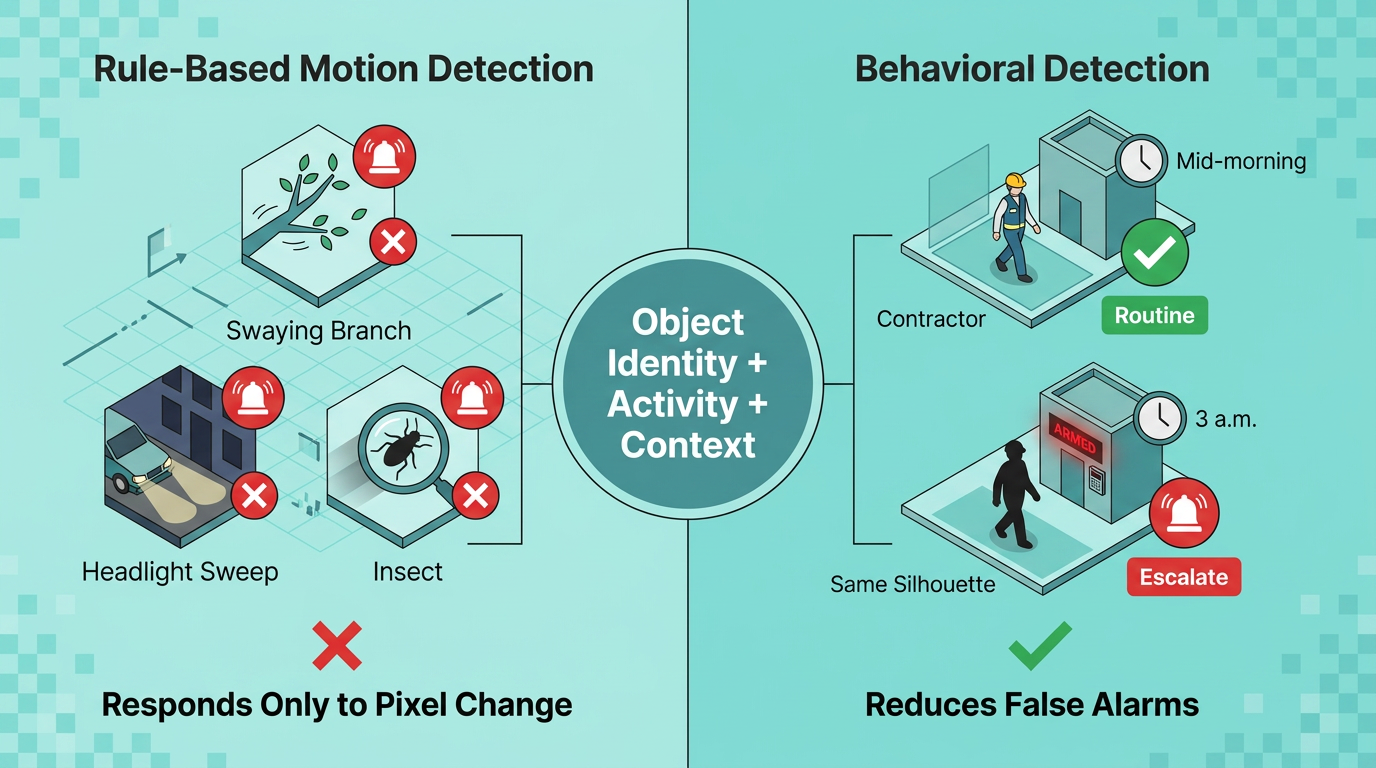
- Behavioral classification that identifies what an object is and what it is doing can filter many false positives beyond rule-based motion detection.
- Tiered escalation with written operator criteria keeps dispatch as the last rung in the response sequence.
What Video Alarm Verification Covers
The CS-V-01 standard from the American National Standards Institute (ANSI) and The Monitoring Association (TMA) defines verification as the process a supervising station uses to confirm whether an alarm signal reflects genuine unauthorized activity. Video verification applies that test visually. An operator reviews live or recorded video tied to the alarm event before initiating any notification, and must at minimum be able to distinguish a human cause from a non-human one.
Verification is a narrower activity than general surveillance. Passive recording captures what happened for later review, while verification demands an alarm-specific clip covering the moments before and after the trigger, seen before anyone picks up the phone. It also goes further than confirming a person on camera, because plenty of false alarms come from employees or contractors entering the building legitimately. Traditional unverified monitoring skips the visual check entirely: signal in, responders called. Audio adds useful context on top of the visual review, but standards treat it as a supplement, not a substitute.
The Cost of Dispatching on Unverified Signals
More than 98% of alarm signals turn out to be false, which fuels operator fatigue and causes critical incidents to slip through. The costs to an enterprise fall into two categories:
Direct costs:
- Escalating per-event fines and permit penalties.
- Suspension of police response at sites with repeated false alarms.
Indirect costs:
- Loss of officer confidence: responders who know that nearly every alarm call proves false can grow less confident in the next signal, which slows response to genuine events and puts responders at risk during a real intrusion.
- Lower dispatch priority: unverified alarms may sit behind other calls in the queue, while a verified alarm can be routed as a crime in progress and reach a responder much sooner.
- Misaligned response assumptions: security leaders who budget for guaranteed police response may find that local policy has shifted toward verified-only dispatch, leaving unverified sites without the coverage they thought they were paying for.
How the Event-to-Camera Workflow Operates
The verification pipeline starts with a trigger and ends with a dispatch or dismissal decision:
- A sensor or video analytics rule fires, and the panel transmits the event to the monitoring center over Internet Protocol (IP).
- The paired camera delivers a clip with pre-trigger footage, so the reviewer sees what caused the alarm and what happened next.
- An operator, an automated system, or both classify the event as real or false.
- The event receives a score under the ANSI/TMA Alarm Validation Scoring standard (AVS-01), which grades alarms from Level 0, no call for service, through Level 4, persons present with an apparent threat to life.
- The operator dismisses the event or dispatches. The operator can also relay scene details to responders, including intruder count and location. If anyone appears armed, the operator can pass that along, too.
Diagnose Root Causes Before Tuning
False alarms cluster around three recurring sources, and security teams cannot cut a rate they have not diagnosed.
User error is a common driver in commercial settings: entry and arming mistakes, along with cleaning crews or contractors who were never briefed on alarm protocols.
Equipment problems are another familiar culprit: oversensitive or misaligned sensors, passive infrared (PIR) detectors mounted near HVAC vents or in direct sunlight, cameras aimed at busy roads, and aging hardware with failing batteries.
Environmental triggers round out the set: animals, insects on the lens, wind-blown debris, moving shadows, vehicle headlights, and weather.
The cause dictates the fix. Retraining users will not solve a camera pointed at a public sidewalk, and recalibrating sensors will not solve a contractor who was never briefed. Tie every false alarm back to a root cause before choosing a corrective action.
How Alarms Get Verified in Effective Programs
Multisource Verification
Human operators at a central station or global security operations center (GSOC) work alongside automated analytic classification, and many programs add audio to the mix. Audio catches what cameras miss, such as breaking glass or distressed voices, and enables live talk-down to intruders.
Weight each source by what it can prove: video confirms whether a person is in the protected area and whether the activity looks unauthorized, while audio corroborates impact, voices, or challenge response. Account-holder review can clear known employees or service activity, but written criteria should still define when the monitoring center proceeds without a callback.
Automated Analytics Accuracy
Rule-based motion analytics only detect pixel change, so a swaying branch, a headlight sweep, or a lighting shift all register the same as an intruder, which is why they generate so many false alarms.
Behavioral detection is a substantial step up: it classifies the tracked object and evaluates what it is doing in context, so a contractor wheeling equipment across a loading bay at mid-morning reads as routine, while the same silhouette crossing at 3 a.m. with the panel armed is exactly what verification exists to catch. No system is perfect, so thresholds must balance over-alerting against missed detections, with a human retaining the final call.
Strategies to Cut False Dispatches
Align Cameras, Sensors, and Scene Conditions
CS-V-01 requires that a paired camera's field of view cover its sensor's full detection pattern, so operators can confirm whether a person was present when the signal fired. Use dedicated fixed views, since staff-repositioned cameras may drift off the pattern.
Mount PIR sensors at height, tilted slightly downward, and away from HVAC airflow, sunlit glass, and reflective surfaces. Start sensitivity at medium, test at realistic distances, and adjust incrementally. Fix the scene with even illumination, balanced infrared, and motion-activated lighting outdoors.
Classify and Confirm Before Escalating
Object classification handles the first pass automatically, filtering out weather and non-human motion before anyone sees it. From there, teams can configure detection zones to exclude streets and sidewalks and add behavioral filters like shadow rejection or loitering detection tied to after-hours schedules.
A second signal should be required before anything escalates, whether that comes from dual-technology sensors that need both PIR and ultrasonic agreement, cross zoning that requires two devices to trigger, or multi-trip notification that holds until an alarm repeats. When video alone is ambiguous, audio can serve as the confirming source.
Escalate in Tiers with Written Operator Criteria
Dispatch should be the last step, not the first. A documented sequence moves from an automated audio or visual deterrent, to escalation if the deterrent fails, to live operator talk-down, and only then to a guard or law enforcement call.
Operators need written criteria at each stage: what qualifies as a verified alarm, how to treat secure versus unsecure areas, and when to contact the premises before escalating. Vague criteria are what create the inconsistent dispatches the program is meant to prevent.
The Operator's Position in the Loop
Steady exposure to non-actionable alarms wears down even the strongest operators and slows their response to the real events hidden in the noise. The problem is one of volume, not diligence, and no amount of individual focus can overcome it.
During high-volume events, the number of alarms can outpace what any operator can absorb without triage support, and cameras without classification make it worse by pushing every motion event, from delivery trucks to insects, straight to the console.
Automated pre-classification shifts the staffing math by filtering routine motion upstream, so operators can focus their attention on events that plausibly warrant escalation. The operator still owns the final decision.
AVS-01 requires the reasoning behind every escalate or de-escalate call to be documented, with the clip or a description retained for at least 12 months, which gives supervisors an audit trail for coaching and quality review.
Where Verification Sits in the Security Stack
Verification connects the alarm panel, monitoring layer, and video management system (VMS) in one pipeline. Alarm panels transmit events to the monitoring layer over IP, and the VMS associates cameras with alarm points so the right clip surfaces automatically.
The Open Network Video Interface Forum (ONVIF) Profile M standardizes how analytics-capable cameras pass metadata and events to VMS and cloud clients across vendors. Physical access control system (PACS) events belong in the same loop: a forced or held-open door can cross-trigger the associated camera, putting badge history and live video in front of the operator together, and tailgating events verify the same way.
A verified event can also trigger mass notification actions such as lockdowns and multi-channel alerts. The Automated Secure Alarm Protocol connects alarm companies with public safety answering points (PSAPs) and delivers the alarm data and its validation score electronically into the 911 center's computer-aided dispatch (CAD) system. This removes the phone relay between operator and dispatcher.
Regulatory and Standards Grounding
Verified Response Ordinances and Fine Structures
Local rules vary widely, which makes site-level policy review a core part of system design: the same handling procedure can produce different outcomes across a portfolio. Site policies should reflect local verification requirements, fine schedules, permit rules, and response limits after repeated false alarms, and monitoring instructions must match any higher priority given to verified alarms.
For each site, document the permit status, fine schedule, false-alarm thresholds, deprioritization policy, and evidence the agency accepts as verification. Monitoring instructions should also spell out what operators pass along on a verified signal: AVS-01 level, number of people, location, apparent weapons, and whether premises contact changed the decision. A single national procedure will hide these jurisdictional differences.
The Standards Stack
On the panel side, features such as exit and entry delays, cross zoning, two-action manual alarms, and duress codes cut down on user-error alarms before they leave the building.
On the monitoring side, Underwriters Laboratories (UL) 827 sets the requirements for central station construction, staffing, operator training, and signal handling, with annual audits, and UL 827B extends those requirements to stations that monitor video exclusively. CS-V-01 then defines the verification procedures operators follow, and AVS-01 standardizes the score sent to public safety. Together, panel-side suppression plus UL 827, CS-V-01, and AVS-01 cover the full path from first trigger to law enforcement response.
Measuring Impact and Maintaining the Gains
A verification program earns continued budget only if its value is provable. Track a small set of metrics consistently:
- False dispatch rate, expressed as alarms per system per year, which normalizes performance across a growing site portfolio.
- Verification or cancellation rate, the share of alarms resolved before dispatch.
- Mean time to verify, from signal receipt to classification decision. Define it internally and trend it against the organization's baseline.
- Fines avoided and operator hours saved, estimated from the reduction in dispatches and reviewed alarm volume.
Sustaining the numbers requires a maintenance loop. Review the cause of every false alarm and route it to user retraining or a service call, with any needed configuration changes. Retune the analytics rules that fire most often, and audit camera health and fields of view on a schedule. Place systems on test mode before inspections and maintenance work.
When the false alarm rate shifts after an equipment change or policy revision, use that change as the trigger for a configuration review before the annual audit.
Earning Back the Benefit of the Doubt
Every unverified dispatch spends credibility the organization will eventually need in a real emergency. Verification rebuilds that credibility by converting each alarm into a classified, scored, documented event that responders can trust. Aligned cameras and sensors reduce the raw trigger count, while behavioral classification and tiered escalation narrow what reaches operators and discipline the response.
Security leaders who instrument the program with clear metrics can prove its value in fewer fines and faster response to real events.
Frequently Asked Questions
What are the AVS-01 alarm validation scoring levels and how does each level affect police dispatch priority?
AVS-01 defines five levels from zero to four. Level zero requires no service call. Level one indicates an alarm without visible threat. Level two shows unauthorized presence. Level three involves property damage or criminal activity. Level four indicates apparent threat to life requiring priority dispatch.
How does behavioral detection in video analytics differ from rule-based motion detection in reducing false alarms?
Behavioral detection evaluates object identity, activity, and situational context, while rule-based motion detection responds only to pixel changes. This allows behavioral systems to interpret whether movement matches expected patterns, dramatically reducing alerts from environmental conditions that rule-based systems cannot differentiate.
What specific metrics should security leaders track to measure the ROI of a video alarm verification program?
Beyond those listed, track insurance premium changes tied to reduced false alarm history, benchmark response time differences between verified and unverified calls, and measure staff retention improvements when operators handle fewer repetitive false positives.
