Lockdown Procedures and AI: Rethinking the Trigger
Explore how AI weapon detection fits into lockdown trigger paths, where human verification belongs, and how to measure response time from alert to locked door.
Lockdown procedures are only as fast as the trigger that starts them. AI detection can flag a brandished weapon in a camera feed quickly, but faster detection does not automatically produce a faster protective response. Where AI belongs in that trigger path has become a live design question for security teams.
Key Takeaways
- A trigger path that adds delay during detection or verification can consume the limited time available for protective action. Notification delays consume that time as well.
- AI weapon detection can compress the observation step, but visual systems cannot detect weapons that cameras cannot see and can mistake ordinary objects for threats.
- A risk-based design keeps a human verification checkpoint in front of consequential actions like facility-wide door locking, while letting routine, reversible responses run automatically under supervision.
- The relevant standards do not prescribe the confidence level at which an AI alert should initiate a lockdown, so each organization must define who can trigger one, what verification is required, and how alerts escalate.
How a Lockdown Gets Triggered Today
A full lockdown is one of several protective postures, and the trigger conditions differ for each:
- Emergency lockdown is a protective action built on locking and hiding, used against a threat inside the building.
- A secure or lockout posture answers an exterior threat instead, with perimeter doors locking while work continues inside.
- Shelter-in-place addresses airborne hazards, not intruders.
Emergency operations plans should identify who holds initiation authority and train designated staff to start a lockdown without waiting for an unnecessary chain of approvals.
In practice, the trigger path runs from observation to coordination. Detection comes from a person or a sensor, and an authorized reviewer then confirms the threat against live video before anyone activates the lockdown through a panic button, a console command, or a mobile app.
From there, the physical access control system (PACS) executes: a lockdown command overrides door schedules and denies normal credential-based entry while preserving code-compliant egress.
Mass notification goes out concurrently over public address, text, and signage, and emergency services are called. The physical security operations center (PSOC) coordinates from there, watching door status and arranging entry for first responders.
Each step adds time, and delays can also occur after the lockdown command has been issued. Security teams should therefore test notification and door-state confirmation as parts of the same trigger path rather than treat them as separate capabilities. The same test should cover coordination.
Why Human-Initiated Triggers Run Out of Time
A witness must recognize what is happening, communicate it accurately, reach someone with authority, and wait for that person to initiate the appropriate response. Unclear authority or conflicting interpretations can extend that process further.
People receiving ambiguous cues may wait for confirmation before acting, especially when the available information does not clearly distinguish an emergency from routine activity. Plans that depend on an immediate, unhesitating human decision inherit that uncertainty. Clear trigger criteria and assigned authority reduce the number of decisions that must be improvised under pressure. Practiced escalation paths reduce that number further.
What AI Detection Changes and What It Cannot See
Automation can shorten the observation step in that trigger path, but its value depends on what the system is designed and able to detect.
Rule-based detection triggers on threshold crossings such as motion in a zone or a crossed line. A pixel change past a set value can also cause the system to fire, whether the source is an intruder or a headlight sweep. Operators compensate by tuning sensitivity down, which trades missed events for quiet.
Learned detection models changed what the observation step can do. Weapon detection systems now classify objects directly from video and raise alerts without needing an operator watching the feed, while behavioral models flag patterns that indicate a security event. Reasoning AI goes further, interpreting visual context instead of matching against a predefined rule set.
That matters because context separates signal from noise. A contractor carrying a pneumatic nail gun across a distribution center loading dock at shift change is routine; the same object raised toward a person in the front lobby is an event. Threshold rules cannot tell those two scenes apart, but context-dependent classification is built to.
Visual systems cannot detect a concealed weapon or an object outside a participating camera's field of view. They can also produce alerts when ordinary objects or responding officers' weapons resemble the target class.
Procurement and acceptance testing should therefore evaluate performance in the organization's actual camera views and operating conditions rather than rely on demonstrations alone.
The False Alarm Problem
False positives can have concrete consequences for the people on the receiving end. An incorrect weapon alert can prompt police to respond and conduct a search even if a security team later dismisses it. It can also cause a facility-wide lockdown. If the security team does not communicate that cancellation to every person responsible for escalation, the response can continue despite a successful verification step. Communication of the verification is therefore part of the control.
Repeated false activations also create operational costs. Staff must clear the alerts, and occupants experience unnecessary disruption. Operators may also respond less confidently when another alert arrives. Turning detection sensitivity down can reintroduce the missed-event risk the system was intended to reduce. A false alert that results in a person being confronted at gunpoint can also create legal and psychological consequences for that person and for everyone locked down around them.
Where the Human Belongs in the Loop
A person should remain in front of high-consequence actions. In a human-in-the-loop design, the system cannot execute a consequential action until a person authorizes it: the AI recommends, the operator decides. In a human-on-the-loop design, the system acts autonomously while a person supervises with override authority. A risk-based deployment can mix the two by alert class. Routine, reversible events such as door-held-open follow-ups can run on-the-loop with logging; weapon detections can stay in-the-loop, with a verification checkpoint before any facility-wide door locking or notification.
The National Institute of Standards and Technology (NIST) treats human oversight in its Risk Management Framework for AI as part of governing and managing AI risk. Applied to lockdown triggers, that oversight should include clear authorization and an effective override. It should also require a documented response when the available evidence is inconclusive.
People may accept a computer-generated conclusion without looking closely for contradicting information, especially under time pressure, so a verification step designed as a rubber stamp inherits the machine's error rate. Designed well, the checkpoint remains focused: a trained operator reviews the relevant clip and checks the surrounding context. The operator then confirms or dismisses the alert without repeating the entire detection process.
Engineering the Path from Alert to Locked Door
Standards can support the exchange of detection events and access-control data, but they do not by themselves define lockdown authorization or guarantee interoperability. ONVIF, an industry forum for physical security interoperability, provides Profile M for analytics events and metadata transported over its event service or Message Queuing Telemetry Transport (MQTT). Its Profile C covers basic IP-based access control and event management, while Profile D covers access-control peripherals. Compatible implementations can use those interfaces as parts of an integration between a detection event and a door command, subject to authorization logic and testing.
On the final leg, OSDP (Open Supervised Device Protocol), adopted as International Electrotechnical Commission (IEC) 60839-11-5, provides bidirectional, supervised controller-to-reader communication; OSDP Secure Channel can encrypt that communication when active. A PSOC can confirm door or lock state through monitored PACS inputs and field hardware rather than assume it.
Engineering choices determine latency. Every intermediate platform between the analytics engine and the PACS adds delay, so time-critical lockdown commands should travel the shortest tested integration path, with middleware routing reserved for correlation and logging where appropriate. Acceptance testing should measure the full path from detection event to locked door under realistic load. Vendor demonstrations alone are insufficient.
Life safety bounds all of it. A lockdown design should preserve egress. Electrified locks wired to release on fire alarm activation can also affect a lockdown strategy, so the project team should review fire alarm interaction and authorization logic before deployment. The review should also confirm code-compliant egress.
Defining the Trigger in the Emergency Action Plan
The National Fire Protection Association's NFPA 3000 defines the minimum elements of an active shooter and hostile event response program and leaves specific policies and tactics to the local organization. The organization also sets its protocols. It does not prescribe an AI trigger threshold. The organization must therefore define and document the threshold and authority. It must also establish the escalation path.
The emergency action plan should state:
- Which alert classes may act automatically and which require human authorization.
- Who holds initiation authority on each shift.
- What verification precedes facility-wide locking.
- Which graduated variants apply, from perimeter-only securing to departmental and total lockdown.
It should also state how the trigger path gets exercised. Drill fidelity improves over the first several repetitions and then plateaus, so quality beats raw count. Inject a test detection during exercises and time the trigger path from alert through locked doors to completed notification. Then assign each corrective action from the after-action review to a named owner with a deadline.
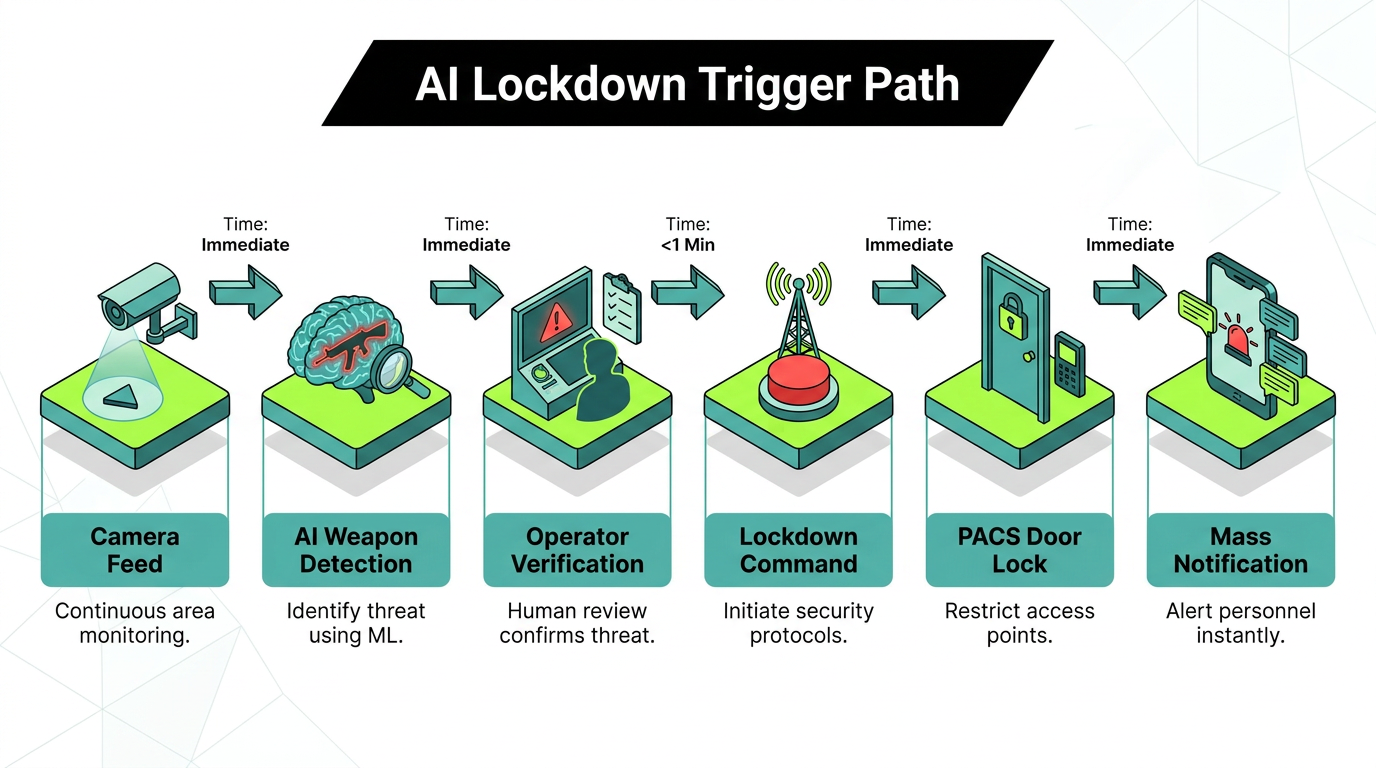
Measure the Chain in Seconds
Faster detection protects people only when verification, authorization, locking, and notification operate as one tested trigger path. Security teams should set human oversight according to consequence, validate integrations under realistic conditions, and use measured response time to determine where automation improves safety without surrendering control.
Frequently Asked Questions
What is the difference between human-in-the-loop and human-on-the-loop AI security designs, and when should each be used for lockdown triggers?
Human-in-the-loop requires explicit operator authorization before execution, while human-on-the-loop allows autonomous action with supervisory override capability. Deploy in-the-loop for irreversible or high-stakes actions and on-the-loop for routine, low-consequence events where supervision with intervention rights suffices.
How should organizations test and measure the full trigger path from AI weapon detection to locked doors and completed notifications?
Organizations should inject simulated detection events during live exercises and measure elapsed time at each stage: alert generation, operator verification, command transmission, lock engagement, and notification delivery. Testing under realistic network load reveals latency points benchtop demonstrations miss.
How can security teams reduce false positive weapon detection alerts without increasing the risk of missing real threats?
Deploy context-aware detection models analyzing behavior and scene relationships rather than object shape alone. Calibrate sensitivity thresholds using your facility's camera angles and lighting, and implement multi-sensor fusion cross-referencing visual alerts with access control events before escalation.
