What Is an Emergency Operations Plan in Healthcare
Learn how a hospital emergency operations plan assigns command authority, sets activation criteria, and keeps patient care running when normal operations fail.
A hospital emergency operations plan is what separates a coordinated response from improvisation when an active assailant, a utility outage, or a mass casualty event overwhelms normal operations. For security leaders, it spells out who takes command, who controls the doors, and who works with law enforcement before the first minutes slip away.
Key Takeaways
- A hospital emergency operations plan covers all hazards, an emergency action plan covers employee protection and evacuation, and a continuity of operations plan keeps essential functions running during a disruption and through recovery.
- Federal regulation ties a hospital emergency operations plan to a documented risk assessment, and surveyors trace the line from that analysis through annexes and exercises to plan revisions.
- Activation can stall when responders lack enough information to confirm what is happening.
- Recurring failure modes include unfamiliar plans, communication breakdowns, vague activation criteria, and staffing assumptions that fall apart during long events.
Defining the Emergency Operations Plan in a Hospital Setting
A hospital emergency operations plan is the standing, all-hazards document that governs how a facility responds to disruptions ranging from active assailant incidents to prolonged utility outages. It assigns command authority, sets activation criteria, and lays out how clinical, security, and facilities teams work together during a response.
The plan draws its scope from a facility-based and community-based risk assessment, and it names the people, resources, and procedures that keep patient care moving when normal operations cannot continue.
How an EOP Differs from an EAP and a COOP
The emergency operations plan (EOP) is the standing, all-hazards plan: it describes how people and property will be protected, who acts, and what resources are available. The Federal Emergency Management Agency (FEMA) preparedness guide sets the reference structure. The hospital version covers incident command and command center operations, along with department-level actions. It must align with local plans and healthcare coalition plans.
An emergency action plan (EAP) under Occupational Safety and Health Administration (OSHA) rules is a worker-safety document. It covers how to report an emergency and how to evacuate. It also covers shutdown duties for employees who stay behind. OSHA's minimum EAP requirements do not cover continuity of patient care or incident command. They also do not cover surge capacity.
A continuity of operations plan (COOP) keeps essential functions running during a disruption and through recovery. It covers succession, delegations of authority, vital records, and backup facilities.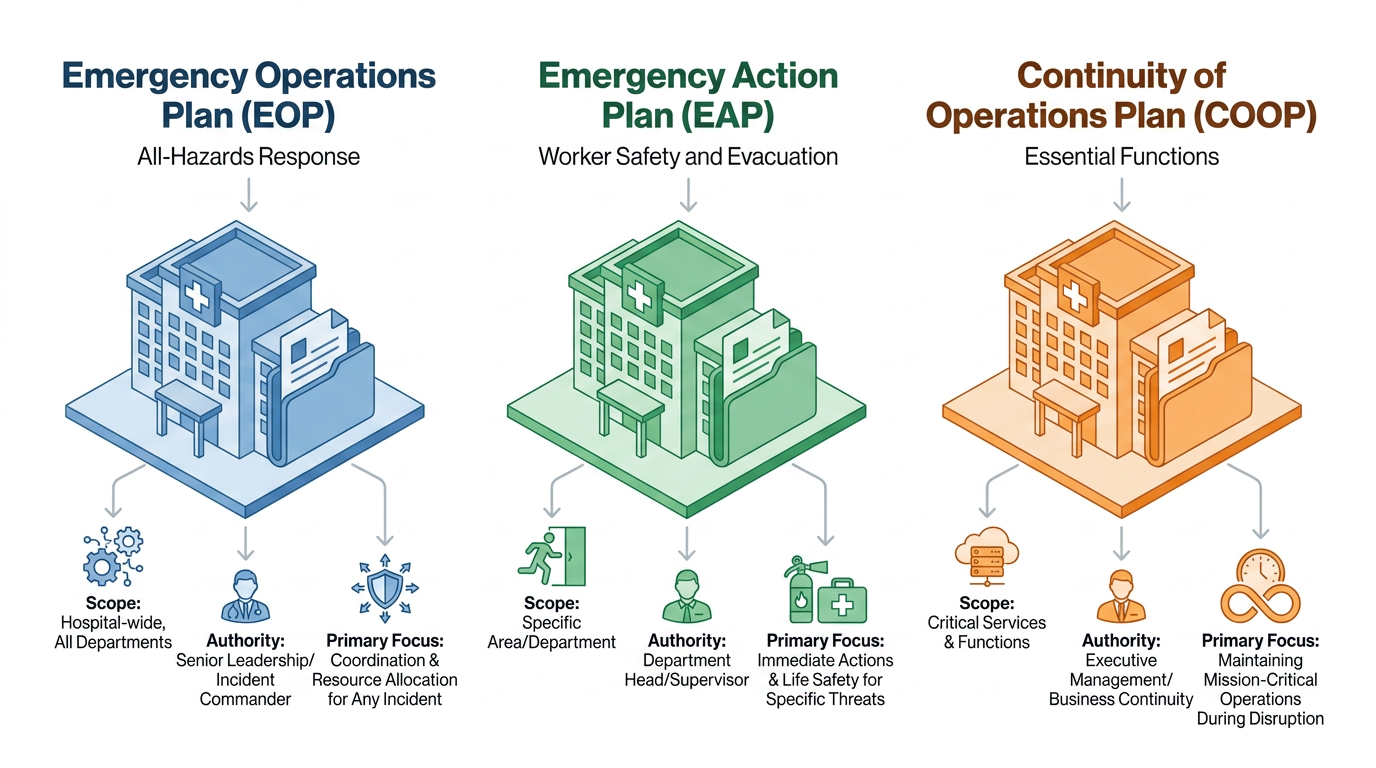
The Regulations Behind the Plan
CMS's Medicare Conditions of Participation require hospitals to develop and maintain an emergency preparedness plan; the EAP is required under OSHA for covered employers, and the COOP rests on FEMA guidance. The CMS Emergency Preparedness Rule requires a documented facility-based and community-based risk assessment, usually done as a hazard vulnerability analysis (HVA), along with an emergency preparedness program built from that assessment. Surveyors look for evidence connecting the risk assessment, plan, exercises, and corrective actions.
The Joint Commission's Emergency Management chapter adds accreditation pressure. Its survey process walks the multidisciplinary team through recent real events against the HVA and the critical areas, including staffing and utilities, along with safety and security. CMS adopted an edition of the National Fire Protection Association (NFPA) health care facilities code but left out the emergency management chapter, which the Joint Commission uses as its emergency management reference.
What the Plan Document Contains
FEMA's preparedness guide organizes the EOP into a base plan with functional and hazard-specific annexes. The base plan spells out purpose, scope, planning assumptions, roles, direction and control, communications, authorities, and how the plan stays current.
Functional annexes are mission-based chapters that apply across hazards:
- Communications
- Horizontal and vertical evacuation
- Shelter-in-place, including lockdown and access controls, where the plan meets the security program most directly
- Surge capacity
- Patient tracking
Hazard-specific annexes hold response detail for individual threats the risk assessment rates as credible. Common examples include active assailant (made harder in hospitals by locked units, MRI machines, and a large vulnerable patient population); infant abduction; infectious disease; severe weather; utility and power failure; hazmat and decontamination for arriving contaminated patients; and cyber downtime. Security teams should plan for long downtime with tested procedures and think through how outages could affect access control, cameras, and alarms.
The Hazard Vulnerability Analysis That Drives It
Behind that annex list sits a scored ranking. Planners can score each hazard's probability and impact, factor in existing mitigation and then rank it by relative threat.
Planners write annexes for the hazards the ranking puts at the top. The process involves community partners, and hospitals should review the HVA regularly so a new threat can reshape the plan. Planners can document the scores and assumptions, along with who took part, so the ranking stays traceable back to the facility-based and community-based risk assessment.
The multidisciplinary committee can then use that record to explain why one hazard gets a dedicated annex or exercise priority ahead of another. The same record can back up the order of corrective actions.
Who Owns the Plan
Those annexes only stay current if someone owns them. The Joint Commission requires a qualified individual to lead the program, with senior leaders providing oversight. A multidisciplinary committee runs it. Surveyors ask for the leadership-approved plan, so the committee's work must end with documented senior-leader sign-off. The Joint Commission also requires after-action reports and improvement plans to reach senior leaders.
A hospital's incident command structure should spell out leadership and operational responsibilities before an event. The plan should assign ownership for patient care, infrastructure, infection prevention advice, and internal and external messaging.
The EOP should place security responsibilities inside incident operations, with clear ownership for access control, crowd and traffic control, search, and the law enforcement interface. For a physical security operations center (PSOC), the plan should define its place in that structure and its role in working with law enforcement during an active assailant response. Outside the hospital, the regional healthcare coalition coordinates resources and situational awareness without holding incident-command authority over its members.
Activation Criteria and Escalation Levels
The Joint Commission requires the plan to name activation authority for the EOP and incident command and to identify primary and backup command center sites. Activation usually follows three escalation levels:
- An alert notifies key personnel that conditions may require a response.
- A partial activation engages specific departments or the command center for a contained incident.
- A full activation stands up the incident command structure and puts the plan into full effect.
Activation decisions depend on clear thresholds and the information available at the time. During an El Paso mass casualty response, limited information from the scene contributed to delayed activation, and staff fell back on personal texts and calls.
Notification and Communication Protocols
Once the incident commander activates the plan, staff use its communication procedures to coordinate the response. Under CMS, the plan must hold current contact information for staff, entities providing services under arrangement, patients' physicians, other hospitals and critical access hospitals, volunteers, and federal, state, tribal, regional, and local emergency preparedness staff, plus primary and backup ways to reach them. Backup options include satellite phones and radios. Priority services such as the Government Emergency Telecommunications Service and FirstNet offer another option.
Clinical staff cannot watch a console. Where video verification sits in the notification path, the alert that reaches security and clinical responders can describe an assessed incident rather than an unconfirmed report. Plans should name their mass notification systems and can use Short Message Service (SMS) emergency messaging when an existing phone tree is slow or inconsistent.
Patient Care Continuity and the 96-Hour Framework
Logistics teams keep the supplies and services flowing that patient care depends on. CMS requires policies for food, water, medical and pharmaceutical supplies, and backup energy, plus a system that tracks on-duty staff and sheltered patients and records the receiving facility for anyone relocated.
The Joint Commission's 96-hour expectation requires hospitals to assess how long they can operate on their own in each critical area and which conservation measures, such as rationing resources or canceling elective procedures, extend that window. CMS does not impose this expectation. The assessment is not a stockpile mandate, and hospitals are not required to stay fully functional for that entire period.
Training, Exercises, and Keeping the Plan Current
CMS requires a full-scale community-based exercise, or a facility-based functional exercise when no community one is available, plus an exercise of choice, such as a clinical tabletop led by an exercise coordinator. An actual activation can earn a temporary exemption from the full-scale exercise. Training reaches staff, including contractors and volunteers, at onboarding and on a regular basis after that. After-action reports and improvement plans use the Homeland Security Exercise and Evaluation Program (HSEEP), through the FEMA HSEEP model, to turn findings into corrective actions.
Hospitals must review and update the plan on a regular basis under CMS. Some hospitals line up EOP review with the HVA cycle. Real activations and facility changes should trigger a revision too.
Where Plans Fail
Exercises expose gaps; after-action reports name them. Plans written for the survey rather than for use fail first: healthcare workers may know their hospital has plans but not be familiar enough to use them effectively.
Communication cascades break on stale assumptions. Hospitals that plan to rely on ordinary phone systems in a major incident risk repeating documented communication failures from mass-casualty responses. Out-of-date on-call rosters and vague activation criteria leave the on-call administrator to improvise in the moment. And surge staffing models that assume the workforce will work harder, or that staff can be borrowed from elsewhere, have broken down again and again during long events.
What a Plan Proves Under Pressure
Security leaders test the EOP in the window between the first sign of trouble and a declared response. Those who sit on the HVA, exercise their annexes, and close the gap between what the plan assumes and what their systems can verify can tell whether it supports timely decisions under pressure. An annex that has never been drilled is still a priority gap.
Frequently Asked Questions
What specific steps should a hospital security leader take to integrate their physical security operations center (PSOC) into the incident command structure during an active assailant event?
Define the PSOC's operational role before drafting law enforcement liaison protocols, establish decision authority for lockdown execution, assign video feed sharing procedures with responding agencies, and designate backup command personnel when primary security leadership deploys to the incident scene.
How should hospitals conduct and score a hazard vulnerability analysis (HVA) to ensure their emergency operations plan addresses the most credible threats?
Hospitals should score each hazard by multiplying probability, impact, and mitigation readiness, then rank threats numerically. Include community partners in scoring sessions to capture external dependencies, and document participant names, rationale, and assumptions for surveyor traceability.
What are the most effective ways to prevent communication breakdowns during hospital emergency activations beyond traditional phone trees?
Deploy mass notification systems with SMS emergency messaging, establish backup satellite phones and radios for infrastructure failures, secure priority telecommunications services like FirstNet, and integrate real-time situational awareness platforms that push assessed incident details to clinical and security staff.
