Security Forensic Investigations in Physical Security
Learn how security forensic investigations work, from evidence collection and chain of custody to legal holds and common investigation failure points.
A security forensic investigation in physical security applies scientific evidence-collection principles to a breach or other incident in a physical environment.
Its purpose is to reconstruct events, identify who may have been involved, and determine whether the available evidence can support legal or disciplinary action. The process is most effective when evidence handling, authority, and preservation procedures are established before an incident occurs.
Key Takeaways
- A security forensic investigation follows a structured process from incident detection through post-incident review.
- Chain of custody is strongest when evidence collection procedures and storage controls are established before an incident occurs.
- Video and access control data require different handling, and alarm records add another timestamp source when systems use synchronized clocks.
- Legal defensibility depends heavily on preparation, including consent policies, retention schedules, legal hold procedures, and clearly assigned investigation authority.
Physical Security Forensic Investigations Explained
Physical security forensic investigation combines related disciplines because no single codified standalone definition governs the field.
A core principle is that contact between persons, objects, and a scene can result in an exchange of material. That is why scene integrity must be protected from the moment of discovery.
Enterprise investigations also depend on impartiality, independence, fact-based analysis, timeliness, and confidentiality. Investigative findings should be well documented and actionable.
Together, these principles define the discipline as the systematic process of securing, collecting, documenting, and preserving evidence from a physical security incident to reconstruct events, identify responsible parties, and support legal or disciplinary proceedings.
Forensic disciplines often aim to reconstruct events and support investigations, but the standards and procedures cited for digital evidence differ from the physical-security controls used to protect evidence and forensic environments. Physical security forensic investigation is grounded in physical evidence handling, with evidence types that can include fingerprints, trace materials, forced-entry marks, and biological samples alongside electronic records from surveillance and access control systems.
The two disciplines intersect frequently. Enterprise investigations increasingly require both skill sets, but the physical investigation still depends on scene control, evidence preservation, and accurate reconstruction of events across physical systems.
The Investigation Process
Enterprise physical security investigations can follow eight phases: detection, scene security, evidence collection, custody control, examination, analysis, reporting, and post-incident review.
Incident Detection and Scene Security
The process begins when a triggering event such as an alarm, guard report, access control anomaly, or witness report requires qualification. Early assessment matters because the type of incident affects the response required.
Once qualified, scene safety, preservation, and controlled access become the most time-critical actions. Scene boundaries should be set beyond the initial scope with the understanding that they can be reduced but cannot be easily expanded. The investigation lead restricts access, suspends normal operations in the affected area, and may assign a scene custodian to log all personnel who enter.
Evidence Collection and Chain of Custody
The collection phase involves identifying all potential sources of data and acquiring them in a manner that preserves integrity. Practitioners manage the collection and preservation of evidence to support later review and response.
Chain of custody runs parallel to collection. It is the record of who had physical possession of evidence, where it was collected or received, and how it was handled as a case proceeds. A complete chain of custody strengthens the investigation record and supports later review.
Analysis, Reporting, and Post-Incident Review
The examination phase involves processing collected data using automated and manual methods, followed by analysis using legally justifiable techniques. Investigators reconstruct the incident timeline from access control logs, video timestamps, alarm records, and witness accounts. They cross-reference multiple sources to identify corroborating or conflicting data.
The formal report documents findings and methods, along with recommendations for improvement. Findings should be well documented and actionable.
Post-incident review closes the cycle. Relevant standards and guidance can help organizations reassess security risks after an incident and improve investigative processes over time.
Evidence Types and Their Forensic Requirements
Video Surveillance Footage
Video is typically the first evidence type sought. NIST IR 8387 supports generating hash values at or as close to the point of collection as possible, ideally at collection or before law enforcement collection when systems generate hashes automatically. VMS platforms that do not natively generate cryptographic hashes require manual hash generation at the moment of export. Hashing later in the process departs from best-practice guidance and can make the collection record less robust.
Preservation is immediate because footage may be overwritten based on storage capacity and retention settings.
Access Control Logs
Electronic records from card readers, PIN pads, and biometric scanners provide the access timeline. For forensic use, investigators typically preserve fields such as timestamp, badge ID, credential holder, door ID, event code, and documentation of the local clock synchronization method.
Investigators export logs in native format without filtering, apply a cryptographic hash immediately, and store the export in a write-protected environment with an access audit trail.
Alarm Data and Physical Evidence
Alarm panel event logs and central station monitoring records may each provide relevant evidence, including communication timestamps between panels and monitoring centers. Clock synchronization status of the alarm panel is forensically significant because time drift affects timeline accuracy and cross-correlation with other evidence.
Physical evidence, including fingerprints, trace materials, and biological samples, is handled under collection, preservation, packaging, and chain-of-custody guidance. Each person who handles evidence must be identified, all periods of custody must be recorded, and storage must occur in controlled facilities.
Legal and Regulatory Considerations
Federal Privacy and Employee Rights
The Electronic Communications Privacy Act can affect employer monitoring of employee communications during physical security investigations. Consent language embedded in employee handbooks before any investigation can help support monitoring authority.
When investigations involve internal EEO matters, EEOC anti-retaliation protections apply. The OSH Act prohibits employers from retaliating against employees for exercising their rights, including filing complaints or participating in inspections. Security directors must document that investigative actions, such as interviews and access revocation, were applied on a non-discriminatory and non-retaliatory basis.
Evidence Admissibility
Electronic records and copied digital data are more useful in formal review when collection and verification practices are consistent and well documented. Enterprise access control logs and alarm event records generated in the ordinary course of operations are also more useful when the recordkeeping process is consistent and well documented.
Retention and Legal Hold
Preservation obligations can conflict with routine deletion schedules once an organization identifies an incident that may lead to claims and formal proceedings, including litigation. Security directors need pre-established legal hold procedures that can be activated immediately upon incident identification, along with documented retention schedules, defined holds preventing routine deletion of tagged footage, and secure disposal procedures with destruction certificates.
Common Investigation Failure Points
Time Synchronization Gaps
Clock drift between VMS, PACS, and alarm systems is a structurally invisible forensic failure. An access event is only corroborable with video footage if both systems reference the same authoritative time source. A common control is synchronizing cameras, recording servers, PACS controllers, and SIEM systems to a single authoritative time source, with the sync method documented per device and verified on a scheduled basis.
Organizational Silos
Integrating security disciplines remains a key challenge, as reflected in the ASIS State of Security Management study. Physical security reports to a wide range of organizational roles. That structure can fragment accountability during investigations.
IT may retain access log data that security cannot compel. HR may interview a subject without coordinating with security, potentially contaminating the investigation. Pre-defined investigation teams with documented roles and authority across physical security, IT, legal, and HR help prevent these failures.
Reactive Evidence Preservation
When corporate security operates reactively, as reflected in the ASIS Security Risk Management report, evidence gaps tend to surface only after an incident. Log retention policies may be set too short to satisfy legal hold requirements, camera coverage blind spots go unnoticed until footage is needed, and access control audit trails can be overwritten before anyone reviews them.
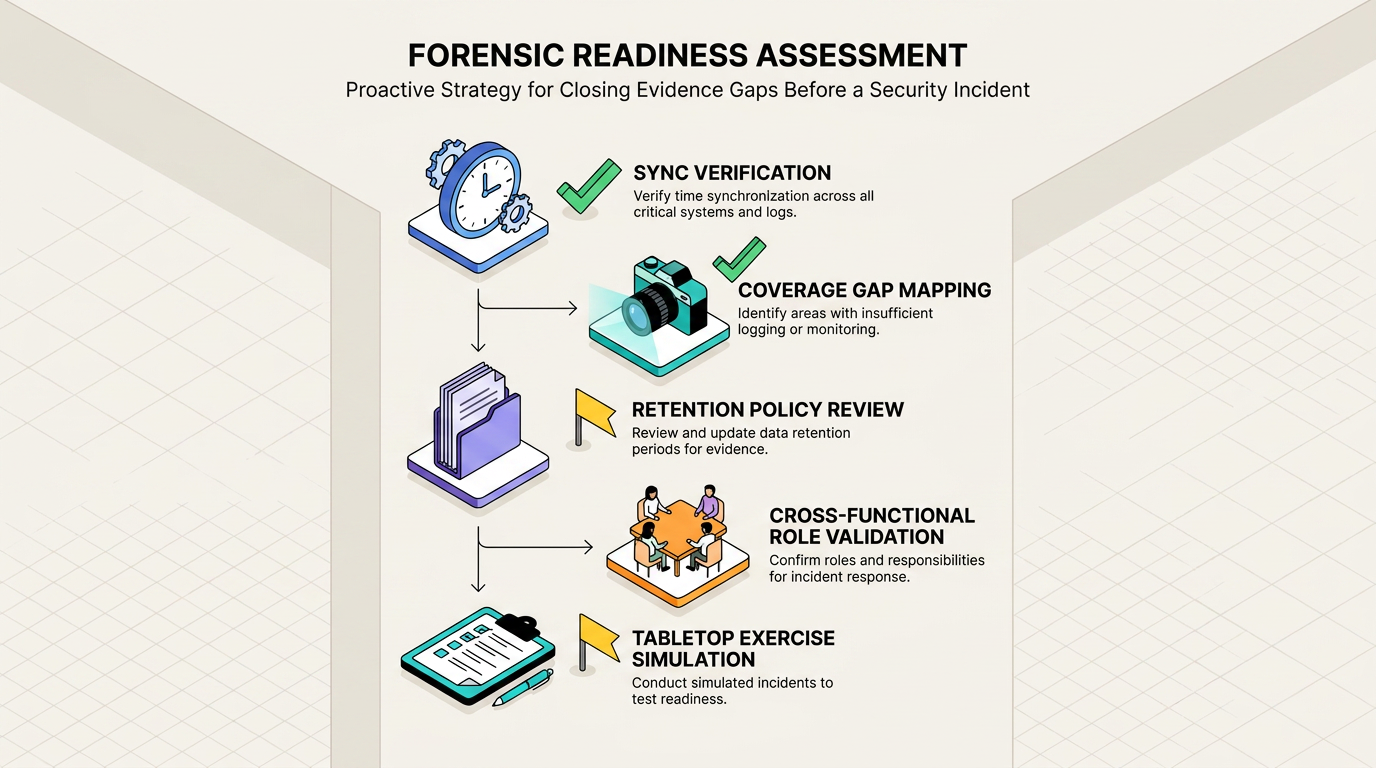
Scheduled forensic readiness assessments, conducted ahead of incidents, surface these weaknesses while there is still time to correct them.
Building Investigations That Withstand Scrutiny
Strong investigations are built before the incident begins. When organizations prepare evidence handling, authority, and preservation processes in advance, they are better positioned to reconstruct events clearly and respond with confidence.
Frequently Asked Questions
How do you implement a forensic readiness assessment to identify evidence gaps before a security incident occurs?
Conduct scheduled audits that test evidence collection procedures, verify system clock synchronization accuracy, document actual retention periods versus legal requirements, map coverage gaps across surveillance and access systems, and validate cross-functional team roles through tabletop exercises simulating real incident scenarios.
What is the best way to synchronize clocks across VMS, PACS, and alarm systems to prevent time drift issues in forensic investigations?
Use Network Time Protocol with a dedicated NTP server as the authoritative source. Configure devices to sync automatically at regular intervals, typically hourly. Verify synchronization regularly through automated monitoring tools that alert when drift exceeds acceptable thresholds.
What should a legal hold procedure include for physical security evidence like video footage and access control logs?
A legal hold procedure should include automated custodian notification, suspension of deletion rules, metadata tagging for preserved items, periodic verification of active holds, and documented release protocols requiring legal counsel approval before restoring retention schedules.
