Integrated Access Control: Connecting VMS, Intrusion, and Identity Systems
Learn how integrated access control connects video, intrusion, and identity systems to give security teams faster answers and fewer blind spots at the door.
Integrated access control gives security teams a faster way to get from a door alarm to a clear answer about what caused it. When tools do not talk to each other, every minute of triage costs more, and the alert queue keeps growing.
Key Takeaways
- Integration proves its value at the door alarm, where an operator quickly identifies the cause instead of sending someone to check in person.
- Open protocol standards let security teams connect readers, cameras, and controllers from different manufacturers without getting locked into one vendor.
- Orphaned credentials are a serious failure. When HR terminations do not reach the door access list, former employees keep walking in long after their network accounts are turned off.
- Good integration depends as much on governance as on technology. Teams need to manage identity changes and active access lists through every stage of a phased migration.
What Integrated Access Control Actually Connects
An integrated access control system ties together the subsystems that usually run on their own: the physical access control system (PACS) at the door, the video management system (VMS) behind the cameras, the intrusion panel, and the identity records. The real test is what the operator sees. One person should be able to run everything from a single view and have it feel like one system doing the whole job.
A simple way to picture it: cameras, card readers, locks, and sensors sit at the device layer, and their data travels over IP instead of separate proprietary wiring. The management layer sits on top, where unified software pulls event streams, video, access logs, and system health into one screen. Physical security information management (PSIM) is the software category built for that job. A PSIM platform lines up events from disconnected devices in a single interface.
What Siloed Systems Cost a Security Operation
When each subsystem runs on its own, alerts arrive without any context from their neighbors. The intrusion panel flags a zone violation with no idea that a valid badge was tapped at the door next to it seconds earlier. An alarm with no video or credential context takes much longer to sort out at the console.
Video monitoring has its own limit: scale. There are simply too many feeds for one person to watch at the same time, no matter how skilled or focused they are. During investigations, investigators have to line up badge logs with footage by hand, then pull alarm history from a third console.
Common Architecture Patterns for Integration
PSIM middleware puts the integration work in a dedicated layer that sits above the existing subsystems. Connectors translate data using native manufacturer protocols, Open Network Video Interface Forum (ONVIF) interfaces for video, the Open Supervised Device Protocol (OSDP) for access control, and the BACnet protocol for building systems. In some setups, a local integration server can normalize event formats and keep basic site operations running if the link to the central control room goes down. Depending on the design, that local server can also hold onto events and video until the connection comes back.
Organizations that skip middleware can pick an open-architecture access control or video platform with published application programming interfaces (APIs) and set up direct data exchange with the other subsystems. The platform can pass a badge scan to the video and intrusion systems the moment it happens, or use a motion sensor to cue a nearby camera.
Converged identity management pushes the integration further into enterprise IT. It brings identity and access management together across operational technology networks, PACS, and IT systems that would otherwise run on their own and produce access records that do not match up. The Physical Security Interoperability Alliance's identity specification does the same thing on the physical side. It carries identities and roles from a trusted logical identity system into one or more PACS.
The Standards That Make Multi-Vendor Integration Work
Those architecture patterns lean on standards that let devices and management platforms share data. The OSDP standard governs the wire between readers and controllers. It was developed by the Security Industry Association (SIA) and published by the International Electrotechnical Commission (IEC) as IEC 60839-11-5. OSDP supports encrypted communication through Secure Channel and adds supervised, two-way communication. The older Wiegand interface it replaces only talks one way and has no supervision, so a cut or removed reader goes unnoticed. OSDP with Secure Channel may be required on every reader port.
ONVIF profiles set the interoperability rules for video and door hardware. Profile T covers advanced video streaming. Profile M covers metadata and events. Profiles A, C, and D cover access control setup, door control, and peripherals like readers, locks, and keypads. The profiles stack together: an IP camera with a relay output wired to a lock can meet Profiles D, M, and T at the same time. The IEC’s 60839-11-5 standard is associated with the OSDP protocol for access control, while ONVIF remains a separate interoperability framework rather than an adopted IEC 60839-11 specification for access control monitoring.
Video Verification of Access Events
Once those interfaces feed door events into the shared workflow, video gives operators instant context. A Door Forced Open event (DFO) marks a door opening with no matching valid credential read or request-to-exit (REX) signal. A Door Held Open event (DHO) flags a door that stays open longer than a set delay. In a siloed setup, each of these is just a line of text in a queue. In an integrated one, the camera feed pops up on the operator's screen automatically, and the operator can see quickly whether the door was forced or a badge tap just failed to register.
Video also brings schedule and location context that the basic DHO event does not have. A loading-dock door held open during a scheduled morning delivery is normal. The same door held open after midnight, right next to a pharmaceutical storeroom, needs full attention.
Tailgating detection takes the correlation a step further. A credential log only records what was tapped at the reader, never how many people actually walked through. A computer vision model counts individuals passing through a defined doorway zone and compares that count against the credentials presented in the same time window. A mismatch shows up in real time instead of being pieced together from footage after the fact.
Security policies can separate accidental tailgating from someone knowingly slipping in behind another person, and set different detection, policy, and training responses for each. The same synchronization helps investigations. A reviewer can pull the clip tied to any swipe or failed read and see who was really there.
Intrusion Detection in a Shared Event Stream
That same shared event stream can coordinate intrusion response through credential-triggered workflows. A valid badge at the entry can disarm the assigned partition, which can cut false alarms from employees who carry a credential but were never trained on the alarm code. Zone-level designs go further. Managers arm and disarm the whole facility, staff handle only their assigned partitions, and some integrations use exit records to arm the system automatically when the last person seems to have left.
The Monitoring Association's alarm validation standard scores every intrusion event on a scale, from no call for service, through non-validated human presence and confirmed threat to property, up to confirmed threat to life. Video or audio evidence collected at the monitoring center moves an event up that scale before anyone is dispatched. The Automated Secure Alarm Protocol (ASAP) sends alarm data digitally into computer-aided dispatch systems at public safety answering points (PSAPs).
Identity Lifecycle and the Orphaned Credential Problem
The shared event stream is only as trustworthy as the credential database behind it, and shaky assumptions about that database can quietly break integrations. Physical identity and access management (PIAM) sits on top of this layer. The PACS enforces access at the door, while PIAM manages the policies and identity lifecycle events that decide who should have that access in the first place. A converged identity architecture connects enterprise identity management and the PACS so that lifecycle changes reach every system.
The HR system should be the source of truth for employee status, and provisioning should flow straight from that record. An identity provisioning standard can create an account when someone joins, update it when a role changes, and shut it off when someone leaves.
Termination carries the highest stakes. The Federal Information Processing Standard (FIPS) publication FIPS 201-3, the standard for federal Personal Identity Verification (PIV) credentials, requires organizations to complete standard termination steps within 18 hours of notification. Those steps include invalidating the credentials tied to the person's identity. When badge revocation drags, a former employee keeps access to server rooms and labs long after their network accounts are shut off, and no firewall rule will stop someone from walking through a door.
Connected identity and event records also support regulatory access controls. The Health Insurance Portability and Accountability Act's (HIPAA's) facility access controls at 45 CFR 164.310 require covered entities to control and validate access to facilities and equipment that hold electronic protected health information.
Planning an Integration That Survives Deployment
Security planners have to think about both the build and the governance around it. Technology alone will not carry the deployment. Planning starts before any product gets picked, and security teams should walk into that stage with a few priorities:
- Take stock of the hardware, software, and existing wiring that an open-architecture system can keep.
- Bring IT in early, since controllers now sit on the corporate network.
- Treat identity as the core asset, with the card as a secondary piece.
Teams can take a phased approach to migration. They can bridge legacy intrusion panels into a managed layer while swapping out readers and controllers on a schedule, and integration teams should keep cardholder databases in sync with HR directories throughout the cutover.
Governance work continues long after commissioning. National Institute of Standards and Technology (NIST) SP 800-53 control PE-2 asks organizations that follow the framework to keep the facility access list current and remove individuals once access is no longer needed.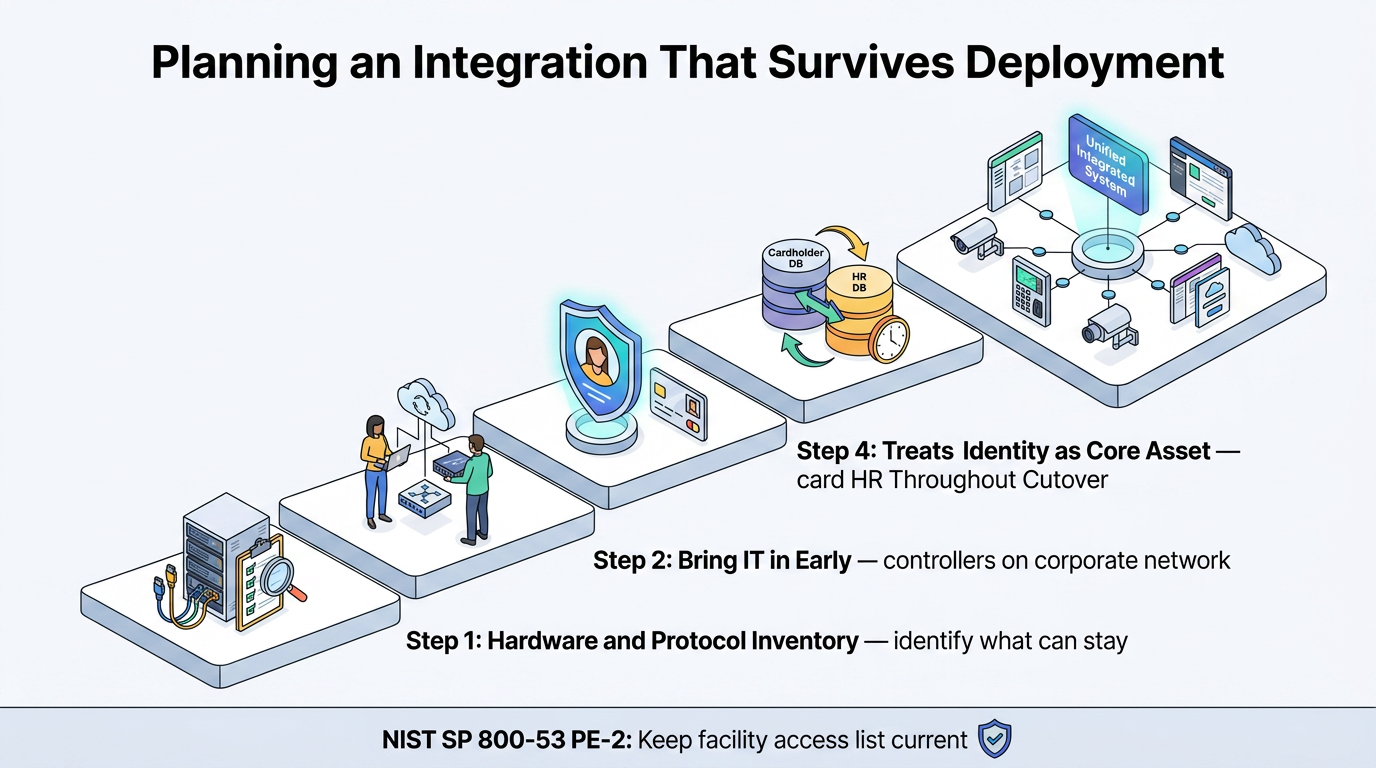
Where Integration Value Actually Shows Up
Security leaders can judge the value of integration through response quality and control reliability, and they should also check that the data stays consistent across systems. When comparing candidates, evaluators should look at:
- How each platform normalizes events across subsystems.
- Whether operators get enough context to make quick, confident decisions.
- How credential lifecycle changes flow from HR through PACS.
- Which open standards its readers, cameras, and controllers actually meet.
Frequently Asked Questions
How do you prevent orphaned credentials when HR termination notifications are delayed or missed before reaching the physical access control system?
Automate credential revocation from HR status changes, eliminating manual notification. Run periodic audits comparing badge lists against employee rosters. Enforce strict revocation timelines with escalation alerts and require dual verification before re-enabling deactivated credentials.
What is the difference between OSDP and Wiegand protocols, and why does OSDP's two-way supervised communication matter for security?
OSDP enables encrypted two-way communication with continuous supervision, detecting tampering or disconnections immediately. Wiegand's one-way signaling provides no supervision, meaning severed wires or removed readers generate no alert, leaving access points vulnerable until discovered during routine checks or after an incident.
What steps should security teams follow when planning a phased migration from siloed legacy systems to an integrated access control architecture?
Begin with a hardware and protocol inventory to identify what can stay. Bring IT into network planning before procurement. Prioritize identity governance over credentials. Maintain dual cardholder databases during cutover, and test synchronization at each phase before decommissioning legacy systems.
