The Anatomy of a Layered Perimeter Protection System
Learn how detection, delay, assessment, and response work together in a layered perimeter protection system to stop intrusions before they reach critical assets.
A layered perimeter protection system runs on a countdown that starts the instant an intruder touches the outer boundary. Every second between that first contact and the protected asset decides whether responders arrive in time or too late. Getting the sequence right means matching sensing, delay, and assessment to the route an intruder chooses, not the one designers hope for.
Key Takeaways
- Layered perimeter protection works only when detection, delay, assessment, and response are timed against the same intruder route.
- Path analysis identifies the critical detection point beyond which no sensor can buy responders enough time, which is why detection belongs at the fence line and hardening belongs near the asset.
- Video, lighting, and access control turn a raw PIDS alarm into a decision an operator can act on, and a broken handoff between any two collapses the entire chain.
- AI correlation across sensors, cameras, and badge reads cuts nuisance alarms and clarifies intent, but weather and site behavior drift keeps human verification in the loop.
What Is Perimeter Security?
Perimeter security comprises the measures at and inside a protected area's outer boundary that detect unauthorized entry, impede movement, and support a response. The boundary starts at the grounds and parking areas around the fence line, continues through the campus grounds surrounding the main buildings, and extends into the facility interior.
The discipline sits within the wider physical protection system (PPS), which combines equipment and personnel, guided by operating procedures, to protect assets from theft, sabotage, and other attacks. The perimeter therefore extends beyond the property line and is the part of the protection system that first encounters an approaching threat and shapes every action that follows.
Why Perimeter Protection Requires a Layered Approach
A fence and sensor protect a site only if the response force reaches the intruder before the intruder reaches the protected asset. Path analysis models that race by considering four questions:
- Does each sensor detect the intrusion?
- Does the alarm reach an operator?
- How long does each barrier delay progress?
- How quickly do responders arrive?
The route with the lowest probability of interruption becomes the critical path, because the intruder can choose it instead of confronting stronger layers.
Along that path sits the critical detection point: the last spot where the remaining barriers can hold the intruder longer than the response takes. Detection beyond it cannot produce timely interruption. A climbable fence with nothing behind it leaves no meaningful delay after detection, so its alarm may reach an operator after the chance to stop forward movement has already passed.
Placing detection earlier and preserving delay behind it pushes the critical detection point outward. That gives operators and responders more usable time without asking any single component to stop the intrusion on its own.
The Layers of a Perimeter Defense System
An intruder crossing a protected site encounters components that perform different jobs at different moments:
- Deterrence: visible fencing and lighting may send an opportunist elsewhere.
- Detection: fence sensors and buried cable register the crossing. Radar and video analytics can do the same.
- Delay: an outer fence and an inner fence extend the intruder's time to complete the task. Vehicle barriers and hardened doors add further delay.
- Assessment: cameras matched to sensor zones let an operator judge what caused the alarm, including environmental sources.
- Response: on-site guards, off-site police, or military personnel interrupt the intrusion.
Because deterrence concerns intrusions that never happen, designers cannot reliably score it.
A sterile zone builds this sequence into the site layout. Open ground separates a sacrificial outer fence that carries detection from an inner fence that provides further delay. The clear space also gives cameras an unobstructed assessment area and makes movement between the barriers easier for an operator to interpret.
Physical Barriers and Their Role in Perimeter Security
Gates are the weakest points in an otherwise continuous boundary. Every gate creates a planned opening that an intruder can target, so each one needs detection and delay on par with the fence beside it. The line weakens further during legitimate use: when a vehicle or pedestrian passes through, sensors may be suppressed, and the barrier stands open. Designers must plan for those windows, not just the closed state, because that is when the gate is most exploitable.
Planting around the boundary can either support or undermine that same line of sight. Low shrubs and maintained tree canopies keep the fence visible to cameras and guards while denying an intruder easy concealment. Left unchecked, the same planting grows into blind spots that hide movement from assessment cameras. Grounds maintenance therefore belongs in the security program, not the landscaping budget.
How Perimeter Intrusion Detection Systems Work
Barriers create delay, but they cannot tell the site that anyone has arrived. A perimeter intrusion detection system (PIDS) does that job, putting the clock on the intruder the moment the boundary is touched. A PIDS provides continuous sensing along the fence line itself, or lays complementary sensor lines across an isolated clear zone so an intruder must cross more than one before reaching cover. No single technology fits every site. Designers pick the sensor by matching it to the fence type and terrain, then weigh how weather, nearby activity, and the likely method of approach will affect it in practice.
The main PIDS technologies each detect a different physical signature:
- Fence-mounted sensors react when the fence itself moves. Fiber-optic cable converts fence-fabric bending into an alarm by disturbing the light traveling through it. Taut wire measures changes in strain across tensioned wires strung along the fence. Mechanical sensors close an electrical contact as the fence shifts.
- Buried sensors detect activity from below the surface, hidden from the intruder. Leaky coaxial cable creates a terrain-following detection zone shaped by the ground itself, while seismic and magnetic sensors pick up vibration or metal signatures. Buried systems demand heavier installation work and can be affected by groundwater.
- Bistatic microwave projects an invisible elliptical field between a transmitter and a receiver. Anyone crossing the field breaks the signal. It performs well through most weather, though microwave reflections from nearby roads or buildings can trigger nuisance alarms.
- Volumetric sensors monitor open ground rather than the fence itself. Passive infrared (PIR), radar, and light detection and ranging (LiDAR) each read the space differently, so combining them provides overlapping coverage. Radar and LiDAR can also extend detection beyond the fence into the approach. Rain, fog, and foliage degrade performance to varying degrees depending on the technology.
Whichever technology a site chooses, it needs to be tested the way it will be used. Exterior systems require evaluation under outdoor conditions, against criteria designed for outdoor equipment, before you can trust their detection numbers on the ground.
Video Surveillance as a Perimeter Detection Layer
Once a PIDS raises an alarm, video supplies the visual context needed to assess what caused it. A sensor with strong detection performance contributes little if no person or automated process reviews the alarm.
Camera placement should follow the sensor layout rather than treat the fence as a separate video project. Overlapping fixed-camera views can cover the boundary continuously, and matching each PIDS zone to the relevant camera field of view helps an operator locate the event quickly. A lens aimed along the fence can also cover the area beneath the next camera, where a perpendicular view may leave a blind spot.
Pixel density determines what an image can prove. Detection requires less image detail than observation, recognition, or identification, so a camera that shows movement at the far edge of a site may not support identification there. Designers must match field of view, lens choice, resolution, and target distance to the assessment task.
Integrating Lighting, Access Control, and Communication Systems
Video assessment depends on the surrounding infrastructure, starting with lighting. Uniform illumination helps a camera preserve usable detail across the fence line and at gates, while glare and bright spots can conceal the activity the light was meant to reveal. Lighting design should therefore account for camera exposure as well as what a guard sees directly.
Access control governs the planned openings. A physical access control system (PACS) at vehicle and pedestrian portals authenticates credentials for authorized entry, and operators can compare access-control events with sensor and video data. A door forced open at a perimeter portal without a corresponding credential read becomes a detection event, not an isolated access-control exception.
Communication completes the handoff from technology to action. An alarm must reach a recipient who can assess it in person or through imagery, such as:
- facility management;
- security staff;
- law enforcement; or
- a monitoring provider.
The escalation path should establish ownership from alarm receipt through verification and dispatch, so that no alarm stalls between systems or teams.
How Artificial Intelligence Closes Gaps Between Perimeter Security Layers
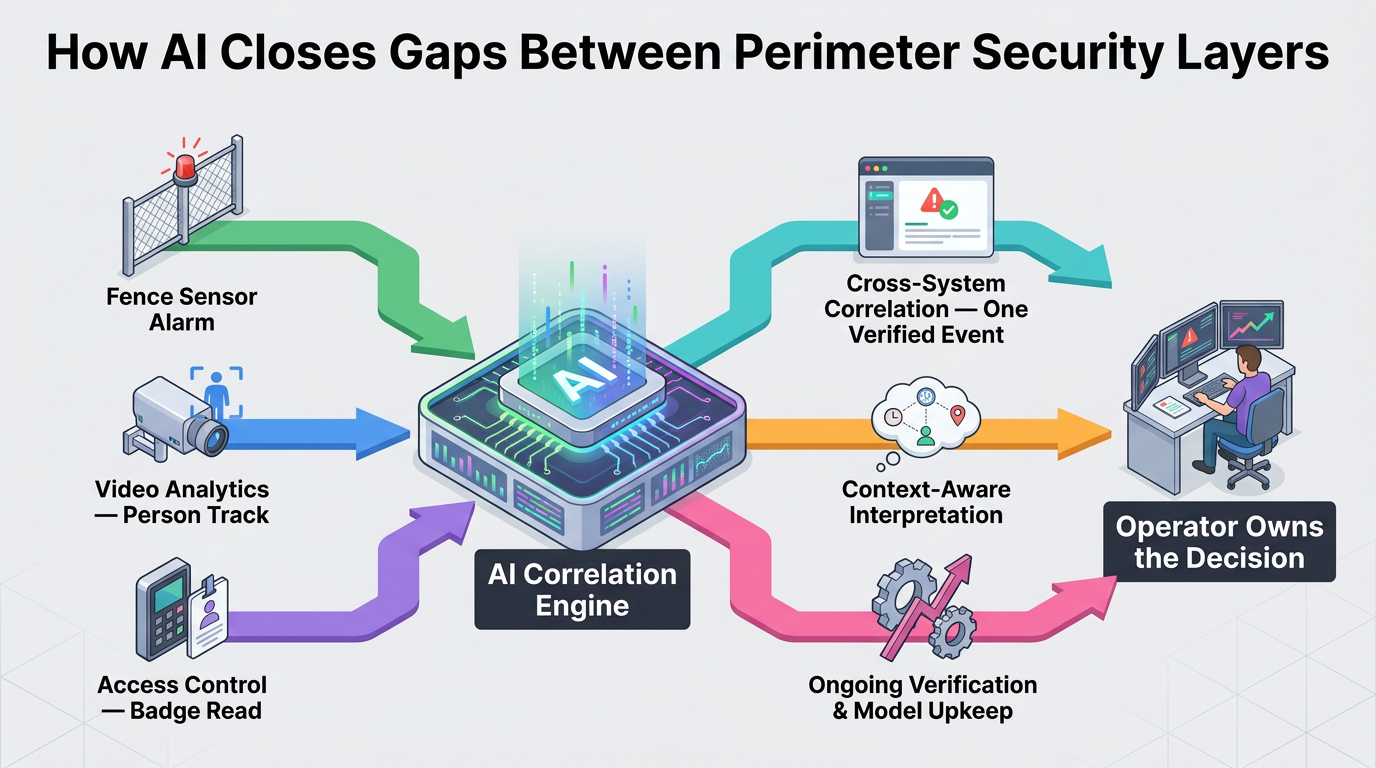
Integration gives operators the relevant data, but AI can help reconcile signals arriving from different perimeter systems. Weather and nearby activity produce nuisance alarms across perimeter sensors and video analytics, and when each technology reports to a separate console, operators must reconstruct the event while additional alarms continue to arrive. AI closes those gaps in three ways:
- Cross-system correlation. A correlated event stream can present one verified event when a fence alarm aligns with a person track in the matching camera zone. The absence of a badge read at the nearest gate adds access-control context. The operator still owns the decision, but correlation reduces the manual work of connecting sensor activity with video and access-control context.
- Context-aware interpretation. Context changes how identical movement should be read. A contractor walking the fence line beside a marked utility truck may be routine during a scheduled inspection. The same figure pacing the sterile zone after the gate has closed warrants dispatch, and the lack of a vehicle at the portal or a credential at the pedestrian door reinforces that concern.
- Ongoing verification and model upkeep. AI performance still depends on input quality. Fog or rain can degrade the sensor and image data used for recognition, and site-normal behavior drifts as operations change. Security teams must therefore maintain human verification and retrain models when reviews show that legitimate activity has shifted.
Designing a Layered Perimeter System for a Site
Risk guides layer selection. The design team should identify the protected assets and credible adversaries, then evaluate the consequences of successful access and the routes that make it possible. The level of protection required depends on:
- mission importance;
- occupancy;
- site layout; and
- local threat conditions.
Applicable sector obligations set the minimum, but compliance alone does not establish whether the design can interrupt the site's credible attack paths. Security leaders should map each route from the outer boundary to the asset, covering normal openings and any terrain that offers concealment or bypass opportunities. The resulting design should align sensing with assessment along every practical route and coordinate delay with response.
Scaling follows the threat, as these illustrative baselines show:
- Low-risk distribution yard: use a sensored fence line and lighting that supports perimeter assessment. Place cameras at gates and control portal access through the PACS.
- High-risk substation or data center: add a sterile zone with a sacrificial outer fence and complementary PIDS technologies. Thermal detection can cue PTZ assessment, while crash-tested vehicle barriers protect credible approach routes.
The final layout should also account for maintenance and operations. Paths can differ from the drawing when:
- crews routinely disable a sensor;
- seasonal growth blocks a camera; or
- deliveries leave a gate open.
Design reviews should therefore include the people who operate the site as well as those who specify the equipment.
What Effective Perimeter Protection Looks Like in Practice
An effective perimeter operates as one integrated system. Security directors can test that system by tracing representative intrusion scenarios through every handoff from initial sensing to response. The review should expose unmatched camera views and unmonitored alarms, and identify bypassable gates and barriers that operations routinely compromise. These exercises show whether the layers preserve enough time for operators and responders to act under realistic conditions, not merely whether each component works alone. Repeating the evaluation as site operations change keeps the design aligned with the paths an intruder could actually use.
Frequently Asked Questions
How do you calculate the critical detection point for a specific site, and what variables determine whether detection is placed too late along an intruder's path?
Calculate the critical detection point by mapping intrusion routes, measuring barrier delay times, and determining response force travel duration. The point sits where cumulative delay exceeds response time. Variables include adversary speed, response readiness, alternative routes, and whether schedules weaken barriers during shift changes or deliveries.
What are the best practices for maintaining perimeter security system effectiveness when site operations frequently change, such as seasonal landscaping growth or routine gate usage by delivery crews?
Schedule reassessments tied to operational milestones, document temporary access procedures in security protocols, and maintain feedback between maintenance crews and security teams to flag vegetation or access pattern changes before they create vulnerabilities.
How does AI cross-system correlation between fence sensors, video analytics, and access control actually reduce nuisance alarm rates without increasing the risk of missing real intrusions?
AI correlation requires multiple independent sensors to confirm the same event before escalating, so a fence vibration from wind with no video track gets suppressed while a human crossing that triggers both systems escalates immediately, raising detection confidence without single-sensor dependency.
