Visitor Access Control at Scale: What It Means for Multi-Site Operations
Managing visitor access across multiple sites requires unified policies, federated credentials, and integrated systems. Learn how to close the gaps.
Visitor access control looks simple at one building. Sign the guest in, notify the host, hand over a temporary badge, and reclaim it on the way out. Stretch that same routine across a distributed enterprise and the cracks show fast. A badge that expires automatically at headquarters lingers on a clipboard at a regional plant. A contractor turned away in one city walks into another without anyone noticing. The work shifts from running a front desk well to proving, across every site, that temporary access stays consistent, time-bound, and visible to the people accountable for it.
Key Takeaways
- Visitor access control at scale depends on consistent policy enforcement across sites that each face different local conditions.
- The visitor category spans short visits, recurring contractor work, audits, and temporary staffing, which drives credential and policy complexity across distributed enterprises.
- Multiple compliance frameworks converge on visitor escorting and identity and access-time records, with electronic systems used to corroborate physical records.
- Integrating visitor records with access control and video gives security teams more confidence in overall system effectiveness than running these systems in isolation.
What Visitor Access Control Means in an Enterprise Context
Visitor access control manages how guests, contractors, vendors, and other temporary users gain physical entry to buildings. Visitor access differs from employee access control in the credential lifecycle. Employee access handles ongoing, role-based permissions. Visitor access grants temporary, time-bound credentials that expire automatically at checkout.
It helps to separate two related functions. Visitor management tracks the guest experience from arrival to departure. Access control restricts and grants physical entry to specific areas based on predefined rules. A visitor management system handles pre-registration and on-site check-in, then preserves records for post-visit audit reporting. Access control enforces where the visitor can actually go once inside.
The standard workflow runs in sequence. A visitor pre-registers online. Reception staff can pre-approve access and avoid incomplete forms during peak hours. On arrival, the visitor checks in through the site's check-in device, completing any required NDAs or waivers and receiving a credential. The system notifies the host. A badge prints with the visitor's name, photo, purpose, and authorized zones. The platform grants temporary access to specific areas, then revokes it automatically at checkout with no manual handoff.
Credentialing detail matters. Color-coded photo badges can distinguish guest types. Deny lists can automatically refuse entry and alert designated staff to an attempted access. Some access-controlled areas require a host to accompany the visitor at all times.
Why Multi-Site Operations Change the Problem
Tracking the movement of hundreds or thousands of visitors in one location is hard enough. Across many sites, each with its own protocols and local regulations, the same task compounds. Several challenges emerge once visitor access spans a distributed footprint.
Centralized Versus Decentralized Administration
Most enterprise security organizations operate under a centralized structure, but a meaningful share run decentralized or regional models where security functions in different locations operate independently. Each approach carries tradeoffs. A centralized model can simplify policy rollout and enterprise visibility, while a decentralized model gives local teams more room to adapt. At scale, though, decentralization can also produce disparate policies and uneven enforcement. Visibility gaps follow.
Central teams can define baseline standards while distributed units implement policies within that framework.
Policy Drift Across Sites
Multi-site environments tend to drift as local teams solve local problems. Different site leaders make practical choices, front desk teams rotate, and contractors and local regulations change. Each decision can be reasonable, yet collectively they create inconsistency, and inconsistency is where risk begins to surface. When each location sets its own rules for access privileges or incident reporting, compliance gaps and uneven enforcement follow.
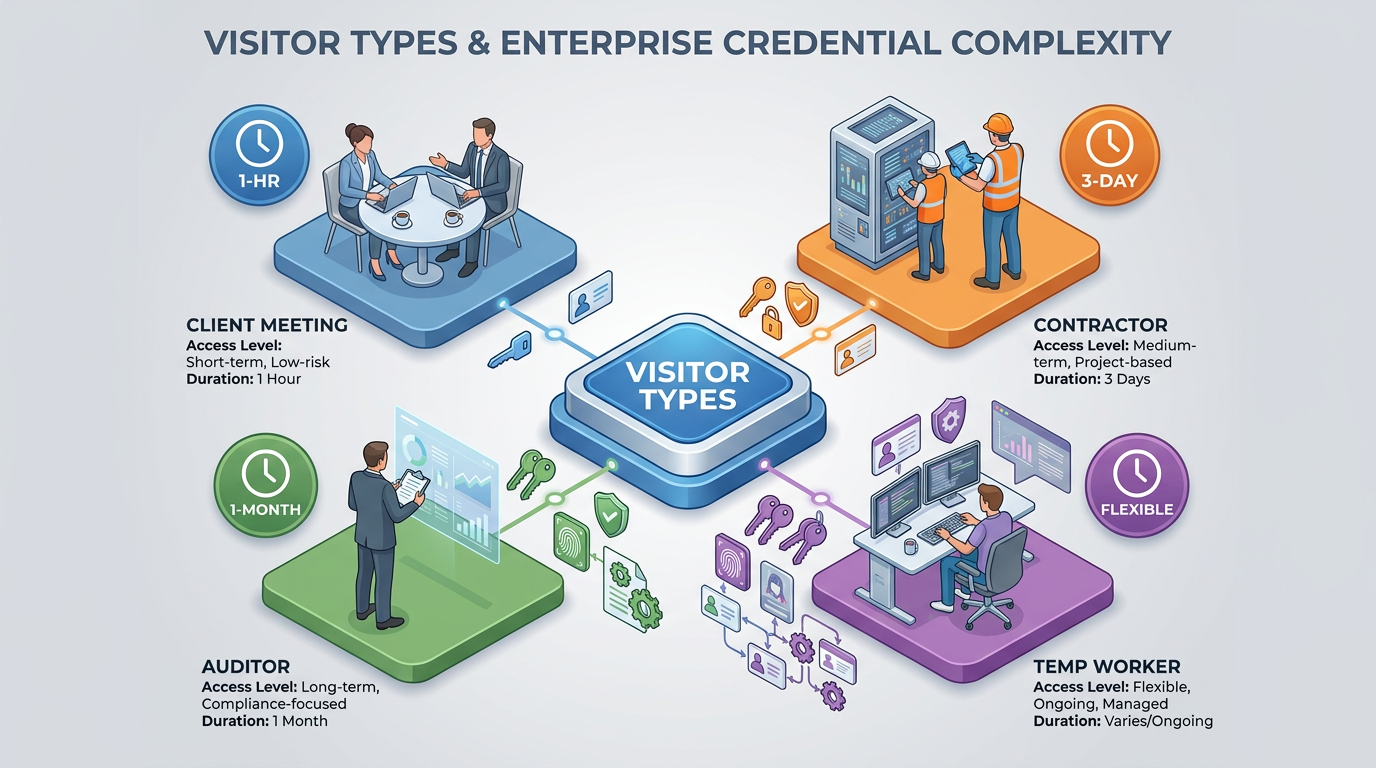
The visitor category itself drives much of this complexity. The label covers a prospective client at an hourlong meeting, an HVAC contractor who might need three hours or three days, accounting auditors present for a month, and a short-term temporary worker. Each carries a different access level and duration, and each demands different policy treatment. Multi-site programs should enforce a shared baseline everywhere, with room for sites to adjust for local risk and regulation, including layout constraints.
Persistent Manual Systems
Paper logs remain common at individual sites. Organizations do not follow one pattern: some use either a physical identity and access management system or a different access-control technology to track temporary credentials at all sites. Others rely on manual systems or issue no temporary credentials, and many use a mix.
Credential Federation and Unified Records
In visitor programs, the practical need is a unified record so temporary-user history is not trapped at one facility. Without that continuity, site-level records can remain parallel workflows and obscure the enterprise view of temporary access.
Credential and Identity Verification Technologies
Credential design guidance separates contractor and temporary credentials from visitor credentials. Contractor badges carry time-bound rights and limited privileges with a distinct visual design. Visitor badges are short-lived, highly visible, and clearly marked. Both contrast with employee ID cards, which encode access through RFID or NFC, with magnetic stripe used where supported, and add security features like holograms.
Mobile and QR credentials have widened the options. Cloud systems can issue temporary QR codes with custom time parameters, valid only between set hours. Where supported, those time limits are more useful for visitor access than credentials with no expiration logic. Mobile credential programs also require platform- and reader-compatibility planning before rollout.
Watchlist Screening Across Sites
Screening matters most where manual systems fail. A paper-based watchlist rarely updates in real time across multiple locations, so a contractor banned at Site A can enter Site B undetected. Automated screening can apply the same policy checks across locations where policy requires them. The value of automation rises with the number of sites, because a shared list enforced everywhere closes the cross-site gap that paper cannot.
Biometrics and the Demographic Differential
Biometric verification can reduce reliance on presented identification, but accuracy depends heavily on conditions. Algorithm performance can also vary sharply by demographic group: within-group false positive rates varied by up to a factor of 7,203 across demographic groups. Security directors deploying biometric visitor credentialing at scale should require algorithm-specific demographic performance data and test at representative sites before broad rollout.
How Tailgating and Piggybacking Target Shared Entrances
Tailgating occurs when an unauthorized person follows an authorized individual through a secured door without that person's knowledge. Piggybacking occurs when the authorized person knowingly allows it. Both undermine the visitor credential model, because the door opens for a valid badge regardless of how many people pass through.
Treat tailgating and piggybacking as entry-control failures that require both physical and procedural controls. Policy and awareness are part of the answer because an authorized person can knowingly hold a door or allow another person through.
Higher-assurance entrances include security turnstiles and mantrap portals, with security revolving doors also used where the cost and throughput tradeoffs fit.
These barriers are expensive and consume space, so they cannot sit at every interior door. That limitation is why software controls and detection fill the gaps. Software controls such as anti-passback can help with credential-sequence anomalies, such as repeated entries without expected exits. Operators still need to treat credential logic as different from proof that only one person crossed the threshold. Video context integrated with the visitor management platform can give operators evidence that barriers and credential logic cannot.
Compliance Frameworks Governing Visitor Records
Multiple regulatory regimes touch visitor access records, and they converge on a consistent set of physical controls.
NIST SP 800-53 Revision 5 includes explicit controls PE-7 for visitor control and PE-8 for visitor access records, with enhancements for automated records maintenance and physical access records, including limits on personally identifiable information. NIST SP 800-171 Revision 3 incorporates the same operational core under control 03.10.07: escort visitors and monitor activity while maintaining audit logs of physical access and controlling physical access devices. CMMC programs built around NIST SP 800-171 inherit similar physical-access expectations.
In healthcare, the HIPAA Security Rule requires policies that limit physical access to systems housing electronic protected health information while permitting properly authorized access. Operationally, that makes visitor identity and access-time records, plus escort records, useful for demonstrating control, but retention periods and exact log formats should be set against applicable healthcare and privacy obligations.
Where biometric privacy obligations apply, an enterprise deploying biometric visitor credentialing must evaluate site-by-site obligations.
Unifying Visitor Data With PACS and Video
A PACS is a collection of technologies that control physical access at one or more sites by authenticating employees, contractors, and visitors and then making an access decision. It explicitly identifies visitor management systems and video management systems as subsystems that interoperate with PACS infrastructure. Intrusion detection can interoperate with the same PACS infrastructure. When a visitor management system cannot communicate with existing PACS hardware, the system sits outside the interoperating subsystem model and creates a parallel workflow.
Standards make that communication possible. Open Supervised Device Protocol, maintained by SIA, governs interoperability between readers, controllers, and management software, and became an international standard as IEC 60839-11-5. ONVIF profiles let access control and video systems exchange events and metadata across vendors. Procurement specifications for a multi-site program should verify support for both.
When access control and video are integrated, access events can be reviewed alongside relevant camera views and event metadata. Access events can trigger video verification, and security teams respond with the full context of an incident. A unified event trail with cross-referencing among visitor records, access records, and video records helps teams reconstruct a timeline faster. That capability also supports audit corroboration.
Reducing Alert Volume Across Sites
Integration alone does not solve the volume problem. Legacy systems have reported door position for decades, leaving teams with a high volume of door forced open and door held open alerts. Across many sites, that volume multiplies.
Correlation and verification help reduce that volume. Door-position alerts should be paired with camera context before escalation where the system supports that workflow, which shifts the team's attention from manual triage to more actionable events. Reasoning vision-language models are designed to interpret behavior and visual context alongside object matches. For a multi-site program, the practical requirement is consistent verification across sites so repetitive door-alert noise does not overwhelm operator teams.
Building a Visitor Program That Holds Up Across Sites
The enterprise that succeeds at scale treats visitor access as a governance problem first and a technology problem second. A shared baseline policy, enforced everywhere and adjusted locally only for documented risk, prevents the drift that erodes consistency. Federated credentials and unified records close the cross-site blind spots that paper and silos create.
Standards-based integration with PACS and video turns visitor logs into corroborated audit trails that satisfy regulators and accelerate investigations. The next gain comes from cutting alert volume so verification can scale with the footprint rather than against it.
Frequently Asked Questions
How do you prevent policy drift in visitor access control when different sites have different local regulations and operational needs?
Establish minimum security requirements centrally, then delegate implementation authority to site managers who document variances in a shared registry. Regular audits verify deviations remain justified by regulation or risk, while periodic reviews reconcile successful adaptations into the enterprise baseline.
What integration standards like OSDP and ONVIF should be required when procuring a visitor management system for multi-site deployments?
Require OSDP for reader-to-controller communication and ONVIF Profile A or C for access control interoperability. Verify API support for event forwarding to central security operations platforms and confirm vendor roadmap alignment with emerging SIA standards for cloud-based credential provisioning.
How can organizations reduce the high volume of door-forced-open and door-held-open alerts across multiple sites without missing genuine security incidents?
Organizations reduce door alert volume by correlating door-position sensors with camera footage before escalating to operators, filtering routine events. Reasoning AI distinguishes legitimate door holds from forced entries by analyzing behavioral context and occupancy patterns.
