Hotel Access Control: How AI Is Changing Security at Hotels
Learn how hotel access control systems work, from RFID credentials to AI-augmented monitoring that reduces false alarms and improves response.
Hotel access control governs how people move through a property while keeping protected spaces secure. In a hotel, every access decision affects both safety and service: movement should feel simple for approved users, while the property maintains control over sensitive openings and spaces. Effective access control gives operators confidence that access is consistent, timely, and auditable, without turning routine movement into constant manual review.
Key Takeaways
- Guests, staff, and perimeter access belong in distinct zones, each governed by security requirements that match the risk and traffic of that space.
- Credentialing has shifted from clonable legacy cards to encrypted RFID and mobile keys, with biometrics reserved for high-value back-of-house areas.
- Door alarms lack context on their own; AI that pairs each alarm with live video helps operators distinguish genuine threats from routine activity.
- Unifying access control, video, and the PMS gives security teams real-time perimeter visibility without ripping out existing infrastructure.
How a Hotel Access Control System Comes Together
Hotel access control is often discussed in terms of core hardware layers: credentials, readers, controllers, and electronic locks. In that model, the controller, sometimes called the access control panel, is the logic hub that stores access rules and decides who may enter which space and when. It also logs taps, timestamps, and results for later review.
For planning purposes, hotels usually separate access across practical security zones, each with different lock and access requirements. Guest rooms use electronic locks tied directly to the property management system (PMS) check-in and check-out state. Back-of-house areas run on role-based staff access, often with stricter credential requirements for high-value spaces like server rooms and vaults. Perimeter entries cover lobby doors, parking gates, loading docks, and amenity entrances.
Offline or Networked Locks: What's the Difference?
The choice between offline and networked locks shapes how quickly a property can revoke access. Offline locks generally store access rights on the credential card itself rather than checking a live database. That lowers wiring cost but can add latency when a credential needs to be pulled.
Wireless online locks are designed to communicate with a central server in real time. Operators get broader control across the property. Depending on product design, online systems may also support centralized firmware updates and security patches, with fallback options if network connectivity drops.
How Readers Talk to Controllers
The protocol linking readers to controllers is a frequent upgrade decision for security directors. Wiegand has been widely used for decades, but it is a unidirectional protocol with a short cable limit and no native encryption. The Open Supervised Device Protocol (OSDP) provides bidirectional communication, strong encryption, longer cable runs, tamper detection, and multi-drop daisy-chaining of multiple readers or OSDP devices on a single controller port.
Tying It All to the PMS
The property management system is the data source that makes guest-room access work. When a guest checks in or out, the PMS can pass state changes to guest-room systems, including door locks, without needing the hotel team to manage each device separately. HTNG, now under AHLA, has published hotel technology standards and related door-lock testing procedures and valuation criteria.
After a reservation, a guest receives an encrypted mobile key. On arrival, they bypass the front desk and unlock the room directly, because the system reads check-in status from the PMS to activate the key. At checkout, access is revoked automatically without any hardware change. The same integration path can support faster revocation when the hotel's access policy requires it. HTNG Express, a lightweight API standard, can simplify many of these integrations, though vendor implementation differences still leave room for extensions and quirks.
Credential Technologies Shaping Hospitality
Magnetic stripe cards are treated as a legacy format, and cloning risk is one reason properties evaluate newer credentials. Newer deployments often favor RFID and mobile key systems, especially for new-build properties.
RFID smart cards often use contactless card standards that operate at close range. A recurring vulnerability in older deployments is MIFARE Classic, a chip family used in some contactless-card environments. Newer hotel card deployments may use encrypted RFID keycards for physical card access.
Where NFC and Mobile Keys Fit In
NFC belongs to the same contactless protocol family behind contactless payments and e-passports. Its operational value is that NFC-capable smartphones can support mobile-key experiences without dedicated BLE hardware.
Mobile credential deployments can use BLE, NFC, and cloud APIs to reduce reliance on physical cards. BLE can support smartphone-based access control at short range. NFC mobile keys can be designed for app-light or wallet-based use. For new construction, teams should confirm whether lock hardware supports the mobile credential technologies they plan to use, because NFC and BLE depend on different physical capabilities.
When Biometrics Make Sense
Where hotels use biometric credentials, they are often easiest to justify for staff access to restricted back-of-house areas such as server rooms and vaults, rather than guest rooms, because of privacy concerns and hardware cost.
Access Control Threats Hotels Should Watch For
Hotels face recurring access control threats:
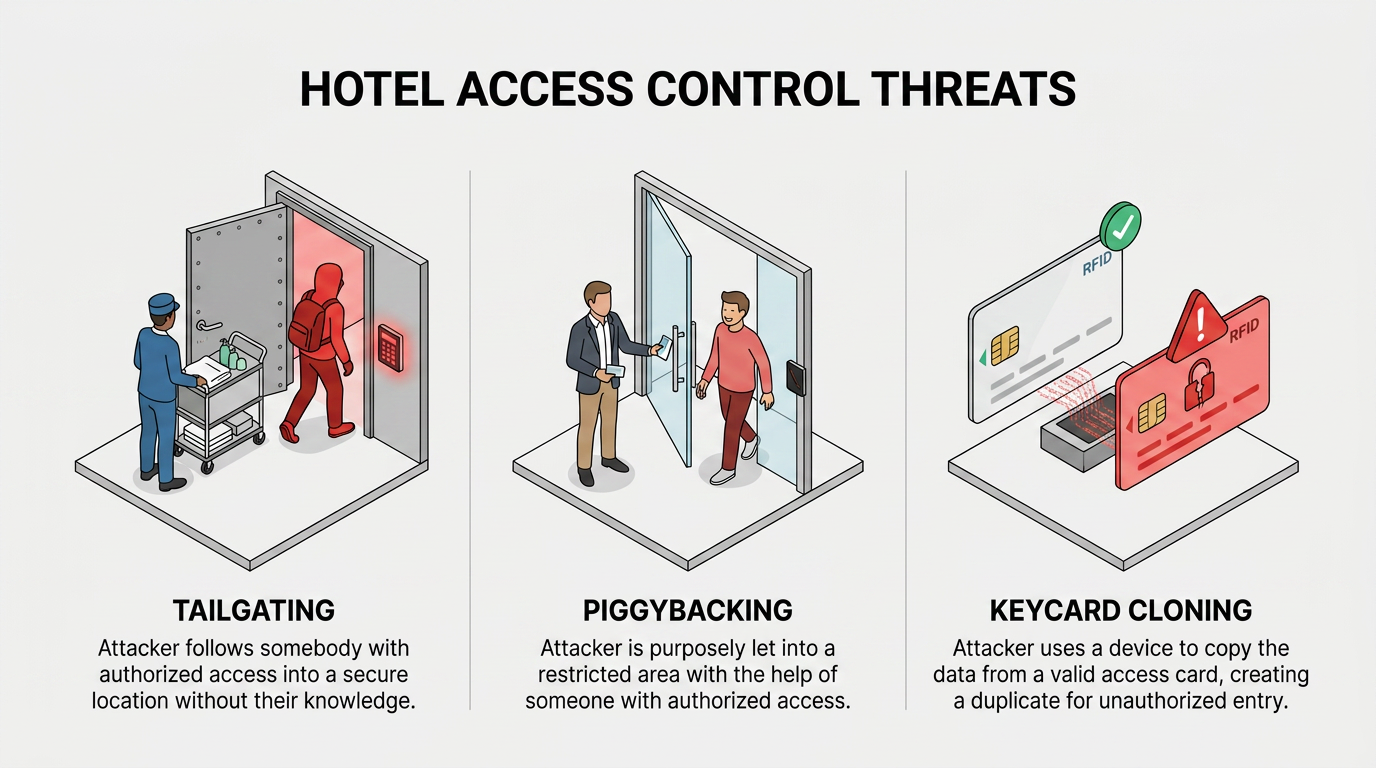
- Tailgating and piggybacking both involve an unauthorized person entering with or behind an authorized person. Security teams often use tailgating for unaware following and piggybacking for knowing assistance. These threats are particularly relevant for back-of-house areas, where staff frequently move through service doors carrying supplies or equipment, making it easier for an unauthorized person to slip in behind them into storage rooms, kitchens, or staff corridors. Tailgating and piggybacking rank as a commonly cited access control failure, with many surveyed security professionals reporting an access control failure in the prior six months.
- Keycard cloning is a hotel-specific threat with documented operational consequences. Researchers disclosed the Unsaflok vulnerabilities in dormakaba's Saflok RFID locks. The flaws allowed forged RFID keycards to unlock affected rooms by exploiting weaknesses in the encryption and the underlying MIFARE Classic system, as tracked in the Unsaflok vulnerability record.
Making Sense of Door Forced Open and Door Held Open Events
Beyond cloning and tailgating, day-to-day alarm activity introduces its own risks. Common PACS event types create recurring alarm volume in hotels: a Door Forced Open (DFO) alarm fires when a door opens without a valid credential or Request to Exit activation, while a Door Held Open (DHO) alarm fires when a door stays open past its programmed timeout.
A major source of false DFO alarms is the mechanical key, since opening a door with a physical key registers no credential event, leaving the PACS unable to tell legitimate use from a forced entry. Back-of-house spaces compound the tailgating exposure noted earlier, with less consistent camera coverage in staff-only storage and service areas, making theft by guests or staff a persistent concern.
Putting AI to Work on Access Control Monitoring
The threats and alarm patterns above share a common gap: a PACS alarm records that an event occurred, but by itself it does not explain what was happening at the door. When a DFO fires, the system alone cannot distinguish a forced entry from a mechanical failure or a maintenance worker propping a sticky door. The alarm carries the event, not the context. AI-augmented monitoring addresses that context gap.
AI-augmented monitoring correlates the PACS alarm with the camera feed for that door in real time and provides verification before escalation. When a forced-door alarm fires, the workflow may retrieve the associated video and cross-reference it against badge data, door schedules, and historical patterns to classify likely root cause before an operator sees it. This access-and-video correlation helps staff identify alerts that constitute a real threat instead of another routine operational event.
The Alarm Fatigue Problem AI Is Built to Solve
The case for AI-augmented monitoring rests on the volume challenge facing operators. An operator cannot absorb every feed simultaneously, regardless of skill or dedication, and a large hotel may run cameras across guest floors, amenities, and back-of-house areas. The data simply exceeds what any individual can absorb in real time.
False alarms in physical security create a practical operations problem. When teams expect alarms to be wrong, they spend more effort verifying low-value events and less time on the incidents that actually need response.
By correlating each alarm with video before it reaches a person, reasoning AI can help reduce false positives and surface higher-confidence incidents with context attached. Agentic systems go further, opening an investigation when an anomaly appears, correlating events across access logs, camera feeds, and door schedules, and routing the result to the right team rather than relying entirely on manual triage.
Where Rule-Based Detection Falls Short
Filtering out false alarms and surfacing real threats depends on how detection logic interprets a scene in the first place, and this is where legacy analytics struggle. Legacy analytics often work on geometric rules. They trigger when an object crosses a line or enters a zone, and they cannot distinguish objects and behaviors that a human observer would classify instantly.
Either the system misses breaches, or it generates false alarms, feeding the same alarm-fatigue cycle described above. Reasoning AI interprets a scene based on its content rather than on a fixed rule set, which lets it handle the variability of a busy hotel environment.
Consider how this plays out at a typical property. A guest leaving a suitcase near a corridor wall during a midday luggage pull-down is routine. The same bag left against a stairwell fire door late at night, with no person nearby, is an event worth surfacing. Rule-based detection sees an object in a zone in both cases, while reasoning AI weighs context like time, location, and the presence of an owner to tell them apart.
Where Hotel Access Control Is Headed
Hotel access control hardware is moving toward encrypted credentials, OSDP, and mobile keys tied to the property management system. The harder problem is operational. A property generates more door events than any team can read by hand, and most are benign.
AI that verifies each alarm against live video, diagnoses the recurring door and reader issues behind chronic noise, and confirms real-time perimeter state lets security teams focus on the incidents that warrant attention.
Frequently Asked Questions
How does AI-augmented monitoring distinguish between a genuine forced entry and a false Door Forced Open alarm caused by a mechanical key or maintenance activity?
AI retrieves video synchronized to the alarm timestamp, then analyzes who triggered the event, what objects are present, their behavior patterns, and whether the activity aligns with scheduled maintenance or badge-holder roles, classifying routine authorized use versus suspicious forced access.
What are the key differences between Wiegand and OSDP protocols, and how does upgrading to OSDP improve hotel access control security?
Upgrading to OSDP improves hotel security through encrypted communication between readers and controllers, preventing credential interception. It also supports reader-level tamper detection and centralized health monitoring, helping teams identify compromised devices before they become entry points.
How do mobile key systems integrate with a hotel's property management system to automatically grant and revoke guest room access at check-in and checkout?
The PMS sends state changes to the access control system via API or HTNG Express. Mobile keys receive encrypted credentials provisioned to the guest's smartphone, activated at check-in and deactivated at checkout without manual intervention.
