Video Surveillance in Schools in 2026: Regulations, Technology, and Deployment
How school video surveillance works in 2026: FERPA rules, AI detection limits, system architecture, and state mandates security directors must know.
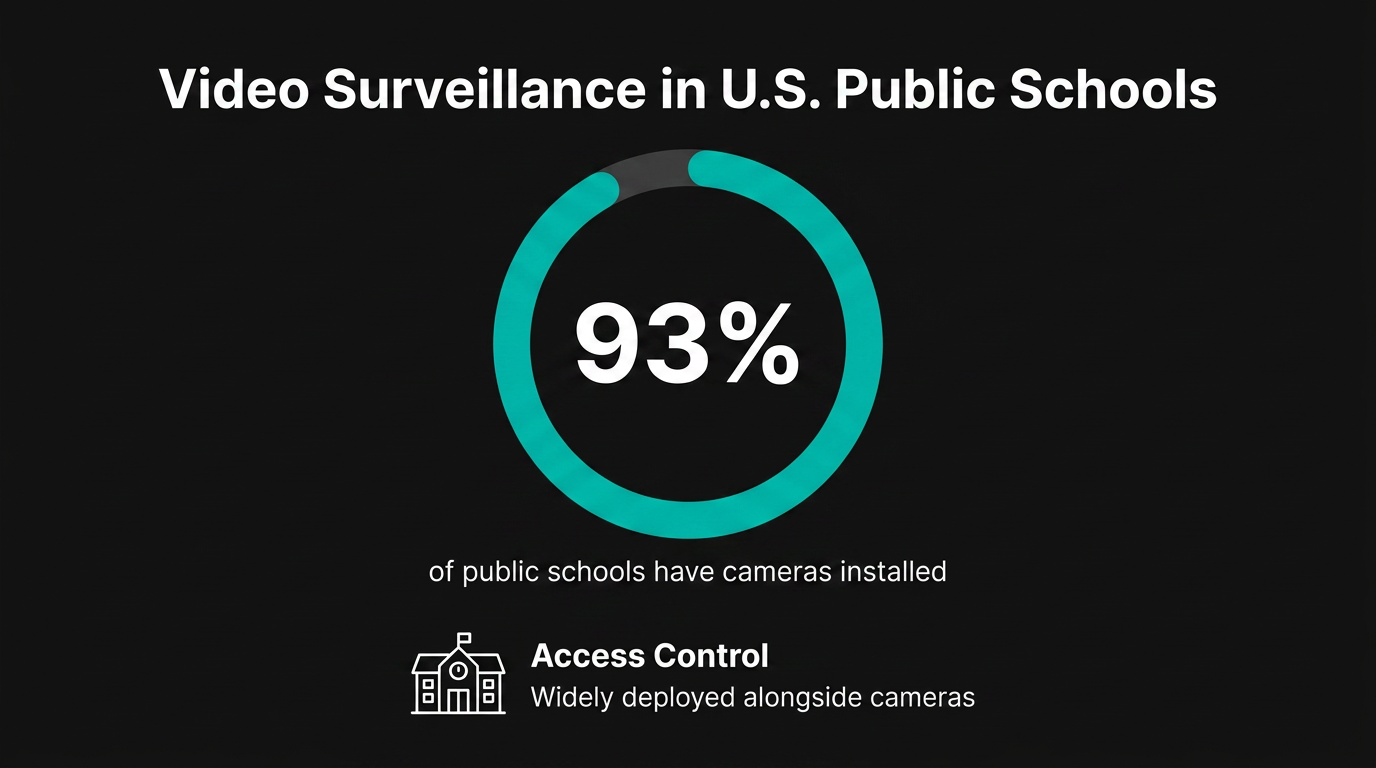
Video surveillance cameras are installed in nearly every public school in the United States. Federal data from the National Center for Education Statistics places adoption at 93%, with controlled building access widely deployed alongside cameras as a companion physical security measure.
That widespread use has not settled the operational questions security directors face. FERPA classification rules, AI-powered detection systems, and growing state-level regulation all affect how school surveillance systems are designed and governed.
Key Takeaways
- Compliance posture, not camera count, defines the maturity of a school surveillance program, with footage classification driving the district's exposure during disciplinary and disclosure events.
- Regulatory ground continues to shift beneath districts, requiring security directors to track state-level mandates as actively as they track federal guidance.
- Adopting AI detection without a sized review function transfers risk from the technology to the people expected to act on its alerts.
- Sustainable programs are governed end-to-end, aligning legal classification, operational workflows, and community trust before any expansion of coverage or capability.
Video Surveillance in Schools Explained
Video surveillance in a K-12 setting is the coordinated use of cameras, recording infrastructure, and review software to capture activity across school grounds and produce footage that staff, administrators, or law enforcement can use during and after an incident. A typical deployment covers entry points, hallways, common areas, parking lots, and the perimeter, with footage feeding a central video management system and stored on-premise, in the cloud, or across a hybrid of the two.
The category has widened considerably. Older analog systems recorded to local DVRs and were reviewed only after an event. IP-based systems now stream to networked storage, support remote viewing, and pair with software that flags specific events such as a propped door, a person in a restricted area, or a suspected weapon. School deployments sit alongside access control, visitor management, and mass notification, and their value depends on how cleanly those systems exchange information.
Security directors evaluating school surveillance work across three connected concerns. The first is legal, covering what footage can be retained and disclosed. The second is operational, covering cameras, network design, and review workflows. The third is community-facing, covering policy communication to parents, students, and staff.
FERPA and the Regulatory Framework
Most operational disputes over school footage come down to a single legal question: who is allowed to see it, and under what conditions. FERPA, the federal statute governing student records at any school receiving Department of Education funding, sits at the center of that question. It controls access, disclosure, and amendment of education records, and it treats some surveillance footage as falling inside that category and some as falling outside it.
The compliance work for security directors begins with classification: deciding whether a given recording is an education record before any request for access arrives.
When Footage Becomes an Education Record
A photo or video of a student qualifies as an education record when it is directly related to a student and maintained by an educational agency or a party acting on the agency's behalf. How footage is identified and used affects later disclosure and retention obligations, especially when footage is later used in a disciplinary process.
Misclassification, particularly when footage enters a disciplinary proceeding without appropriate FERPA controls, is a primary compliance exposure for school security directors.
Law Enforcement Exclusion and Disclosure Rules
Footage created and maintained by a designated law enforcement unit for a law enforcement purpose is excluded from the education records definition under FERPA guidance on photos and videos. If a school's resource officers operate as a law enforcement unit and maintain surveillance footage for law enforcement purposes, that footage falls outside FERPA's disclosure restrictions. A copy of the same footage provided to another school component for disciplinary use may become an education record. Districts should establish clear protocols for when and how footage transfers between law enforcement and administrative functions.
When footage is an education record, schools may not disclose it to outside law enforcement without written consent or an applicable FERPA exception, such as a health or safety emergency or a judicial order or lawfully issued subpoena. Schools must also maintain records of access requests and disclosures, subject to certain exceptions.
State-Level Mandates and Restrictions
State legislatures have added requirements that go well beyond FERPA, with several states now directing where cameras must be placed and how footage may be used.
- Texas mandates cameras in special education classrooms upon request by a parent, staff member, or administrator. Cameras must capture video and audio. Recordings must be retained for a minimum period. Footage may be used only for safety or incident review, not for teacher evaluation.
- Louisiana requires cameras in every classroom where most students receive special education services for a substantial part of the day, with an installation deadline and a minimum retention window.
- Alabama requires districts to install cameras in special education classrooms, with state funding available to districts that apply through the authorizing legislation.
- West Virginia requires cameras, upon request by a parent or staff member, in primarily self-contained special education classrooms, conditioned on appropriated state funds.
Audio capture obligations vary independently of camera mandates. All-party consent statutes in states such as California, Florida, and Illinois shape whether audio can be recorded at all, and districts in those states often default to video-only configurations outside the specific classroom contexts where state law authorizes audio.
AI Detection in School Environments
AI-powered detection is one of the fastest-growing additions to school surveillance programs, layered onto existing camera infrastructure to surface events that would otherwise go unnoticed in real time. The appeal for security directors is concrete. A camera network that previously functioned as a forensic record can now flag specific conditions as they happen, shortening the path from event to response and giving small school SOC teams a way to cover more cameras than headcount alone would allow.
Camera-based weapon detection is the most visible category. These systems analyze video frames for brandished firearms, route a still image to a human watch center for validation, and dispatch based on that review. The benefit is speed. A flagged image can reach a trained reviewer within seconds, compressing the window between sighting and lockdown decision.
Behavioral detection and crowd analytics extend the same approach to physical altercations, medical emergencies, and anomalous movement in dense areas like cafeterias and dismissal zones. The operational value is contextual awareness. A fight breaking out in a hallway, a student collapsing in a stairwell, or an unusual gathering near a perimeter gate can surface as an alert rather than waiting for a staff radio call.
Across both categories, human review remains the operating principle. Simple binary alarms such as door-held or motion-detected events already add workload in school SOCs, and AI-generated alerts compound that load when they trigger without enough context. Districts that size watch-center capacity, define response protocols, and document review obligations before expanding detection coverage capture the upside of these systems without inheriting an unmanageable alert queue.
System Architecture for School Deployments
A school video surveillance system operates across interdependent layers: capture (cameras), network (IP infrastructure and PoE switches), processing (VMS and edge analytics), storage (on-premise, cloud, or hybrid), and integration (access control, mass notification, intrusion detection). For districts still operating analog equipment, the decision to upgrade typically triggers a broader architectural evaluation across each of these layers.
Camera Selection by Environment
Camera selection depends on the specific environment. Wide dynamic range cameras handle the bright-to-shadow transitions common in school lobbies and libraries. Fisheye or 360-degree cameras cover large open spaces like gymnasiums and cafeterias with fewer devices. Bullet cameras with zoom serve perimeter and parking lot coverage. PTZ cameras provide active tracking for large outdoor areas.
VMS Selection Criteria
The VMS is the operational core of the system. The most important capabilities for campus deployments include open platform architecture that avoids single-vendor lock-in, scalability that addresses configuration and maintenance burden alongside camera count, remote management for multi-site coordination, health monitoring for camera and server status, and redundant recording with failover protection.
For multi-building campuses, a federated server architecture is a common approach for scaling video surveillance across multiple buildings or sites. Dedicated servers at each site feed a central interface, allowing security staff to manage distributed cameras from one location.
Storage and Network Considerations
On-premise storage offers full local data control but requires dedicated IT staff and higher capital costs. Cloud-based video surveillance as a service (VSaaS) reduces hardware burden and appeals to districts with thin IT teams. Hybrid models split critical footage between local servers and cloud archives.
Network design must account for bandwidth requirements, particularly when remote viewing or managed video services require upstream capacity for simultaneous streams at different resolutions.
Privacy, Bias, and Community Concerns
Privacy concerns around school surveillance carry operational weight. They affect policy sustainability and stakeholder trust, and in several jurisdictions, they have produced binding legal restrictions. Biometric identification systems can show systematic demographic performance differences, and technical improvements do not resolve the separate question of when such systems should be used and how results should be interpreted.
School surveillance can affect discipline and trust in different school environments. Pre-deployment community engagement and transparent policy communication are risk mitigation strategies, not optional public relations exercises.
Implementation Best Practices
The Partner Alliance for Safer Schools (PASS) Safety and Security Guidelines organize school security across physical layers, including district-wide coordination and digital infrastructure protection. Video surveillance is one integrated component within each layer, not a standalone system.
Planning and Assessment
A formal security assessment should precede any camera procurement. PASS specifies that assessments examine all physical layers and that districts establish district-wide standards before addressing individual school needs. Without clear objectives, equipment selection and placement decisions lack direction. Security priorities can vary by school setting and risk profile.
Camera Placement Priorities
Entry and exit doors should be included in camera placement planning. Parking lots and vehicle areas require cameras capable of capturing readable license plate images. High-traffic common areas, including hallways, cafeterias, and gymnasiums, should be covered based on both traffic volume and incident history. Cameras must never be placed in bathrooms or locker rooms.
Every school has a unique floor plan. Staff input on incident-prone areas should inform placement decisions alongside architectural analysis.
Policy, Training, and Integration
A complete surveillance policy must address purpose, permitted and prohibited placement locations, access permissions, retention and secure disposal procedures, FERPA classification protocols, parental notification requirements, and an annual review cycle.
Staff training is as consequential as the technology. Required scope includes FERPA compliance for footage classification and disclosure, real-time alert response procedures, data privacy, and implicit bias awareness. Districts should also decide, and document in policy, whether cameras will be monitored in real time or reviewed forensically after incidents.
Schools should partner with their local emergency communications center to enable rapid sharing of surveillance video during emergencies. After-action reviews with first responders following both exercises and real events should be standard operating procedure.
Federal Funding for Surveillance Upgrades
FEMA's Nonprofit Security Grant Program funds cameras and physical security monitoring for qualifying nonprofit organizations, including private and independent schools. FEMA published the Fiscal Year 2025 funding opportunity for the Nonprofit Security Grant Program in July 2025, with the FY 2026 NOFO expected to follow FEMA's typical late spring or summer release pattern.
The program prohibits expenditure on equipment from prohibited manufacturers, a hard procurement constraint that security directors must verify before specifying equipment. Districts planning a multi-year surveillance upgrade should track NOFO releases against their procurement calendar so vulnerability assessments and investment justifications are ready when the next cycle opens.
Where School Surveillance Stands
Video surveillance is widely used in U.S. schools, with practical value primarily for incident reconstruction after an event. FERPA classification decisions carry real compliance consequences, and state legislatures continue to add mandates and restrictions. For security directors, the practical task is to align technology decisions with policy,staffing, and governance before expanding camera coverage or detection use.
Frequently Asked Questions about Video Surveillance in Schools
Should school cameras capture audio along with video?
Audio recording introduces wiretap and eavesdropping considerations that vary by state and may require additional consent. Most district policies limit audio capture to settings where state law specifically authorizes or mandates it, such as certain special education classrooms.
How long should districts retain surveillance footage?
Retention should be set in policy and tied to investigative usefulness rather than storage convenience. Districts typically establish a default retention window with longer holds applied to footage tied to incidents, litigation, or open records requests, and shorter cycles for routine recordings.
Can parents request access to footage that includes their child?
Footage classified as an education record is generally subject to parental inspection rights under FERPA, but disclosure becomes complicated when other students appear in the same frame. Districts often redact or blur additional students before releasing footage to a requesting parent.
