Warehouse Access Control: Protecting Inventory and Staff
Learn how warehouse access control protects inventory, manages dock risk, and keeps staff safe through zoning, credentials, and verified entry.
Warehouse access control governs who can physically enter a logistics facility and which spaces they can reach once inside. In a warehouse, that decision has to work in a fast-moving environment where people and vehicles constantly cross controlled boundaries, and inventory moves through those same points.
Security directors who treat a warehouse like an office building with bigger doors leave critical entry points under-controlled. Getting the program right protects inventory and keeps unauthorized people away from active operations. It also gives security leaders a defensible record of who entered controlled space.
Key Takeaways
- Warehouse access control manages physical entry across gates, docks, employee entrances, and interior zones, a wider problem than office entry management and a separate discipline from warehouse management software.
- Least-privilege zoning, from the perimeter fence to the high-value cage, limits each person to the areas their role requires.
- Behavioral detection at docks and entrances catches tailgating and held-open doors that badge readers alone cannot see, and human verification before dispatch keeps operators focused on genuine incidents.
- Constant workforce churn makes disciplined credential deprovisioning, recurring access reviews, and routine tailgating tests as important as the hardware itself.
What Warehouse Access Control Is
A physical access control system (PACS) decides who gets into a facility and which interior spaces they can reach. That decision set is wider in a warehouse than in an office. An office moves a badge-carrying employee population through a lobby. A distribution center handles mixed populations coming through gates and pedestrian doors, with overhead dock doors adding another controlled boundary on top. The hardware behind those overhead doors is usually separate from the pedestrian access hardware.
A PACS is not a warehouse management system (WMS), and the two shouldn't be confused. A WMS runs goods workflows: receiving, storage, picking, and shipping. A PACS controls who reaches the spaces where those goods sit. Badge data can help an inventory investigation, but the WMS tracks the goods and the PACS tracks the doors.
Why Entry Control Drives Loss Prevention
Warehouses sit at the sharp end of cargo-theft risk because product and vehicles converge at the same boundary, with shipping documents close at hand. Cargo theft losses in the U.S. and Canada reached nearly $725 million in 2025 as organized groups shifted toward high-value shipments, and stolen goods move quickly through distribution networks once they leave the yard.
Insider risk compounds the external threat. A worker or driver with more access than the role requires can stage product near a dock or hold a door for an accomplice. Inventory can also leave through an uncontrolled exit.
And the same uncontrolled entry points that admit thieves endanger workers: a facility that cannot say who is inside cannot separate pedestrians from powered equipment or account for staff during an evacuation.
Zoning the Facility for Least Privilege
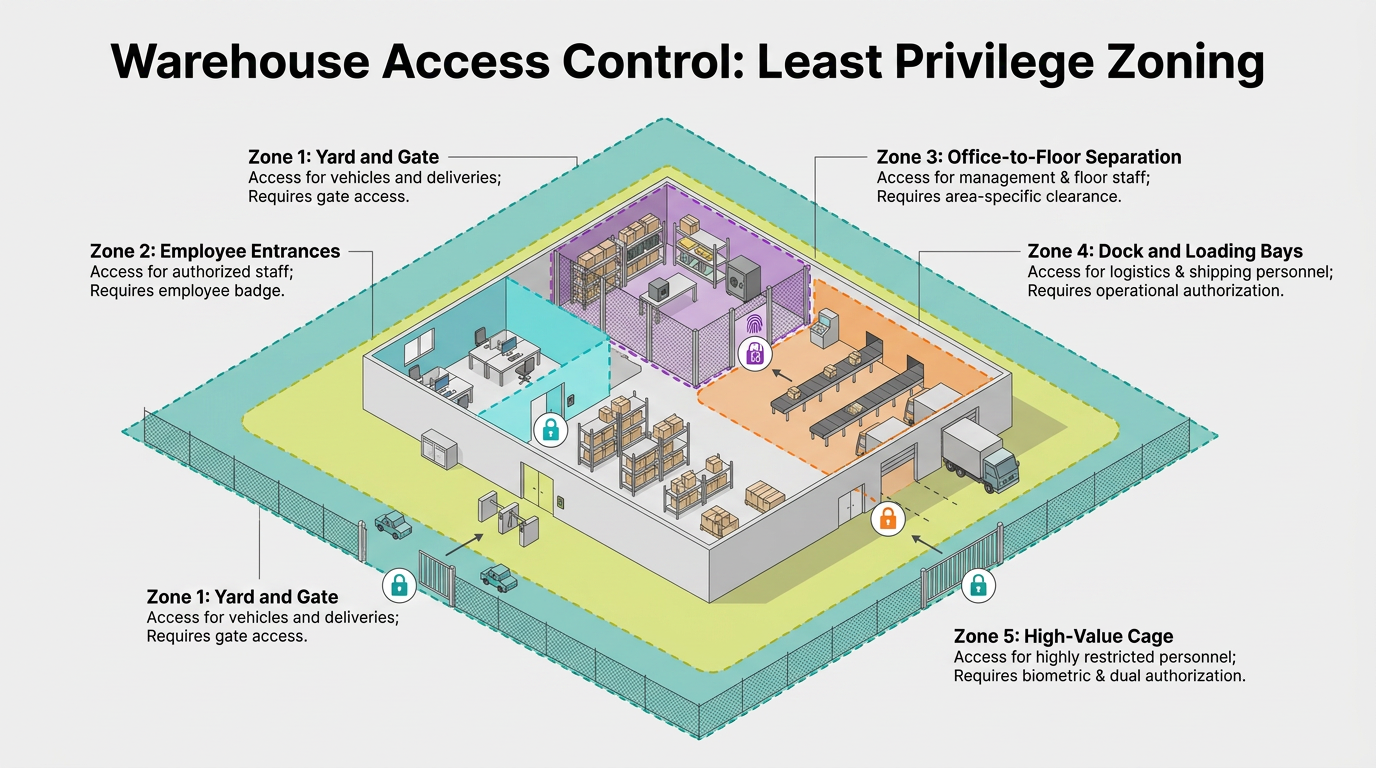
Employees should receive access only to the secure areas their duties require, a rule reflected across Customs Trade Partnership Against Terrorism (C-TPAT) and Transported Asset Protection Association (TAPA) expectations. Apply it by dividing the warehouse into nested zones.
- Yard and gate. Perimeter fencing should enclose the entire truck yard, and gates must be manned or monitored, with the number of gates kept to the minimum necessary.
- Employee entrances. Positive identification at every point of entry, with badge issuance and removal controlled and documented.
- Office-to-floor separation. Administrative staff badge onto the floor only when their role requires it; the doorway between office and racking is a controlled portal.
- Dock and loading bays. TAPA's Facility Security Requirements (FSR) restricts dock and warehouse access to authorized workforce and escorted visitors with a business need.
- High-value cages. Caged or hard-walled on all sides including the roof, with a locked gate, camera coverage of the entrance and interior, and a logged access list.
Credentials, Anti-Passback, and Escort Rules
Credential strength should scale with the zone. Badges handle general entry; high-value cages and other sensitive areas justify a PIN or biometric check as an added factor, ideally using an authentication method different from the one at the perimeter. Biometric readers on a warehouse floor must tolerate gloves and dust during continuous operation, a harder environment than an office lobby.
Anti-passback closes a common hole: a badge admitting several people in sequence. Once a credential passes an "in" reader, the system refuses another "in" until that credential passes an "out" reader. Anti-passback should stay active unless a clear business need can be identified. For the most sensitive spaces, layer in human controls: monitored airlocks for escorted visitors and large items that need controlled movement, with escort requirements for anyone without standing access.
Dock, Driver, and Vehicle Access
The dock carries the highest risk because it is designed to be opened. Control starts at the gate, where guards or automated systems check each trailer in, verify the driver's identification, and positively identify drivers before cargo is received or released. Pre-registered driver and vehicle records, matched to the shipment, can support more consistent gate check-in workflows.
Inside the fence, a yard management system tracks which trailers are present and how long they have been there. It also shows whether each trailer has permission to be there.
At the dock face, loaded trailers bound for the U.S. under C-TPAT must carry a high-security seal meeting ISO 17712. Gate staff verify the seal by viewing the seal and locking mechanisms and checking the number against shipment documents. They then tug and twist to confirm engagement.
Gate staff should treat drivers without standing access as visitors or service providers: they verify identity, log the visit, issue visible badges, and assign escorts when drivers need to move beyond the gatehouse.
Visitors, Contractors, and Temporary Labor
Warehousing separations churn a large share of the workforce each year, and every departure is a credential that must die on time. C-TPAT members must maintain written procedures governing how badges and access devices are granted, changed, and removed, with removal at separation.
For visitors and contractors, that translates to a consistent set of controls at every arrival:
- Photo identification and a log at arrival. Verify identity against a government-issued ID and record the visit before entry.
- Escorted movement. Assign an employee escort for any area beyond the reception or gatehouse.
- Visibly displayed temporary badges. Issue distinct visitor credentials that staff can spot at a glance.
- Time-boxed credentials. Set expiration to the engagement window so access ends without manual action.
Security teams should apply the same screening rigor to temporary labor as permanent staff, and procurement and security leaders should hold contracted providers not eligible for C-TPAT participation to the same minimum security requirements by contract.

Monitoring and Verifying Every Entry
Video Verification
A badge reader confirms a credential, not the person using it. Video at docks and gates closes that gap, and employee entrances need the same coverage. The detection layer behind the video decides whether footage is useful in real time or only after a loss. Pixel-based motion detection triggers on any frame change, so headlights, a passing forklift, and a tailgater all generate the same alert.
Reasoning-based video intelligence interprets people, vehicles, and objects together with scene context, distinguishing routine activity from a genuine threat. A driver walking from the gatehouse to the waiting room reads as routine. The same driver slipping through a pedestrian door behind a badged employee reads as tailgating and surfaces as an alert with the clip attached.
Alarm Context
The access system adds signals through door forced open (DFO) and door held open (DHO) alarms, which must activate when a door is held or forced under TAPA's FSR. Pairing those alarms with video lets a Global Security Operations Center (GSOC) operator verify an event before dispatching a guard.
Verification is strongest when PACS events stay connected to video and camera data. A door event should pull up the matching camera view, recent badge history, and any open alarms, letting the operator see whether the credential matches the person and behavior at the portal. That context keeps routine deliveries from triggering dispatches and keeps forced doors or tailgates out of a generic alarm queue.
Access Control as a Staff Safety System
Forklift-related incidents can be fatal, and National Institute for Occupational Safety and Health (NIOSH) guidance calls for clear separation of pedestrian and forklift pathways. Access control enforces that separation at the door, routing pedestrians onto marked walkways and keeping untrained staff out of powered-equipment aisles.
One constraint cuts the other way: the Occupational Safety and Health Administration (OSHA) exit route rule requires exit doors to be free of any device that could restrict emergency use if it fails, so access hardware on exit routes must use fail-safe operation.
Badge data also supports evacuation. When readers log who entered which zone, a muster process can compare those records against check-ins at assembly points and flag anyone unaccounted for, replacing clipboard headcounts with live data.
Audit Logs That Hold Up in an Investigation
Every access event should identify the credential used at a specific portal and time. A complete log captures the full range of activity at each door:
- Successful entries. Credential, portal, and timestamp for every granted access.
- Failed attempts. Denied reads, invalid credentials, and out-of-schedule tries.
- Forced doors and held-open events. DFO and DHO alarms tied to the specific portal.
- Badge issuance and deactivation. Provisioning and removal actions with the responsible administrator recorded.
- Visitor escort assignments. The escort's credential linked to the visitor's temporary badge.
Logs earn their cost during investigations. When shrink surfaces weeks after the fact, pulling a specific date's dock-door records within minutes, and corroborating them with retained video, separates a resolved case from a write-off. Security teams should set retention windows against investigation timelines, because operations teams often discover losses long after footage would roll off a short retention cycle.
Review logs on a schedule and conduct separate reviews after incidents; repeated failed attempts at a high-value cage or badge activity outside an employee's shift pattern are pre-incident indicators.
Testing and Maintaining the Program
Access control decays without maintenance, and turnover accelerates the decay. TAPA's FSR requires dock and warehouse access lists to be reviewed on a recurring schedule, and C-TPAT members must maintain a routine full security profile review.
Between reviews, run tailgating tests: unannounced attempts to follow employees through controlled doors at varied times and entry points reveal whether detection and staff challenge procedures actually work.
Deprovisioning deserves its own drill. Simulate an immediate termination, measure how long the badge stays live, and test whether the departed credential still opens anything. Orphaned credentials accumulate in the gap between churn velocity and offboarding discipline; access-list review and removing individuals when access is no longer required are physical access controls.
Where to Start Strengthening Warehouse Entry
Map the zones, then audit who can actually reach each one; the gap between those two lists is the program's real risk register. Prioritize the dock and the gate, since they carry vehicle traffic and the heaviest theft exposure, then confirm that credential removal keeps pace with turnover.
A facility where every entry is credentialed and verified on video, with the event logged, gives security leaders the same visibility over people that operations already expects over goods.
Frequently Asked Questions
How does anti-passback work in a warehouse environment, and what are the business cases where it might need to be disabled?
Anti-passback tracks credential state across reader pairs, preventing reuse at entry until exit registers departure. Disable sparingly for shared equipment badges, emergency muster, or maintenance crews using communal credentials, always with compensating video monitoring and time-limited exceptions.
What is the difference between a physical access control system (PACS) and a warehouse management system (WMS), and how do they work together during an inventory investigation?
A PACS controls entry and movement through secure zones, while a WMS manages inventory workflows like picking and shipping. During investigations, the WMS flags goods discrepancies, and PACS badge logs reveal which individuals accessed those locations during relevant timeframes.
How should warehouse security teams handle credential deprovisioning for temporary labor and high-turnover positions to prevent orphaned badge access?
Automate credential expiration tied to contract end dates in the access system, require manager sign-off before badge extension, and run weekly audits comparing active credentials against current HR rosters to catch deprovisioning failures before they accumulate across turnover cycles.
