How Physical Identity and Access Management (PIAM) Works
PIAM governs who holds physical access, automates joiner-mover-leaver workflows, and keeps credentials current across every connected PACS site.
Physical identity and access management (PIAM) is the software layer that governs physical access permissions across facilities. Security leaders responsible for enterprise workplaces usually inherit access programs that grew site by site and process by process. PIAM sits above that complexity as a single governing authority. The strength of that layer determines whether an access program can prove that access is appropriate, current, and controlled.
Key Takeaways
- PIAM sits above PACS and IAM, deciding whether a given badge should exist based on a person's verified identity, role, and current status in HR.
- When HR marks someone as terminated, a single event should deactivate that person's credential in every connected PACS the same day and leave an audit trail behind it.
- Mover workflows are where most programs quietly fail: new access has to be granted and old access removed in the same transaction, or employees accumulate rights they no longer need.
- Even a well-run PIAM program cannot see a shared badge or a tailgated door on its own, so door verification and video analytics still carry the last mile of enforcement.
What PIAM Is and How It Differs from PACS and IAM
PIAM automates onboarding workflows for every identity type an organization issues and confirms that the right identity receives the right level of access to the right areas for the right duration. That places it above two systems most security leaders already run.
A physical access control system (PACS) controls entry at the door: readers, panels, credentials, locks. Logical identity and access management (IAM) administers digital identities, governing who can log into which applications and networks. IAM and PACS leave a governance gap. An IAM platform can cut a terminated employee's application access instantly, yet its view ends before the data center badge. A PACS knows which badge opens which door. Security teams still need to know whether that badge should exist.
PIAM sits between them. It decides what physical access a person's verified identity, role, and the organization's policies justify, and whether that access is still current and compliant. PIAM is primarily an industry term; in federal contexts, the same work may be described through PACS, identity, credential, and access management (ICAM), and identity-lifecycle architecture terminology.

The Problems PIAM Solves
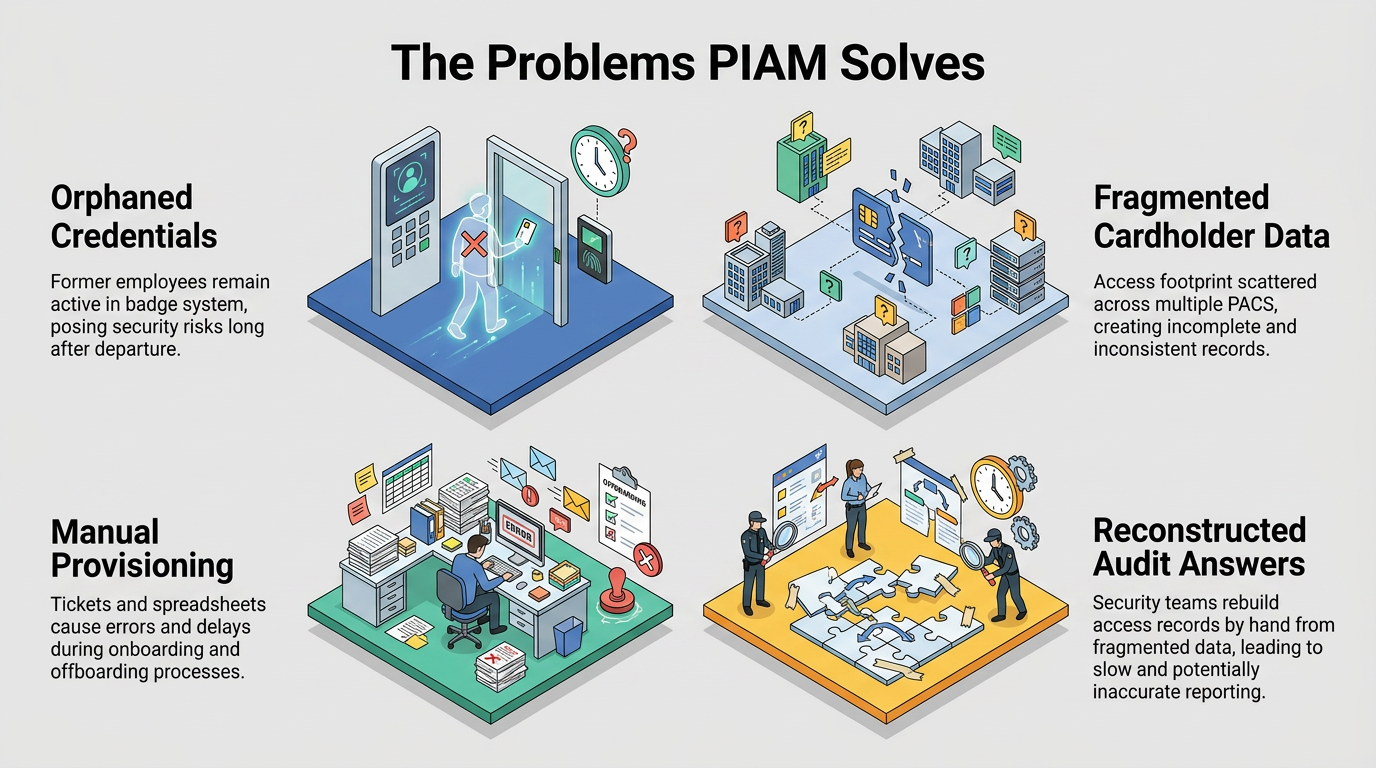
Orphaned credentials are the clearest example. A Department of Energy (DOE) Inspector General audit confirmed the failure mode: former federal and contractor employees who had left the department remained active in the badge control system.
Beyond orphaned credentials, three related problems recur across enterprise access programs:
- Fragmented cardholder data. In multi-PACS environments, each site's PACS keeps its own cardholder database, so a person's full access footprint can be scattered across systems no one can query in one place.
- Manual provisioning. Provisioning runs on tickets and spreadsheets, which produces errors at onboarding and, worse, at offboarding.
- Reconstructed audit answers. When an auditor asks who can enter a given area and why, security teams often have to reconstruct the answer by hand from siloed systems.
How PIAM Works as an Orchestration Layer
The PACS keeps controlling doors while PIAM supplies authoritative data about who belongs inside. A mature identity-lifecycle pattern designates human resources (HR) systems as the source of truth for identity creation and termination. It also uses identity governance tooling to build one master user record that links each person's credentials and access entitlements. HR holds the most reliable record of a person's status: active, on leave, suspended, or deactivated.
When HR registers a hire or later status change, PIAM translates the event into provisioning or deprovisioning in each downstream system. PACS should integrate with the enterprise identity and credentialing infrastructure, so credential information provisions automatically and access policies stay consistent across sites.
The Identity Lifecycle from Joiner to Leaver
At hire, PIAM provisions role-based access, so credentials work on the first day and reach only what the job requires. Watchlist or background screening can gate enrollment before the organization issues any credential.
Role and location changes are where programs quietly fail. Mover workflows must grant new access and remove old access in the same transaction. Authorization creep occurs when employees accumulate rights from previously held positions because additions get processed and removals never do. Automated mover workflows remove the prior role's entitlements at the moment the new ones apply.
Offboarding tests whether HR status changes reach every PACS by the departure deadline. The Cybersecurity and Infrastructure Security Agency (CISA) Cybersecurity Performance Goals call for revoking and collecting physical badges, key cards, and tokens, and disabling accounts, by the day of departure. PIAM meets that bar by acting on the HR termination event directly. One trigger deactivates the credential in every connected PACS and logs the action for the audit trail.
How the Policy Engine Decides Who Gets Access
A policy engine evaluates every entitlement against defined logic. Role-based access control (RBAC) assigns permissions to roles rather than individuals. A finance analyst role might carry lobby, office floor, and records room access; anyone in the role inherits exactly that set, which enforces least privilege.
Roles alone cannot express conditions like time or location. Attribute-based access control (ABAC) evaluates attributes of the subject, the object, the requested operation, and environment conditions such as time, location, and threat level. In physical terms, a contractor's badge works at the loading dock during the project window on weekdays, and nowhere else. Rule-based conditions can layer similar constraints onto role baselines, and enterprise deployments can combine the approaches.
Area owners approve access to their own spaces, so server room requests route to IT and warehouse requests route to operations rather than through a central badge office. Segregation-of-duties policies flag conflicting privilege combinations and can keep the person who authorizes access separate from provisioning it.
Access Requests, Approvals, and Self-Service
A requestor initiates an entitlement request; the requestor may be the person, their supervisor, HR, or a security team member, and an approver compares it against access requirements and business need before granting it. Multi-step approvals add area-owner sign-off for sensitive zones.
Requests can also chain to operational systems. In a work-order-driven workflow, closing the work order can automatically remove the technician's access authorizations, so temporary access expires with the task rather than with someone's memory. Self-service portals move routine requests out of the badge office: employees submit and track requests online, and managers approve from a queue.
One Policy Framework for Every Identity Type
Contractors, vendors, visitors, and tenants turn over faster and with weaker oversight than employees, and a separate manual process for each population is where governance breaks down. PIAM applies the same unified policy framework to all of them; only the rules differ.
Contractor access is time-bound to the engagement and often gated by screening. Chemical facilities regulated under the Chemical Facility Anti-Terrorism Standards (CFATS) must complete background checks, including terrorist-ties vetting through the personnel surety program, before granting unescorted access to restricted areas.
Visitor policies encode escort requirements and expiration rules, along with entry and exit logging. In multi-tenant buildings, centralized multi-tenant control lets each tenant control its own space while central policy governs shared areas. In every case, one record holds the identity, its sponsor, its screening status, and its expiration date.
Integrations and Interoperability Standards
Connectors link PIAM to PACS and to related identity and visitor management systems. Typical integration targets fall into two categories:
- Identity side. Human resources information systems (HRIS) such as Workday and SAP SuccessFactors, and directories and identity providers including Active Directory.
- Physical side. Multiple PACS vendors and visitor management platforms.
Interoperability work helps normalize create, read, update, and delete operations on user records across domains. It can also support the movement of identities and roles from a logical directory to one or more compatible PACS. Reader-to-controller communication is another interoperability concern, especially where legacy Wiegand wiring remains in use.
Compliance Requirements PIAM Automates
The compliance requirements below map to outcomes PIAM delivers rather than to the product category itself.
- NERC CIP-004. The North American Electric Reliability Corporation (NERC) Critical Infrastructure Protection (CIP) standard CIP-004 requires electric utilities to run reviews comparing who is actually provisioned against who is authorized, and to begin revoking unescorted physical access within 24 hours of a termination for cause.
- HIPAA physical safeguards. The Health Insurance Portability and Accountability Act (HIPAA) physical safeguards in the Code of Federal Regulations (CFR) at 45 CFR § 164.310 require covered entities to limit physical access to facilities housing electronic protected health information, with addressable specifications for access control and validation procedures, including visitor control.
Scheduled access certification campaigns route each area's access list to its owner for attestation. A well-configured PIAM program records approvals and revocations as part of each provisioning decision, so when an auditor asks for evidence of entitlement decisions and remediation over time, the platform can support the report rather than forcing the security team to reconstruct it. Because the evidence is tied to each identity record, the same report can show the approver, policy basis, date, affected area, and downstream system where the entitlement was last changed.
The Governance Loop That Keeps Entitlements Honest
National Institute of Standards and Technology (NIST) Special Publication (SP) 800-53 control PE-2 physical access requires maintaining the authorized facility access list, reviewing it at a defined frequency, and removing people when access is no longer required.
That means reviews with recorded decisions, deprovisioning that meets separation deadlines and applies the same urgency to role changes, and policy updates when a reorganization or review surfaces over-provisioning. Each audit cycle then tests whether the loop actually ran, using the trail PIAM produced.
Where PIAM Stops and Verification Begins
PIAM governs access entitlements. Door verification confirms whether the person presenting a credential is its rightful holder. Door authentication can check a credential alone or pair it with another factor such as a PIN or biometric. A revoked identity can be removed through connected downstream systems under PIAM; security teams may need door verification to detect a shared or borrowed credential, or a tailgated door, because PIAM alone may not flag those events as policy violations.
Security teams use video to verify events that readers cannot confirm. Video review and analytics can help investigate tailgating when the initial entrant used the access control system properly, and behavioral analytics can surface patterns that may indicate credential sharing or repeated access attempts outside normal work patterns.
Treating Physical Access as an Identity Problem
Treating physical access as identity data gives security leaders a practical governance test. How long does a termination take to reach every door? And can an access list for any sensitive area be produced, with justifications, on demand? The answers show how much governance the current stack actually provides.
Frequently Asked Questions
How does PIAM handle mover workflows to prevent authorization creep when employees change roles or departments?
PIAM handles mover workflows by executing role transitions as atomic operations, processing new entitlements and old removals simultaneously within a single transaction. This prevents additions from executing while removals stall, ensuring employees cannot retain accumulated privileges from prior positions.
What is the difference between PIAM and PACS, and why do organizations need both systems?
PACS controls physical entry at the door through hardware like readers and locks, while PIAM governs who should have access based on verified identity and role. PACS enforces access decisions but cannot determine whether those decisions remain valid as personnel status changes.
What compliance standards like NERC CIP-004 and HIPAA require automated physical access deprovisioning, and how does PIAM help meet those requirements?
PIAM centralizes deprovisioning workflows so HR termination events can automatically trigger credential revocation across connected systems, with revocations subject to propagation windows at edge controllers. This automation produces timestamped audit trails that demonstrate compliance with revocation deadlines and access review requirements, eliminating the manual reconstruction auditors otherwise require.
