Data Center Access Control: Securing Critical Facilities
Learn how data center access control works, from layered zone models to authentication factors, audit logging, and framework compliance.
Data center access control determines who can physically reach the servers and supporting infrastructure on which an organization's operations depend. Office badge systems mostly guard people and property, while data center access control safeguards the continuity of critical services.
The stakes are concentrated. A single unauthorized person inside a data hall can pull drives or trigger an outage that cascades across the business, which is why corporate security leaders need disciplined, auditable control over entry and exceptions.
Key Takeaways
- Data center access control governs physical entry through concentric zones, from the property perimeter down to the individual rack, with least-privilege permissions mapped to each layer.
- A valid badge read confirms only the credential, which is why sensitive zones require multiple authentication factors and video verification of every entry event.
- Visitor, vendor, and contractor entry demands pre-registration, time-boxed credentials, mandatory escorts, and complete logging to satisfy auditors across every major framework.
- Programs decay without scheduled recertification reviews, tailgating tests, and post-incident policy revision, so the maintenance loop deserves the same investment as the hardware.
What Data Center Access Control Governs
Data center access control combines written rules with the hardware controls and operating procedures that grant or deny physical entry to a critical facility and the zones inside it. Its scope extends beyond people to the equipment and media moving in and out of a room, plus the wiring, electric power service, cooling plant, and data lines the systems depend on. That breadth separates it from office access control, which rarely reaches past doors and elevators.
It is also distinct from logical access control, which governs accounts and permissions on systems and networks. The two depend on each other. An intruder with physical access to a server can reboot it and bypass logical controls entirely, so physical entry is the layer on which every software safeguard rests.
Risk Assessment Comes Before Hardware
Every control decision should trace to a documented threat, and the data center threat set is specific:
- Tailgating and piggybacking. Tailgating occurs when an unauthorized person follows an employee through a door without their knowledge; piggybacking involves employee cooperation. Both defeat a reader without touching it.
- Insider misuse. Authorized access used, intentionally or unintentionally, to harm the facility or its systems.
- Theft and sabotage. Drive and hardware theft alongside sabotage of power and cooling systems.
- Social engineering. Manipulation of reception staff to gain unauthorized entry.
- Vendor and supply-chain access. Maintenance contractors routinely reach spaces employees never enter.
Why Insider Risk Warrants Extra Weight
Insider risk deserves particular weight because it is, by definition, misuse of legitimate access. Zone restrictions and monitoring are required because credentials alone cannot stop insider misuse.
Budget pressure raises the stakes: physical protections at many data centers remain constrained to 5% or less of overall build budgets. A rigorous risk assessment tells security directors where that limited spend must concentrate.
The Layered Zone Model
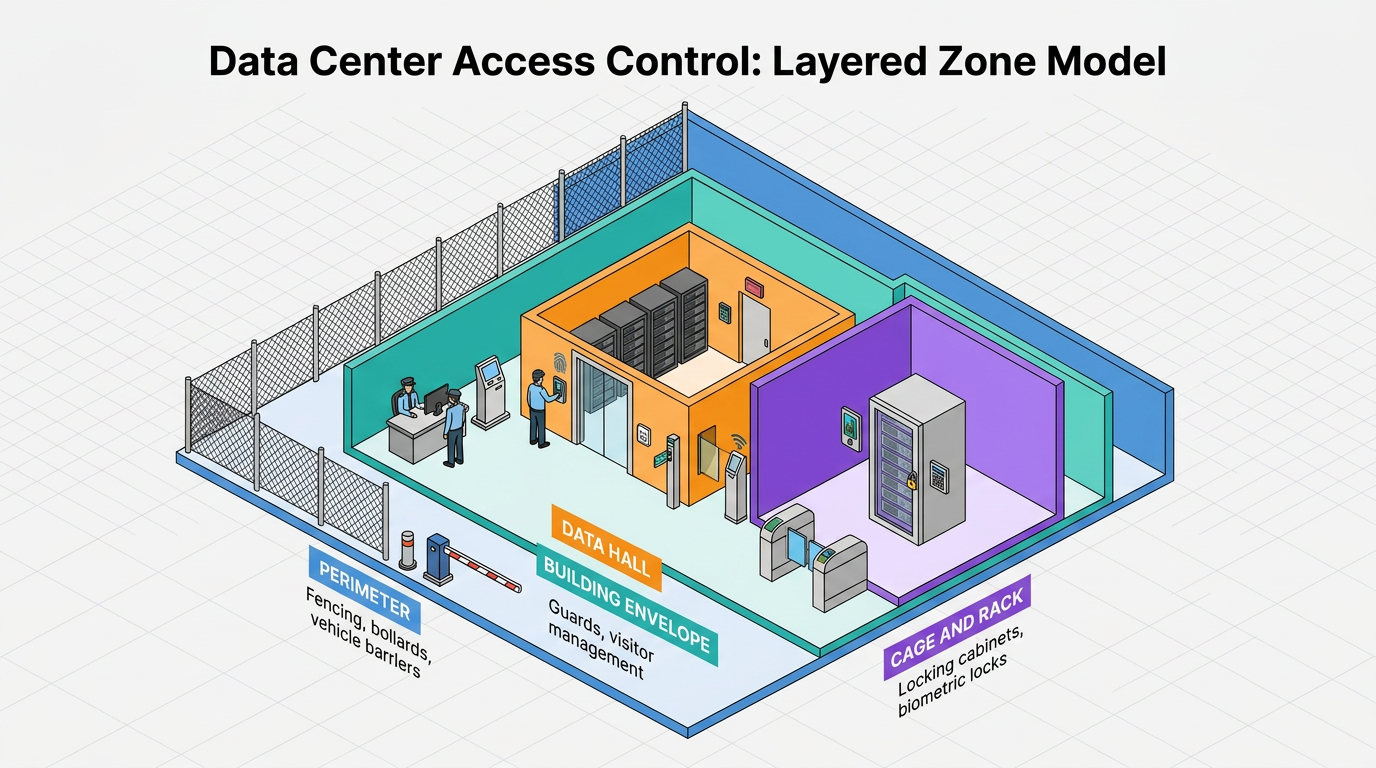
American National Standards Institute/Telecommunications Industry Association (ANSI/TIA)-942, the primary standard for data center design, organizes physical security into four layers: perimeter security, facility controls, computer room controls, and cabinet controls. The model works as a box inside a box. An attacker must defeat each layer separately, and the inner layers must also guard against insiders who were authorized to pass through the outer ones.
- Perimeter. Fencing, vehicle barriers, bollards, lighting, and surveillance at the property boundary, with visitor and employee parking physically separated at higher rating levels.
- Building envelope. Guards and reader-backed visitor management controlling every entry point into the shell.
- Data hall. Entry on a need-to-enter basis, with stronger authentication and physical entry controls at the door.
- Cage and rack. Locking cabinets and cage systems, with rack-level readers or biometric locks protecting individual customers or workloads.
Least privilege maps directly onto these zones. A practical three-tier model divides space into controlled, limited, and exclusion areas. Each tier demands stronger authentication than the last. In practice, a shift engineer may hold data hall access without keys to customer cages, while office staff never pass the building envelope at all.
Credentials and the Verification Gap
A badge read proves possession of a credential, nothing more. Under Federal Information Processing Standards (FIPS) 201-3, authentication provides a degree of confidence that the presenter is the person the credential was issued to, never certainty.
That gap between badge and body is why data centers stack authentication factors and pair every reader with a camera. Behavioral video context closes the gap by confirming the person and headcount behind each valid read, along with the activity that followed.
Authentication Factors and Their Limits
Legacy proximity cards still leave the system verifying a credential rather than the person holding it. PINs add a knowledge factor but can be observed or shared. Biometric identification binds the credential to a body, yet it still should not be treated as a stand-alone control for exclusion areas.
Authentication should scale factors to sensitivity: one factor for controlled areas, two for limited areas, and three for exclusion areas, with an attendant present during biometric checks at the highest tier.
Anti-Passback and Escort Rules
Anti-passback blocks a credential from entering twice without an intervening exit, which stops an employee from badging in and passing the card back to a second person. It governs badge logic only. A tailgater presents no credential and therefore generates no violation, which is why anti-passback needs video coverage alongside it.
Escort rules cover the people who hold no standing access: escort-only badges grant no reader privileges, visitors stay with pre-approved escorts who observe their activity, and the asset owner authorizes unescorted access only for documented business need and revokes it when that need ends.
Entry Hardware and Where It Belongs
An access control vestibule, or mantrap, is a space between two interlocking doors designed to keep unauthorized individuals from following authorized ones into controlled space. Each entry mechanism belongs at a specific layer:
- Full-height turnstiles at the perimeter fence line deter intrusion and force single-person passage at the site boundary.
- Optical turnstiles at the building lobby use sensor arrays that can distinguish two people from one person with a rolling bag. They alert on a tailgate rather than physically stopping it, so they belong at staffed entrances where a guard can respond.
- Mantraps and anti-tailgating portals at the data hall boundary enforce single entry with overhead sensors. Portals suit facilities where floor space or throughput rules out a full dual-door vestibule.
Visitor, Vendor, and Contractor Access
Visitor controls for sensitive data center areas should start with a documented baseline: visitors authorized before entry, escorted at all times in sensitive areas, and issued expiring badges that visibly distinguish them from personnel and cannot be reused.
Security directors should extend that floor with pre-registration, background screening for contractors holding recurring access, and temporary credentials issued for one-time use or a strictly limited period.
Every entry gets logged with name, organization, sponsor, form of identification, purpose, and both entry and departure times. Critical-facility procedures often go further. They restrict access to pre-approved, sponsored, and escorted visitors only. Guards record serial numbers of computers entering and exiting.
Monitoring Every Access Event
Every controlled door should carry camera coverage so operators can visually verify each badge event. Door forced open (DFO) alarms fire when a door opens without a credential read; door held open (DHO) alarms fire when it stays open past a programmed interval, which often signals a propped door. The access controller knows only that the door opened, not how or by whom.
Video gives operators that context, and the global security operations center (GSOC) should confirm through video before dispatching a guard or requesting law enforcement. Escalation logic then routes confirmed events by severity, from a roving guard for a held door to immediate response for after-hours data hall entry.
Rule-Based Alerts Versus Behavioral Context
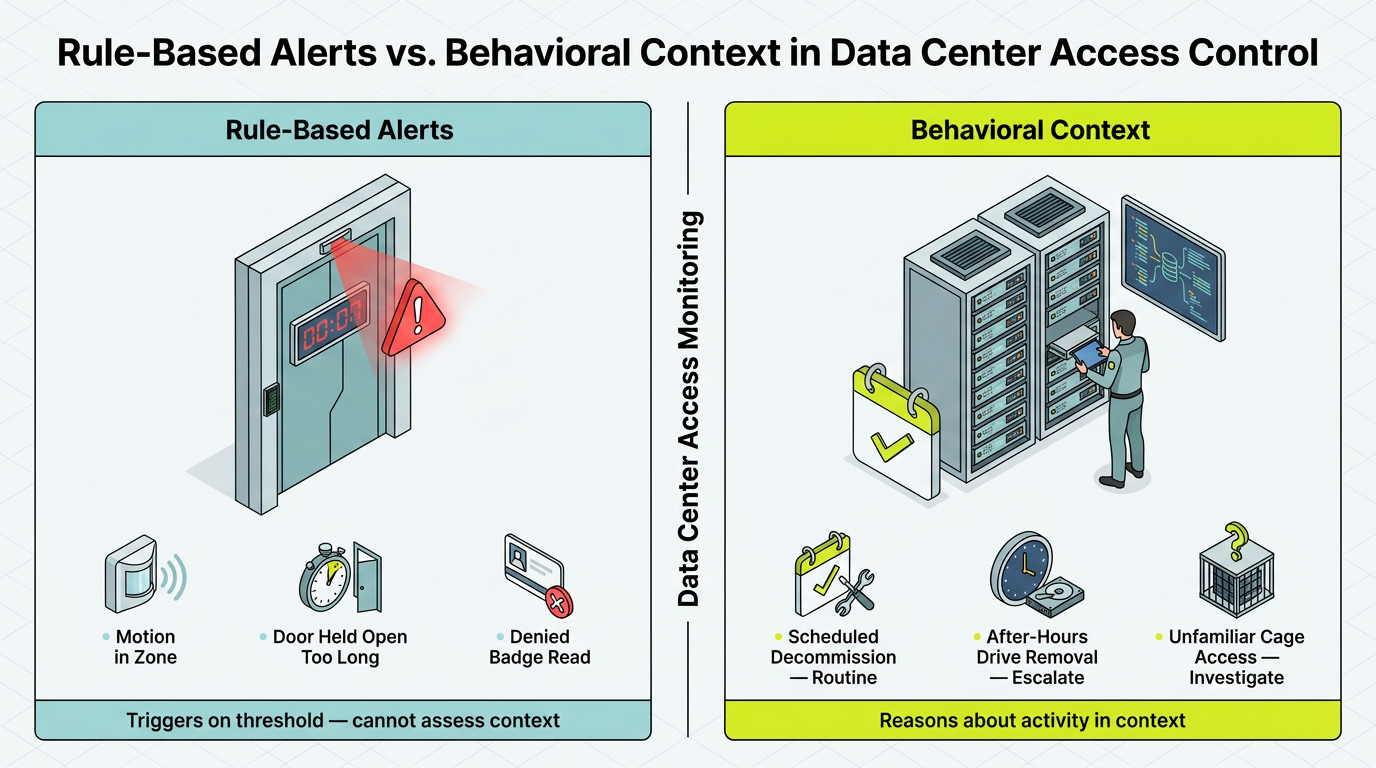
Rule-based detection triggers when a threshold crosses: motion in a zone, a door open too long, a denied read. It cannot ask what the person is actually doing. Behavioral detection reasons about activity in context. A technician pulling drives from a rack during a scheduled decommission, with a clean badge trail and an open change window, is routine work. The same person removing drives at two in the morning from a cage they rarely enter warrants escalation.
That contextual layer remains rare in practice, with machine learning or AI applied to access log analysis deployed by only 10% of surveyed organizations, according to research.
The Access Lifecycle and Its Records
Provisioning, Recertification, and Removal
Administrators should provision physical access by role during onboarding, deriving zone permissions from job function rather than handling requests case by case. Mature access programs treat access creation and removal, along with periodic review, as named, non-optional steps across the access rights lifecycle.
Privileged zone access should be reviewed more frequently than standard access, and all permissions should be revoked immediately after terminations or role changes. Without this discipline, access creep sets in: employees who no longer need entry to sensitive zones retain it, turning former data hall engineers into unmonitored risk.
Audit Logging and Retention
Logs must capture who, where, when, and whether access was granted or denied, for every attempt. For audit readiness, records should capture user identity, event type, timestamp, and success or failure, maintain visitor logs, and preserve audit history for investigation and sampling.
Tamper resistance means restricting read access to job need, protecting log files against modification, and backing them up promptly to a central log server. These records reconstruct an incident timeline and satisfy an auditor's sampling.
How Major Frameworks Treat Data Center Physical Access
Several regulatory and industry frameworks shape physical access requirements for data centers:
- Health Insurance Portability and Accountability Act (HIPAA) at 45 CFR 164.310 applies to covered entities (and relevant business associates) that handle electronic protected health information, not to every data center housing ePHI, and requires limiting physical access to those systems and their facilities while allowing properly authorized entry; its facility access controls standard has four addressable implementation specifications including a facility security plan.
- ANSI/TIA-942-C, the primary data center design standard, was published May 2024 and scales minimum physical security requirements to its Rated-1 through Rated-4 data center levels.
One widely cited framework should not be mistaken for a physical security standard. The Uptime Institute Tier Classification System (Tier I through Tier IV), often referenced in data center RFPs and procurement as shorthand for facility quality, rates only infrastructure resilience such as power redundancy, cooling, and uptime. It does not prescribe physical security controls.
Uptime Institute has explicitly labeled the belief that Tier III or IV requires reinforced fencing or closed-circuit television (CCTV) as documented myths. A security director who points to a Tier certification as evidence of physical security compliance is citing the wrong framework, and should look to HIPAA and ANSI/TIA-942 instead.
Keeping Controls Effective over Time
Routine Reviews and Penetration Testing
Physical access controls degrade between commissioning and the first incident, so the maintenance loop is part of the design. Quarterly walkthroughs that inspect access lists, verify revocations, and observe visitor procedures produce a trend line where a single annual audit produces only a snapshot.
Red-team exercises add adversarial pressure: physical penetration testing uses social engineering, including tailgating, and routinely surfaces cloneable badges, unlocked rooms, and reception staff accepting weak pretexts. High-baseline programs should include unannounced attempts to bypass controls at physical access points.
Security teams should treat the following events as triggers to revise access policy and the supporting alert or reader configuration:
- Role changes.
- Suspicious log patterns such as after-hours or out-of-sequence entries.
- Physical penetration test findings.
- Regulatory change.
The operational stakes are high. An Uptime Institute survey found that 87% of operators who suffered an impactful outage said it could have been avoided with better management, processes, or configuration. A propped data hall door or an informal contractor walkthrough is exactly that kind of avoidable failure.
Making Every Entry Accountable
Strong data center security treats access as an operating discipline. Zones enforce least privilege. Layered authentication and video verification narrow the credential gap. Durable programs depend on governance, including lifecycle reviews that catch stale permissions and tests that expose gaps before an adversary finds them. Their records also need to withstand audit sampling. Security leaders who fund the audit and testing loop as seriously as the entry hardware will find their controls still holding years after commissioning.
Frequently Asked Questions
What is the difference between anti-passback and anti-tailgating controls in data center access, and why do you need both?
Anti-passback prevents credential reuse by tracking badge swipes, while anti-tailgating physically blocks or detects multiple bodies per entry attempt. They address different attack vectors: shared credentials versus unauthorized followers, so neither alone covers both threats.
How should authentication factors be scaled across different data center security zones, and what qualifies as a controlled, limited, or exclusion area?
Authentication factors scale from one at controlled areas like general building access, two at limited areas such as data halls requiring badge plus PIN or biometric, and three at exclusion areas where attendant presence adds human oversight to credential and biometric checks.
Why is the Uptime Institute Tier classification not a valid measure of data center physical security, and which frameworks should be used instead?
Uptime Institute Tier classification evaluates infrastructure availability metrics like redundant power paths and concurrent maintainability, not access controls or perimeter defense. Security directors seeking enforceable physical standards should reference ANSI/TIA-942 for design requirements and HIPAA where protected health information applies.
