Building Emergency Response Procedures for the Workplace
Learn how to build workplace emergency response procedures that integrate access control, video, and on-site response into coordinated action.
Emergency response procedures turn a written plan into coordinated action when things go sideways. The real test comes when access control, video surveillance, alerts, and on-site response all have to work together as conditions get worse, not just when a document checks a compliance box.
For anyone running a physical security operations center (PSOC), the gap between what a plan says and what actually happens is where people get hurt. This article is about closing that gap.
Key Takeaways
- Emergency response procedures define how access control, video, and occupant actions support the emergency action plan during an incident.
- A risk assessment determines which scenarios a site should prepare for and which door control, video surveillance, and response capabilities each one requires.
- Protective actions depend on where the hazard is, whether people can move safely, and how operators should manage doors and alerts.
- Procedures only hold up when security workflows are drilled regularly, revised after exercises and incidents, and reachable when power and networks are down.
What Emergency Response Procedures Are
The OSHA emergency action plan standard sets the floor: reporting, evacuation, critical-operations staffing, accountability, rescue and medical duties, and named points of contact. Above OSHA's threshold it must be written; below it, oral communication is allowed.
Emergency response procedures are the operations layer beneath that plan. They define what security operators actually do in the opening minutes: which doors release, which doors secure, who overrides schedules, how the PSOC verifies alarms, and how badge and visitor records feed accountability.
Two adjacent disciplines are distinct. Hazardous-material response belongs to trained responders, not general occupants. Business continuity restores functions after disruption, while emergency response protects people during it. The NFPA planning standard covers all three.
Prioritize Scenarios with a Risk Assessment
Template procedures only work once adapted to the facility's hazards, layout, staffing, and response capabilities. A structured risk assessment surfaces realistic threats and matches each to the capabilities it demands.
Two frameworks help. A Threat and Hazard Identification and Risk Assessment (THIRA) starts with threats most likely to overwhelm the site, while a security risk assessment standard offers a repeatable method for evaluating physical and logical risks.
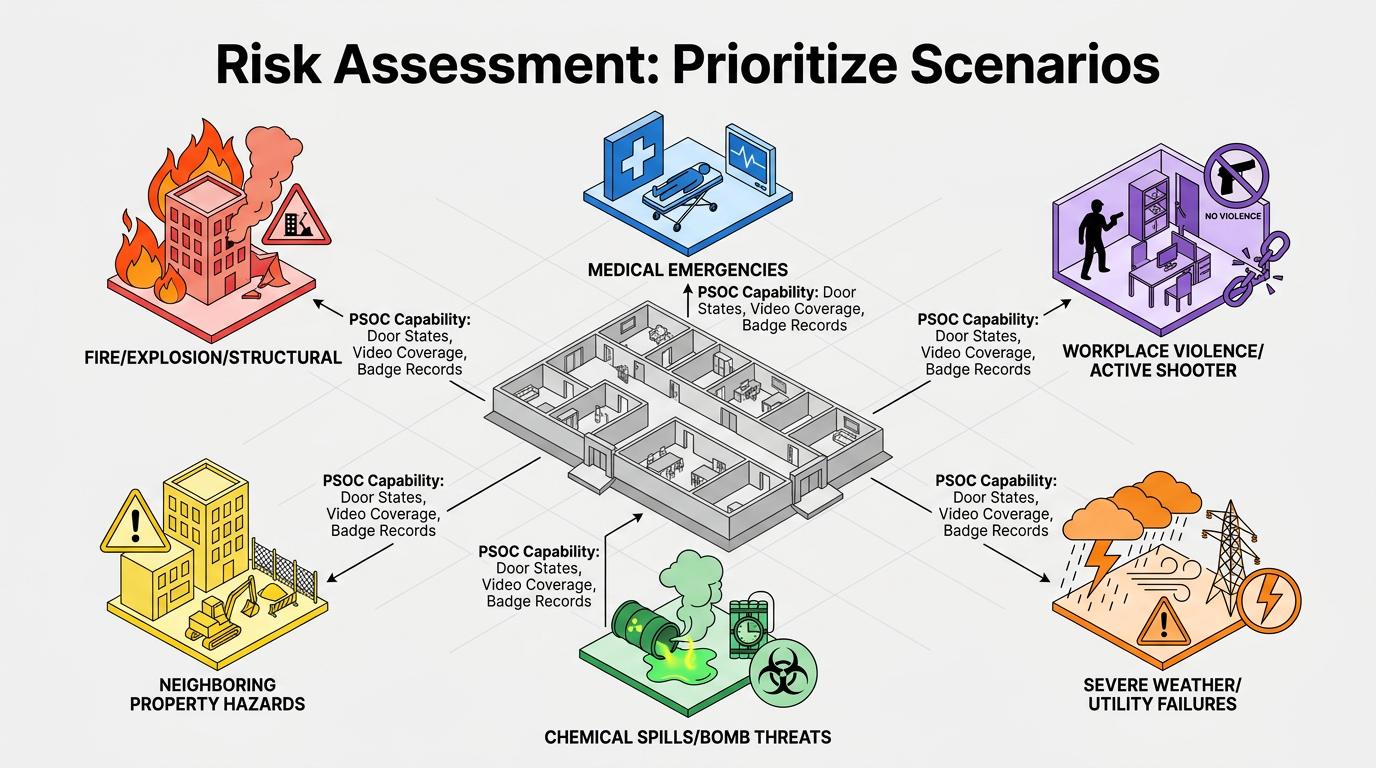
A thorough workplace assessment usually covers:
- Fire, explosion, and structural threats.
- Medical emergencies.
- Workplace violence and active shooter incidents.
- Severe weather and utility failures.
- Chemical spills, bomb threats, and hazards from neighboring properties like chemical storage or fuel dispensing.
Set priorities against multi-year patterns rather than a single year.
Each priority scenario should define what the PSOC needs to see, which door states must change, and how badge and visitor records support accountability. Early reporting of workplace violence is especially critical: it gives responders time to assess behavior and line up the right door-control and video-review workflow before things escalate.
Assign Roles and a Chain of Command
Authority has to be assigned before an incident forces the question, with a clear command structure that scales to whatever unfolds.
Every site needs an incident commander on duty at all times. This role sets objectives, approves resources, and calls demobilization. The plan should define the chain of command for evacuation decisions, and OSHA's emergency action plan rule specifically requires the name or job title of employees who can be contacted for more information about the plan or an explanation of their duties under it.
Below the commander sit floor and evacuation wardens, staffed to cover the workforce during working hours. They guide occupants to exits, sweep offices and restrooms last, keep alternate paths in mind, and track who needs help. Medical and automated external defibrillator (AED) responders cover rescue and medical duties.
The PSOC anchors on-site dispatch, backed by an executive notification list that names which leaders and outside agencies to contact per incident type.
The same role map should make clear who can grant door access, initiate lockdown, override schedules, and hand door-status information to the incident commander.
Evacuation, Shelter-in-Place, or Lockdown
Authority only helps if the procedure also spells out which protective action fits the hazard and how security operators back it up through door control and camera review as part of dispatch.
The plan has to state who has authority to initiate each protective action and the criteria for picking among them. Planners use the warning time they have to work out which protective action is feasible: a hurricane gives days of warning, an active shooter gives minutes or seconds.
Access control procedures make those decisions executable by defining which doors release, which doors secure, and which alerts operators have to confirm first when time allows.
When to Evacuate
Evacuation fits fire, explosion, structural threats, and a hazardous release inside the building. For an interior chemical release, occupants should get out without passing through the contaminated area if they can.
People leave belongings behind, help others when it is safe to do so, keep hands visible when exiting during a violence event, avoid moving wounded people, and call emergency services once they are clear.
Accounting starts right away at the assembly area, with security operators using badge records and camera views to back up the headcount.
When to Shelter in Place
Shelter-in-place answers a hazard outside the building, including an exterior chemical release and contaminated outdoor air. Severe weather can also mean occupants need to stay inside.
Shelter-in-place fits situations where a release will be short-lived or the health hazard is low, and it also fits situations where there is no time to evacuate.
Occupants move to an interior room with few or no windows, shut down fans and heating, ventilation, and air conditioning (HVAC) when told to, and keep an eye on official channels. If a toxic material is released inside the building, evacuate.
When to Lock Down
Lockdown answers a threat inside the building, most often an active shooter or violent intruder. A lockdown order typically locks all exterior doors automatically, with alerts pushed over the public address (PA) system and mobile channels.
For individuals, Cybersecurity and Infrastructure Security Agency (CISA)'s Run, Hide, Fight options apply in order of preference: run to the nearest exit using available cover; hide in a lockable space out of the shooter's view, behind material that can stop a bullet where possible; fight only as a last resort, with decisive action to incapacitate the threat. When law enforcement arrives, everyone follows responder instructions.

Account for Everyone, Including Those Who Need Help
Once a protective action is underway, the focus shifts to confirming who is safe, missing, or in need of help. OSHA guidance recommends that the EAP cover visitor assistance and employees with disabilities, and consider employees and visitors with limited English proficiency.
A personal emergency evacuation plan (PEEP) captures how an individual gets alerts, their primary and secondary routes, and any support they need. Assigned buddies always ask before helping.
Multi-story buildings without supervised sprinklers need a marked area of rescue assistance under the Americans with Disabilities Act (ADA) on each floor, sized for wheelchairs and equipped with bidirectional communication.
Muster-point accountability includes visitors, which is why visitor logs and badge records matter. Assembly area monitors run the roll call and report gaps to the incident commander.
Voluntary, confidential registries help wardens plan, and drills should include participants with disabilities. When available, access control data lets operators cross-check badge activity, visitor logs, and camera views against warden reports.
Communication Protocols During an Incident
Accountability depends on clear alerts and reliable dispatch reaching both occupants and responders. NFPA's mass notification provisions require a site-specific risk analysis and intelligible audio paired with visible notification for hearing-impaired occupants and high-noise areas.
Alert messages should use plain language that names the threat, the location, and the required action. The PSOC's message must line up with the protective action underway, so occupants are not sent through doors being secured.
Coordination with emergency services has its own federal floor. Kari's Law requires phone systems to support direct emergency dialing with no prefix and to alert a central location like the security desk on every call, so responders can be met and directed.
RAY BAUM'S Act adds dispatchable location: street address plus floor and room. Internally, the emergency coordinator confirms the emergency, activates procedures, notifies outside services, and directs utility or process shutdowns.
Integrating Security Systems into Response
Access Control and Video Integration
Access control and video systems shorten the distance between detection and action. An IP-enabled physical access control system (PACS) can trigger a facility lockdown from a perimeter intrusion before anyone even makes entry, and badge data helps establish who is in the building when a lockdown or evacuation forces a headcount.
Operators compare door events, badge activity, and live camera views before escalating, while wardens use the same records to reconcile occupancy during response. The procedure should also spell out who triggers the lockdown, the confirmation step before activation when time allows, and the handoff from the PSOC to the incident commander.
Alarm Verification and Detection Methods
Video verification changes what happens before dispatch. Before calling law enforcement, use multiple verification methods under the American National Standards Institute and The Monitoring Association (ANSI/TMA) alarm verification standard, and use Alarm Validation Scoring to help monitoring centers and public safety agencies prioritize calls. Both exist because false alarms chew up responder capacity.
Detection method matters. Threshold-based alerts, like motion in a zone or a door held open past a timer, differ from systems that add contextual review before escalating. A propped loading-dock door during a scheduled delivery may be nothing; the same door propped after hours while someone moves equipment to an unmarked vehicle warrants attention.
Drills, Exercises, and Training Cadence
Security workflows have to be tested with the people who use them. A drill cadence should reflect occupancy type, building use, and applicable requirements. Access control gets the same discipline, with tests covering who initiates lockdown, how operators verify door status, and how badge data supports accountability.
Exercise programs should progress from discussion-based scenarios to operational simulations:
- Tabletop exercises walk teams through a scenario in discussion.
- Functional exercises simulate realistic events under the incident command structure with outside partners.
- Full-scale exercises deploy resources across agencies and jurisdictions.
FEMA's Homeland Security Exercise and Evaluation Program (HSEEP) methodology builds these into a multi-year program, with each exercise producing an after-action report and improvement plan. Repetition cuts hesitation and saves critical minutes.
Keep Procedures Reachable and Current
Drills only improve the program if findings reach the version people actually use. A plan stored only on a network server fails at the worst moment. OSHA requires the written plan kept on-site; hard copies also matter during a ransomware event or network outage. PACE planning (Primary, Alternate, Contingency, Emergency) applies the same redundancy to communication paths.
Update procedures when responsibilities, layout, equipment, or hazards change. Access control needs a fresh look when door schedules, credential rules, camera coverage, or PSOC dispatch workflows shift. After each drill, walk through what worked and what did not, and move corrective actions into an improvement plan. The NFPA planning standard requires program evaluations on a regularly scheduled basis, with annual review recommended if the entity has not specified another schedule.
Procedures That Hold Up Under Pressure
A workplace emergency program earns its keep in the opening minutes of an incident, when authority, routes, and security systems have to work without discussion.
Security leaders who rank scenarios honestly, put a named person behind every decision, and wire detection and access systems into the response will find that the written plan and the actual response finally match. Regular drills are what keep movement fast. Start with the risk assessment; every other element follows from the hazards and capabilities it identifies.
Frequently Asked Questions
How do you integrate access control lockdown procedures with active shooter response when the PSOC operator has only seconds to verify the threat before triggering a facility-wide door lock?
Pre-authorize lockdown triggers tied to specific alarm combinations, like glass break plus gunshot detection, enabling operators to act without multi-step verification. Define fallback authority so floor staff can initiate lockdown if the PSOC is unreachable.
What is the difference between OSHA's emergency action plan requirements and NFPA's planning standard, and which one should a facility follow for comprehensive emergency response procedures?
OSHA sets minimum workplace requirements for emergency action plans, while NFPA provides voluntary consensus standards for broader emergency management. Facilities must comply with OSHA regulations and may adopt NFPA standards for enhanced preparedness beyond regulatory minimums.
How should organizations maintain emergency response procedures during a ransomware attack or network outage when digital access control and communication systems are unavailable?
Organizations should maintain offline hard copies at multiple physical locations, establish radio or cellular backup communication channels, deploy manual door-release protocols with physical keys, and train staff to execute procedures without electronic badge readers or monitoring systems operational.
