Key Card Access Control Systems: How They Work and What to Consider
Learn how key card access control systems work, where they fail, and what compliance frameworks apply before you procure or configure a system.
A key card access control system governs who can enter a facility by replacing mechanical locks with electronic credential verification. The system reads data from a card or mobile device, checks that data against stored permissions, and releases a lock only when conditions are met. Understanding how the system works, where it breaks down, and what compliance obligations apply is foundational to sound procurement and configuration decisions.
Key Takeaways
- Credential technology, reader-controller protocol, and integration architecture must be evaluated as a coordinated set, because upgrading one layer without the others leaves the security stack silently compromised.
- Proximity cards and Wiegand wiring are the two dominant failure points in existing key card access control deployments, and each requires its own remediation path.
- OSDP with Secure Channel closes the wire-level interception path, provided the default installation key is replaced with a site-specific key before the system goes live and install mode is disabled after commissioning.
- Compliance frameworks including HIPAA, PCI DSS, FIPS, and ISO 27001 apply distinct scopes to physical access, and mapping them before RFP issuance prevents costly post-deployment remediation.
From Card Tap to Door Release
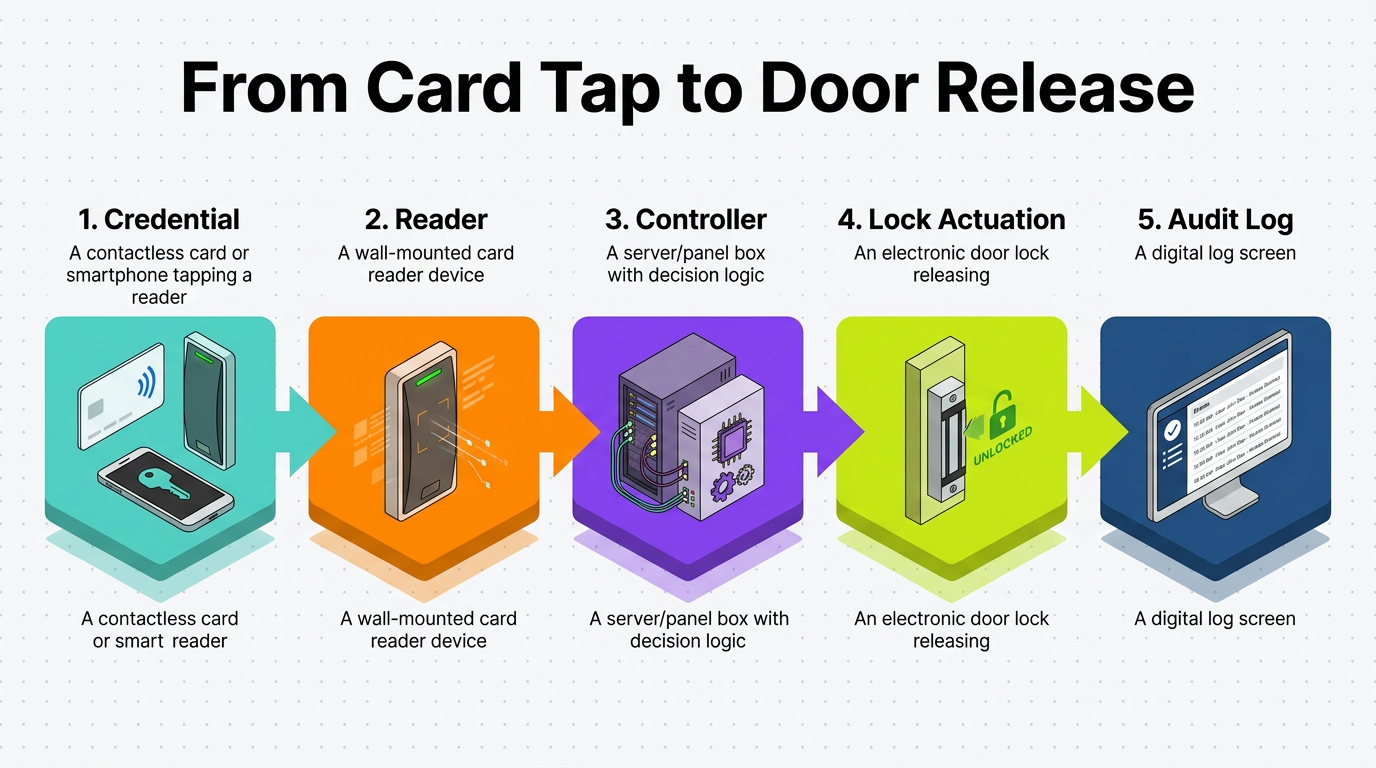
A Physical Access Control System (PACS) processes every access attempt through a signal flow from credential to reader, reader to controller, controller decision logic, lock actuation, and finally audit trail generation. Each phase introduces distinct security properties and failure modes.
Credential-to-Reader Communication
When a cardholder presents a credential to a reader, the interaction depends on the underlying RF technology. A legacy proximity card is energized by the reader's RF field and automatically broadcasts its facility code and card number. No command from the reader is required, and no cryptographic exchange occurs. Magnetic stripe cards, still present in some older deployments, offer even weaker assurance because their data can be copied with commodity reader-writer hardware.
A smart card operating under common contactless card standards behaves differently. The interaction uses a command-response model rather than automatic transmission, which enables mutual authentication and PKI operations that proximity cards cannot support.
Reader-to-Controller Transmission
The reader passes credential data to a controller through a wired communication protocol. The protocol selected at this layer determines whether the credential's security properties survive the journey. A protocol that transmits data in cleartext strips away any encryption the card performed, reducing a cryptographically capable credential to a simple identifier. The two dominant protocols, Wiegand and OSDP, differ fundamentally in their security architecture. Wiegand transmits unencrypted, one-way pulses, while OSDP supports bidirectional, encrypted communication.
Controller Decision Logic
Two distinct checks happen inside the controller. Authentication establishes that the credential is genuine and still valid. Authorization determines whether the holder has permission for this specific door at this specific time. Conflating the two produces systems where valid credentials open doors they should not.
The controller evaluates the credential against a sequential checklist: credential lookup, activation and expiration dates, access group membership, time schedule, anti-passback status, and any supplemental rules such as two-person control. Every check must pass. A single failure results in denial, and the system logs the event.
Lock Actuation and Audit Logging
On a granted access event, the controller activates a relay to release the electrified lock. Fail-secure locks require power to unlock and stay locked during outages, while electromagnetic locks (maglocks) require continuous power to stay locked and release when power fails. Selection depends on door function and applicable life-safety codes.
Door position sensors detect conditions credential authentication cannot. A Door Forced Open (DFO) event fires when the door opens without a valid read, often from a mechanical key or faulty request-to-exit sensor. A Door Held Open (DHO) event triggers when a door stays open past threshold, with severity judged by context. Every event generates an audit record for investigations.
Credential Technologies and Their Security Properties
Credential selection has the longest operational tail of any PACS decision. The technology chosen will often constrain security posture and migration costs over a long deployment lifecycle.
A principle that applies across every credential type: the security a credential achieves depends on the full stack, including the card technology, the reader-to-controller protocol, and the authentication mechanism selected. A cryptographically capable smart card connected via a legacy protocol that strips its encryption provides no meaningful advantage over a proximity card.
Proximity Cards
These cards transmit a static identifier without encryption. Legacy 125 kHz proximity cards broadcast a fixed ID number with no encryption and no mutual authentication, and the system checks only that number. These credentials provide negligible assurance, and they should be phased out of active deployments. Many organizations still operate with these credentials, meaning a substantial share of surveyed enterprises still rely on a technology that offers no cryptographic protection against cloning.
Encrypted Smart Cards
Contactless smart cards commonly operate at 13.56 MHz at short range. Cards such as MIFARE DESFire EV2 and EV3 support mutual authentication where both the card and reader verify each other's identity, with AES-128 encryption on the card side.
Card-side cryptography alone does not guarantee assurance. Vulnerabilities have surfaced in both card chips and reader configuration handling, allowing extraction of the very keys the system depends on. The takeaway for practitioners: reader-side key handling matters as much as card cryptography, and both belong in any credential audit.
A critical distinction exists within this category. Frequency alone is not a security indicator. An enterprise audit must identify the specific card model and cipher, not merely the operating frequency.
Mobile Credentials
Smartphone-based credentials using NFC and Bluetooth Low Energy are increasingly used in access control and can offer security and management advantages over physical cards. In managed deployments, remote revocation is supported, reducing the terminated-credential risk that affects physical cards. A mobile credential can also be removed remotely from a lost phone, while recovering a physical card supports inventory assurance.
Physical cards retain practical advantages. They need no onboard battery, they serve as visible photo identification worn on the body, and they can be issued to a visitor or contractor within minutes. The practical question is not mobile versus card, but which doors and populations justify which credential, and whether the readers can serve both.
Wiegand Versus OSDP at the Reader-Controller Layer
The protocol connecting readers to controllers is the layer most frequently overlooked during upgrades, and the layer where security most often breaks down silently.
Why Wiegand Is a Liability
The Wiegand protocol transmits data as unencrypted, one-way pulses from reader to controller. The format yields a small address space that creates collision potential at scale. The controller cannot verify reader integrity, send commands to the reader, or detect tampering. Because the signal is plaintext, exposed reader wiring creates a risk of credential interception and replay.
OSDP as the Replacement Standard
The Open Supervised Device Protocol (OSDP) addresses each of Wiegand's weaknesses. OSDP uses RS-485 wiring, daisy-chains devices on as few as two wire pairs, supports bidirectional communication so the panel can detect a tampered or failed reader, encrypts data via Secure Channel with AES-128 and mutual authentication, and provides native tamper detection. The Security Industry Association maintains the current version, and the protocol is also published as IEC 60839-11-5:2020. A growing roster of products carries SIA OSDP Verified certification.
Deploying OSDP requires one configuration discipline that practitioners must enforce: the default installation key (SCBK-D) must be replaced with a site-specific key before the system goes live, install mode must be disabled after commissioning, and panels must be configured to refuse unencrypted fallback.
Common Vulnerabilities and Practical Mitigations
Card Cloning and Protocol Exploits
Legacy cards can be cloned from close proximity in an elevator, lobby, or parking area. The countermeasure is a credential upgrade to PKI-based or mobile credentials paired with OSDP Secure Channel at the reader-controller layer. Upgrading the credential without upgrading the protocol leaves the wire-level interception path open.
Tailgating, Piggybacking, and Credential Sharing
Card logs record one valid read no matter how many people walk through, so tailgating and piggybacking are events the card system alone cannot see. The distinction matters for countermeasure selection. Tailgating means an unauthorized person follows a badge holder without their knowledge, and calls for physical barriers such as optical turnstiles or mantrap portals that admit one person per cycle. Piggybacking means the badge holder knowingly holds the door, which is a training and culture problem.
Tailgating and piggybacking affected surveyed organizations in the prior six months, making it the most commonly reported incident type. Propped doors and credential sharing were also widespread.
Hard anti-passback enforcement denies re-entry until exit is logged, while soft anti-passback logs the violation for follow-up. Physical barriers enforce one-person-per-credential. Camera-based detection can identify multiple persons entering on a single badge event. No single countermeasure eliminates the risk. Layered deployment across physical barriers, policy enforcement, and detection technology addresses the problem from multiple directions.
Networked PACS as an IT Attack Surface
Controllers connected to IP networks inherit IT cybersecurity attack surfaces. Unchanged default passwords, outdated software, and issues such as expired certificates can affect systems like PACS. Network segmentation, mandatory MFA for administrative access, and a defined patch cadence from the vendor are operational requirements, not optional hardening steps.
Compliance Frameworks That Apply to Key Card Access Control
Multiple regulatory frameworks impose physical access control requirements, each with distinct scope and specificity.
- FIPS 201-3 and HSPD-12: Homeland Security Presidential Directive 12 mandates a government-wide identity credential for federal employees and contractors, implemented as the Personal Identity Verification (PIV) card under FIPS 201-3. Federal guidance scales authentication to area risk, with a controlled area requiring one factor, a limited area requiring two, and an exclusion area requiring three factors: the PIV card, a PIN, and a biometric.
- HIPAA: 45 CFR § 164.310 requires covered entities to limit physical access to systems containing electronic protected health information. The rule is technology-neutral, mandating policies and safeguards without specifying credential type. Joint Commission requirements effective January 2026 add that hospitals must control access to areas they identify as security sensitive and keep written procedures for incidents including infant and pediatric abduction.
- PCI DSS: Applies to entities that store, process, or transmit cardholder data under the PCI Security Standards Council. Physical access to data and systems must be restricted, with audit logs and formally assigned roles and responsibilities as part of the standard's control structure.
- ISO 27001: The current revision reorganized physical security into a dedicated controls category. Organizations seeking certification must implement physical entry controls or formally justify their exclusion in a Statement of Applicability.
- PASS Guidelines for K-12: Under the Partner Alliance for Safer Schools guidelines, K-12 buildings use secured vestibules at main entrances, classroom doors lockable from inside, immediate credential deletion when staff leave, and lockdown capability triggered from the access system.
Practitioners should map all applicable mandates before issuing an RFP. Post-deployment compliance remediation is significantly more expensive than pre-procurement requirements definition.
Credential Lifecycle and Administration
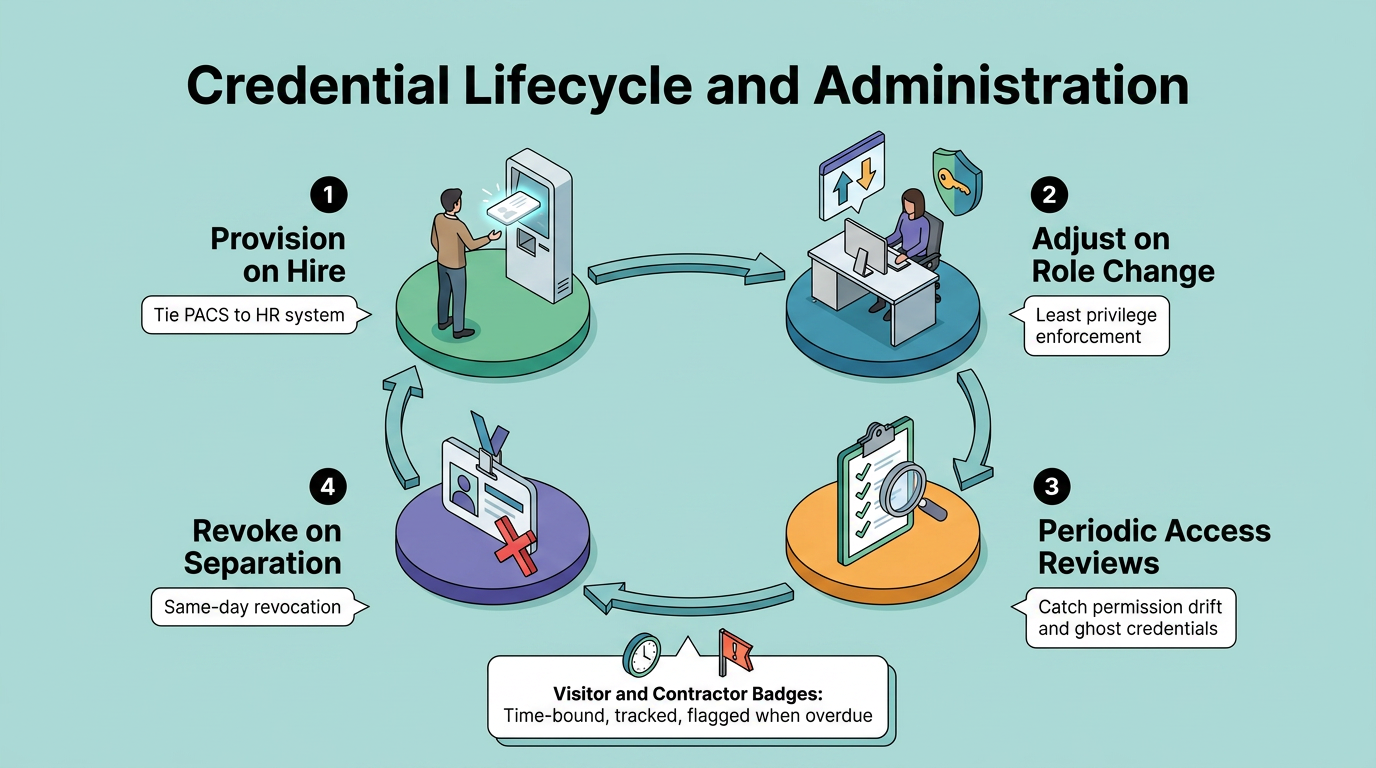
Administrative failures can undo cryptographically strong credentials in a single afternoon. The following practices keep credential state aligned with personnel reality:
- Tie the PACS to the HR system. Provision on hire, adjust on role change, and revoke on the day of separation so status changes propagate automatically. Manual synchronization is where credentials survive terminations they should not.
- Treat role changes as the subtle case. Deleting permissions the new role needs blocks work, while retaining permissions the new role does not need violates least privilege and invites abuse.
- Run periodic access reviews. Reviews catch permission drift after role changes and surface ghost credentials belonging to people who left years ago.
- Hold visitor and contractor badges to the same standard. Make them time-bound, track them from issuance to return, and flag them automatically when overdue.
Evaluating a Key Card Access Control System
Start with Risk Assessment, Not Product Selection
The ASIS Enterprise Security Risk Management framework aligns security requirements with the organization's mission, assets, and identified threats. For multi-site deployments, risk assessment must happen at the site level.
A warehouse, a data center, and a corporate lobby face different threats and require different credential and barrier configurations. Identifying highest-protection assets and probable threat vectors determines where to allocate budget for stronger credentials, physical barriers, or multi-factor authentication. Complete and document this assessment before issuing an RFP, because criteria lacking a site-specific risk basis over-protect low-value areas and under-protect high-value ones.
Specify the Protocol, Not Just the Credential
RFP documents should require OSDP with Secure Channel enabled on all reader and controller specifications. Wiegand-only readers should be classified as end-of-life in any new deployment.
Requiring multi-technology readers supports parallel operation of legacy and encrypted credentials during phased migration. The RFP should explicitly prohibit cleartext reader-to-controller communication. Procurement teams can verify vendor claims against the SIA OSDP Verified product registry, which independently certifies protocol compliance.
Prioritize Integration Architecture
Video surveillance integration is a common PACS integration category, using open standards and vendor APIs to connect access control and video systems. Access events can trigger automatic video retrieval, placing a door event beside the matching camera feed. NIST SP 800-53 control PE-3 covers Physical Access Control for physical access points. RFP evaluation should verify whether integrations are certified or require custom development, and event-to-video latency.
Visitor management often uses proprietary REST APIs rather than ONVIF interfaces, increasing vendor dependence. Building management systems use BACnet/IP, Modbus TCP, OPC UA, or KNX, requiring middleware or PSIM translation.
Model Total Cost of Ownership over the Full Lifecycle
The purchase price is typically the smallest component of the full lifecycle cost. Software licensing, annual maintenance, credential replacement stock, administration staffing, help desk volume for credential requests, and eventual decommissioning all contribute. Request itemized cost projections as a required RFP deliverable.
Model the cost of not migrating from legacy credentials, including the operational and liability exposure of a credential cloning incident.
Plan the Migration Before Procurement
A phased approach begins with a full inventory of readers, controllers, credential types, firmware versions, and protocols at every site. Multi-technology readers deployed during infrastructure preparation allow legacy and encrypted credentials to operate in parallel. Issue new encrypted credentials during natural replacement cycles, including new hires, lost cards, and role changes, to reduce forced re-badging costs.
The project team must communicate a hard cut-off date for legacy credential acceptance to all cardholders. Administrators must disable legacy read capability once migration is complete.
Building a Resilient Access Control Foundation
Key card access control decisions made during a single procurement cycle will shape a facility's security posture for years. An attacker needs only one weak link, whether in the credential's cryptography, the wire behind the reader, or the administrative workflow governing who holds what.
Selecting credential technology, reader-controller protocol, and integration architecture as a coordinated set, and repairing the revocation and visitor workflows where risk quietly accumulates, produces systems where each layer reinforces the others instead of silently undermining them.
Frequently Asked Questions
How do I migrate from Wiegand to OSDP without replacing all existing readers and controllers at once?
Deploy multi-protocol controllers supporting both Wiegand and OSDP, replacing readers during scheduled maintenance. Prioritize high-risk doors first while maintaining backward compatibility. Once migration completes, reconfigure controllers to reject unencrypted communication and disable Wiegand support entirely.
What specific steps are required to replace the default OSDP installation key (SCBK-D) and disable install mode before commissioning?
Consult the controller manufacturer's documentation for key replacement procedures. Typically, access the panel's configuration interface, generate or enter an AES-128 key, then upload it to all readers on the device bus. Disable install mode after enrollment.
How do I determine which compliance frameworks (HIPAA, PCI DSS, FIPS 201, ISO 27001) apply to my facility and map their physical access control requirements into an RFP?
Identify which data types your facility handles, as regulatory scope follows the asset. Engage legal counsel to confirm jurisdiction, then extract physical security obligations from applicable frameworks and map each mandate to specific technical requirements before vendor outreach.
