School Access Control Systems for Campus Security
Learn how school access control systems work, from credentials to lockdown integration, and what frameworks guide layered campus security decisions.
School access control systems govern who enters a campus, when they can enter, and which interior spaces they can reach. For a K-12 district or multi-building university, these systems form the first enforceable boundary between a routine school day and an emergency.
Key Takeaways
- Access control is a system decision, not a hardware purchase; the reader, controller, credential, and lock must be evaluated together.
- Encrypted reader-to-controller protocols close the largest legacy vulnerability, but only when secure channels are explicitly configured and verified.
- Readers and locks alone do not stop tailgating or propped doors; physical controls and door-status monitoring close those gaps.
- Student biometric deployments carry the heaviest regulatory exposure and should not proceed without legal review in the relevant jurisdiction.
How a School Access Control System Decides Who Gets In
A door under access control runs on a small set of parts working in sequence. A basic physical access control system includes a credential, a reader, a locking device, a door position switch, a request-to-exit device, and a controller.
The decision follows three stages:
- Presentation. A person presents a credential (a card, a PIN, a mobile pass, or a biometric) to the reader.
- Transmission. The reader scans the credential and passes the data upstream to the access control panel.
- Decision. The panel checks the credentials against permissions, schedules, and door-specific rules, then releases the lock only when all conditions are met.
The controller is the decision-maker inside the secure area. It enforces user permissions, time-based restrictions, and visitor rules. When a credential is used outside a permitted window, the controller denies it and logs the attempt.
Every installation needs an application and database to configure and monitor it; events such as Access Granted or Door Forced Open create a running activity log that answers a question mechanical keys never could: who opened a given door, and when.
Wiegand and OSDP at the Reader
The link between reader and controller is where many older school systems carry hidden risk. Wiegand, the legacy standard, transmits facility codes and card numbers in cleartext over a unidirectional line. An attacker can intercept credential data during a legitimate presentation and replay it indefinitely.
The current standard, OSDP, was approved as an international standard by the International Electrotechnical Commission and published as IEC 60839-11-5. OSDP supports bidirectional communication, so the controller can supervise the reader and detect tampering, and it carries data in a secure channel with AES 128-bit encryption.
One caveat carries real operational weight: OSDP Secure Channel requires explicit configuration. A school that assumes encryption is active without verifying it may be running OSDP hardware without the protection it expected.
Locking Hardware Choices in Schools
The locking device determines what happens when power fails and how the door behaves under daily traffic. Common choices include electric strikes, magnetic locks, electric latch retraction, and electrified locksets; the practical selection turns on egress, fail-safe or fail-secure behavior, traffic patterns, and door-code constraints.
For primary school entrances, electric latch retraction is favored over electric strikes in PASS 6th Edition guidelines.
What National Frameworks Recommend for Layered Access
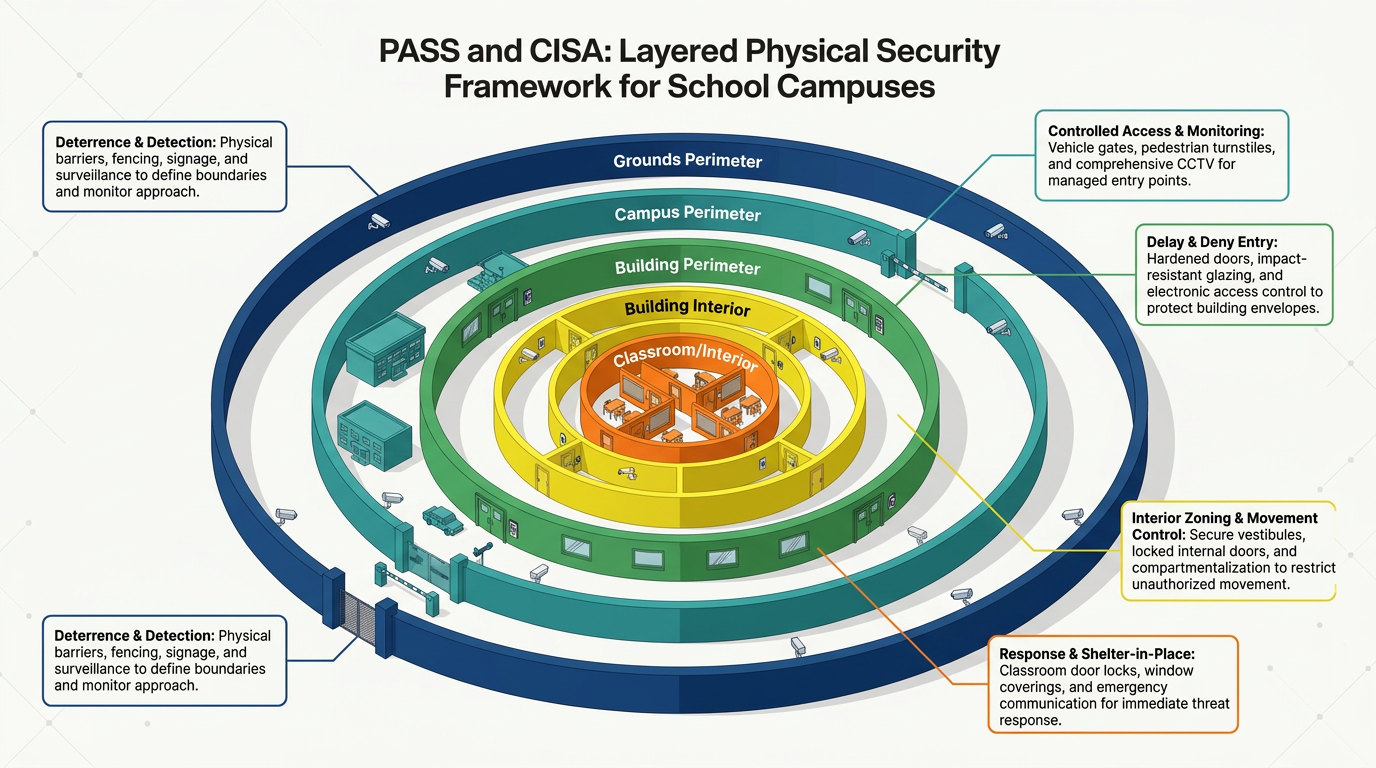
In the Partner Alliance for Safer Schools (PASS) 7th Edition, physical layers span district-wide, digital infrastructure, campus perimeter, building perimeter, and classroom or interior protection. Its tiered continuum runs from baseline to the highest tier of measures. The structure helps administrators, school boards, and law enforcement measure a school's current posture and select measures matched to budget and need without treating one fixed standard as the goal.
At the building perimeter, entrances should combine electronic and mechanical locks. Electronic systems add real-time ingress tracking, instant credential deletion, and immediate system-wide lockdown. If a building has no system to monitor whether each exterior door is open or closed, intrusion detection using door position switches closes a critical visibility gap.
Visitor management follows the same tiered logic, with electronic systems sitting beyond the baseline tier. Resilience matters as much as control: any gate and access control system should have battery backup that keeps it working during a power outage, and a separate offline mode or connectivity backup for internet outages.
In CISA's K-12 School security guide, physical security spans layers covering the grounds perimeter, school grounds, building perimeter, and building interior. Outer layers detect or delay threats so response actions can be taken, while inner layers contain threats through delay, lockdown, or evacuation. PASS and CISA are structurally compatible even though they divide the environment differently.
Credential Technologies and the Tradeoffs Behind Them
Many campuses may operate mixed credential environments, and the gap between the oldest and newest can undermine the whole system if not managed deliberately.
Legacy Proximity Cards
Legacy low-frequency proximity cards are weaker than encrypted smart-card credentials, especially when paired with unencrypted reader-to-controller paths. The more dangerous failure mode appears in mixed environments.
Multi-technology readers that accept both 125 kHz and 13.56 MHz credentials can preserve legacy exposure when backward-compatible readers still accept older credential data. The strength of a newer credential becomes less meaningful when the same identity remains usable through an older path.
Contactless Smart Cards
Encrypted 13.56 MHz contactless smart-card implementations can provide stronger assurance than credentials that rely on a copied static identifier.
Generation and implementation still matter: campuses should verify the credential technology and configuration they actually deploy rather than assuming every 13.56 MHz card provides the same assurance.
Mobile Credentials
Mobile credentials store a digital identity on a smartphone and are presented over NFC or BLE. Campus interest in mobile access adoption is substantial, and when students authenticate to a phone with a passcode or biometric to present a mobile ID, the device adds a second authentication factor.
Infrastructure is the catch: mobile credentials may require reader and network upgrades in legacy buildings.
Biometrics and Keypads
Biometric readers appear in K-12 settings for building access, attendance, lunch payments, and bus boarding, but they carry the heaviest regulatory load of any credential type, addressed in the compliance section below.
Biometric identification based on facial characteristics has documented accuracy concerns across women, people of color, and children. Keypads can reduce lost-card replacement work and support code updates, but shared PINs and less granular user attribution can limit assurance, which is why keypads often serve as the PIN factor in a card-plus-PIN configuration.
The Vulnerabilities That Access Control Does Not Automatically Solve
Installing readers and locks does not close every gap. Several weaknesses persist regardless of credential quality, and one common assumption about them is wrong.
Piggybacking and Tailgating
Piggybacking means more than one person entering on a single credential, or following an authorized person into a secure area. Tailgating is the related breach where an unauthorized person follows an authorized one without that person's knowledge. Piggybacking involves perceived consent, such as a teacher holding a door, while tailgating happens without the authorized person knowing.
Anti-Passback and Physical Controls
Anti-passback prevents a person from passing their card back to someone else by tracking each credential as in or out and refusing a second consecutive entry. It is a strong control against credential sharing. Tailgating requires other controls because a tailgater never touches a credential.
Controls that reduce tailgating are physical: turnstiles, security revolving doors, and interlocking mantrap portals restrict unauthorized movement through controlled entrances.
Propped and Forced Doors
A propped exterior door can bypass access control entirely, whether opened for convenience, by mistake, or through deliberate misuse. Managing this behavior depends on door-status monitoring: in access-control event terminology, Door Held Open Time is the interval before an alarm is generated for a door being open too long, often after a valid access request. Door Forced Open is triggered when a door contact sensor detects that the door has opened without a preceding valid access grant or credential read.
Door-status monitoring and video surveillance can give operators more context when reviewing physical-access events.
Security Vestibules
The security vestibule, or mantrap, is a common school perimeter control. A vestibule controls entry through two sets of doors, so access can be verified before a person reaches the building interior. Some vestibule systems can be configured to reduce multi-person entry rather than relying only on credential checks.
Tying Access Events to Video and Lockdown
Access control delivers more value when it does not operate in isolation. When access control and video work together, door events can be associated with a camera feed. A credential used outside normal hours can trigger review of the relevant camera view. Door-forced, door-held, and after-hours access events can be reviewed alongside video. Physical-access monitoring can include video surveillance and monitoring physical access to systems. Reviewing a badge swipe against synchronized video strengthens the audit trail that compliance reviews depend on.
Interoperability across access control and video products rests largely on ONVIF standardized interfaces for IP-based physical security devices. Conformant products support at least one profile, with Profile A covering access control configuration, Profile C covering basic IP-based access control and event management, Profile D covering access control peripherals, and Profile S and Profile T covering video streaming.
Electronic access control provides the means for immediate lockdown of doors across a system. When configured for lockdown, it can secure doors automatically on activation.
Resilience is non-negotiable: if a building loses network or electrical power during an emergency, the access control and lockdown system must still operate, usually on backup battery power. Emergency plans should also address first responder access: how responders enter during a lockdown and how incidents are reported and communicated.
Regulatory Limits That Shape Deployment
Federal and state law constrain what a school can collect and store, and the constraints fall hardest on biometric credentials.
FERPA, codified at 20 U.S.C. § 1232g and implemented at 34 CFR Part 99, applies to all educational agencies receiving federal education funds. Under 34 CFR § 99.3, a biometric record means a record of one or more measurable biological or behavioral characteristics usable for automated recognition, including fingerprints, retina and iris patterns, voiceprints, DNA sequence, facial characteristics, and handwriting. Biometric records are listed as direct PII identifiers alongside name and Social Security number, which means disclosure generally requires written consent except under FERPA's limited enumerated exceptions.
This reaches further than many security directors expect. The restriction applies to any biometric reader deployed for a student population, including systems based on fingerprints, retina and iris patterns, voiceprints, DNA sequence, facial characteristics, or handwriting. FERPA also obligates schools to use reasonable methods to authenticate the identity of anyone requesting access to education records.
State law adds a second layer that differs significantly by jurisdiction. Illinois enforces the Biometric Information Privacy Act, which requires a written retention policy and permanent destruction of biometric identifiers either when the collection purpose is satisfied or within three years of the individual's last interaction, whichever comes first.
A security director planning any biometric deployment for students should obtain legal review and verify current statutes in the relevant jurisdiction before installation.
Architecture and Lifecycle Decisions for Multi-Building Campuses
The reader-to-controller protocol choice has direct architectural consequences. Wiegand's short maximum run often forces additional door controllers for remote campus structures, while OSDP's RS-485 backbone reaches far longer distances and needs fewer conductors. OSDP Secure Channel with AES-128 is the minimum standard for reader-panel communication where operationally feasible.
The deployment model is the second axis. On-premise systems keep infrastructure local. Cloud and hosted systems can simplify multi-site credential administration because administrators can remotely provision access across multiple campuses and systems, though connectivity-loss planning still matters. Wireless locks address a major barrier to upgrading older buildings by reducing difficult wiring to individual doors.
Credential governance should include regular update cycles and revocation through automated lifecycle management rather than manual spreadsheet tracking when people leave or change roles.
Building Toward a Coherent Campus Security Posture
The strongest school access control programs treat the door as one element in a connected system rather than a standalone barrier. Layered frameworks from PASS and CISA give districts a structured way to match measures to budget, while encrypted credentials and reader protocols close the documented gaps that legacy hardware leaves open.
Integration with video and lockdown turns isolated events into actionable context, and disciplined credential governance protects the system over its full operating life. Before any biometric deployment, legal review should come first. The next step for most teams is an honest audit of which layer is weakest and where a single upgrade closes the most exposure.
Frequently Asked Questions
What is the difference between OSDP and Wiegand protocols for school access control readers, and why does it matter for security?
Wiegand sends unencrypted card data one way, making credentials interceptable and replayable. OSDP enables encrypted bidirectional communication, allowing controllers to detect tampering and secure the channel. The difference determines whether attackers can clone credentials from a single scan.
What legal requirements must schools meet before deploying biometric access control systems for students?
Depending on the jurisdiction and applicable policies, schools may need to obtain written parental consent before collecting biometric data, set retention and destruction timelines, and complete privacy impact assessments. Jurisdictions may require public notice periods, breach notification protocols, and vendor agreements specifying data handling and sharing prohibitions.
How can schools prevent tailgating and piggybacking at controlled entrances when access control readers alone cannot detect these breaches?
Schools deploy physical barriers enforcing one-person-per-credential entry: turnstiles, security revolving doors, and mantrap portals mechanically separate each entry event, preventing follow-through regardless of whether the trailing individual has consent or awareness from the authorized user.
