Multi-Door Access Control System: What Security Teams Need to Know
Learn how multi-door access control systems work, where they fail, and what specifications security teams need to close credential, wiring, and audit gaps.
A multi-door access control system puts every reader, lock, and door sensor across a building or portfolio under centralized PACS management, with a single database and a central audit trail. Centralization simplifies administration, but it also broadens the operational impact of bad decisions and stale configurations. Unnoticed failures can have the same effect.
Key Takeaways
- Controllers configured to cache cardholder data can keep using it during a head-end outage. A server-side revocation therefore stays ineffective at a disconnected controller until it receives the update.
- Security teams should require encrypted, supervised reader links because Wiegand carries badge numbers unencrypted in one direction.
- Door position switches and request-to-exit devices enable forced-door and held-open alarms. Context determines whether a propped door signals routine activity or intrusion.
- For PACS event logs, NIST SP 800-53 leaves retention periods and review frequencies as organization-defined parameters, making written policy the evidence of record.
How a Multi-Door System Differs from Standalone Locks
A standalone lock stores its credentials at the door, and an administrator who needs to add or remove a card visits each door in turn. Multi-door networked systems move both jobs to a central head-end: the physical access control system (PACS) application, its database, the field controllers, and the administrative workstations. The head-end is where the system interoperates with intrusion detection, video management, visitor management, and enterprise identity management.
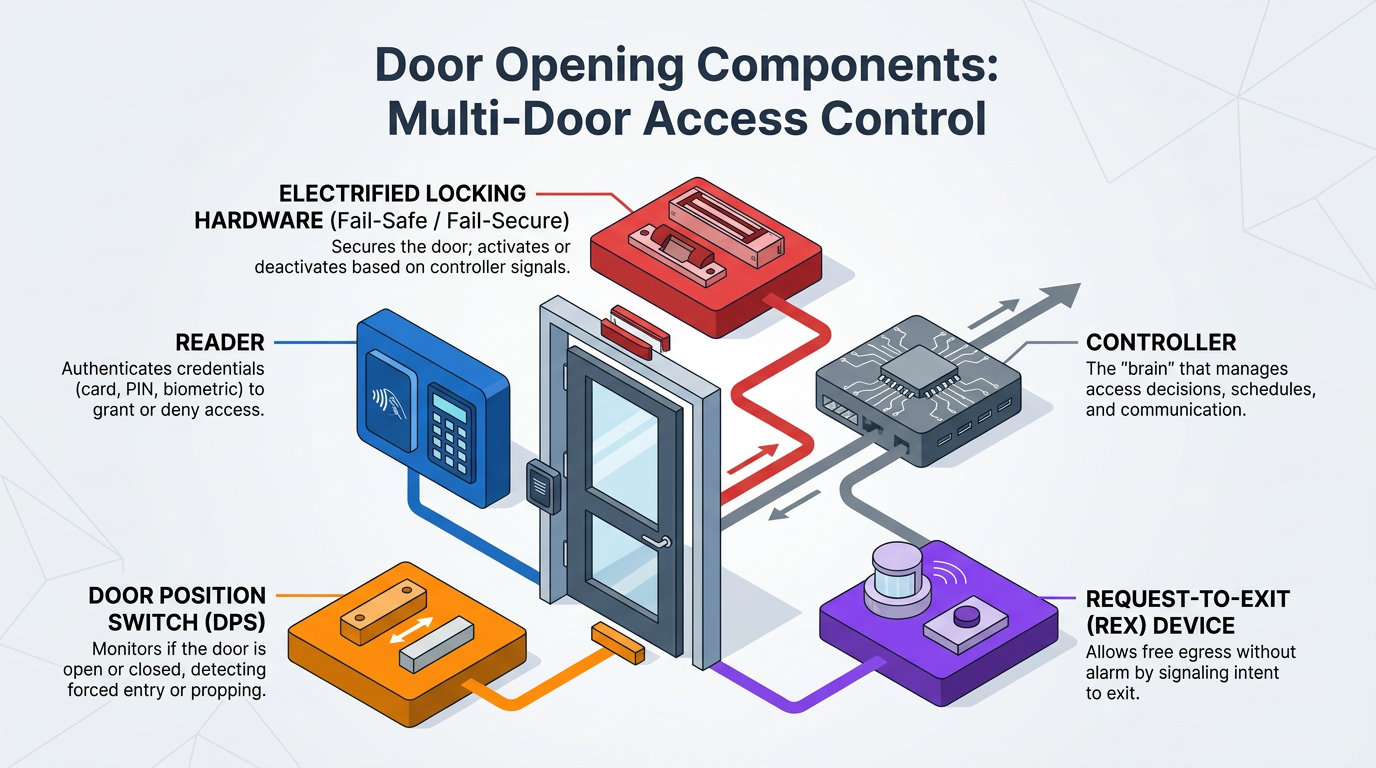
At the door, each opening carries components with distinct roles:
- Reader: powers the card, reads it, and forwards the data to a controller.
- Electrified locking hardware: specified as fail-safe or fail-secure, releasing the lock when power is lost or staying locked. That per-door choice governs behavior in a power failure.
- Controller: checks the identity store and releases the lock if the cardholder is authorized.
- Door position switch (DPS): reports open or closed in real time.
- Request-to-exit (REX) device: tells the controller that someone opened the door from the inside.
Controller Topology and Network Outages
Controllers come in fixed door-count increments, and you can add a controller before an existing one runs out of door capacity. In a centralized layout, controllers sit in one location within the specified cable distance of the doors, and every reader, lock, and switch runs a home-run cable back to them.
Edge controllers instead place a controller and a copy of the database at each opening, powered over Ethernet, which shortens cable runs but leaves decision-making hardware at the opening, where it must be hardened against physical tampering. Under the 2025 edition of the Department of Defense Unified Facilities Criteria (UFC) 4-021-02, an access control system uses distributed processing. Local controllers connect to a head-end server, while client workstations handle administration and enrollment.
In both layouts, controllers can hold a downloaded cardholder database and decide to grant or deny access on their own, so a lost link to the server does not necessarily stop doors from working. That resilience can also create exposure. A cardholder deleted at the head-end remains valid at a controller configured to use cached credentials until it receives the update, and the controller can keep admitting that badge until communication returns.
Specifications should state how the system reports a controller offline and how many transactions controllers buffer. They should also define how reconnection reconciles revoked credentials.
Where Reader Wiring Fails
The link between reader and controller is the least protected segment of that chain. Wiegand is a one-way, unencrypted interface that installed readers use to communicate with their controllers. Anyone who reaches the wiring between reader and controller can intercept badge data as it passes, and the controller cannot tell the reader has been disturbed unless an installer wired a separate tamper circuit.
The Open Supervised Device Protocol (OSDP), maintained by the Security Industry Association (SIA) and published as IEC 60839-11-5:2020, replaces that with two-way RS-485 communication. OSDP continuously monitors the wiring, so tampering with the link is detectable rather than silent. Secure Channel adds encryption. RS-485 also carries multiple devices on a shared wire run over much longer distances than Wiegand permits and uses far fewer conductors.
OSDP protects the link only when both ends enforce it. Unsecured mode belongs only in initialization; a controller that accepts a reader claiming not to support encryption has recreated the Wiegand problem with better cabling.
Credential Assurance Varies by Card Technology
An encrypted reader link does nothing for a credential that can be copied. Legacy proximity credentials can be vulnerable to electronic cloning, leaving the reader unable to distinguish a clone from the original, a weakness documented in NIST SP 800-116. International Organization for Standardization (ISO)/IEC 14443 defines the RF interface for proximity smart cards, while cryptographic features such as AES-128 encryption and mutual authentication are implemented above the base standard in products such as MIFARE DESFire EV2/EV3, but published cloning attacks exist against widely deployed contactless card families.
No credential technology addresses tailgating. Anti-passback blocks successive entries by the same credential, which catches badge pass-back but not the person who walks in behind an authorized entry, because that person presents no credential at all. Tailgating detection requires a sensor at the opening.
Personal Identity Verification (PIV) cards under FIPS 201-3 are high-assurance credentials with public key infrastructure (PKI) authentication. That revision removed the Cardholder Unique Identifier (CHUID) as an authentication mechanism and deprecated the visual and Symmetric Card Authentication Key (SYM-CAK) methods. Organizations in regulated sectors should confirm whether their readers still accept mechanisms the standard has dropped.
What Door Events Record
Beyond the credential decision, every controller timestamps access decisions, including access granted and access denied. The record contains the badge ID and identifies the door. It also gives the denial reason. The DPS and REX add events that no credential produced:
- Door forced open (DFO): fires when the DPS reports open with no preceding valid read or REX signal. The system knows only that the door opened without its involvement, not how.
- Door held open (DHO): fires when the door stays open past a configured timeout after a granted entry.
Before acceptance, teams should test controller tamper and alternating-current (AC) power loss. They should also verify low-battery events separately. Teams should also validate passive infrared REX behavior during security testing, and the DPS, not the REX alone, should anchor the forced-door logic.
Which of these deserves a response depends on context. A run of access-denied reads at a lab door during shift change, when new hires' badges have not yet been provisioned, is a helpdesk ticket. The same run at a server room overnight is someone testing a door. Across a large portfolio these inputs arrive at high volume at a central monitoring station, creating an operational challenge for manual triage no matter how skilled the operator. PACS specifications should therefore allow operators to mask DFO or DHO on a specific door and assign distinct alert tones per alarm type. They should also let operators attach response instructions to each alarm.
Operators can verify a DFO by reviewing associated video. ONVIF Profile C addresses basic IP-based access control, including door control and event management. Alarm-triggered camera call-up builds on that integration: the access system manages the alarm and the associated camera images appear in its client.
Retention Periods Across Compliance Frameworks
Auditors examine those event records, and most of the major frameworks leave PACS event-log retention to the organization. HIPAA's facility access controls require limiting physical access to systems holding electronic health information and cover maintenance records for doors and locks, but the regulation sets no separate retention period for door events.
PCI DSS v4.0.1 Requirement 9.3.4 is the exception in this group because it specifies how long visitor logs must be kept. NIST SP 800-53 Rev. 5 addresses access logs and log review, but duration and review frequency remain organization-defined parameters. ISO/IEC 27001:2022 and SOC 2 both call for periodic review of physical access without fixing a cadence. Written policy therefore becomes the evidence auditors examine, and it should state retention duration, review frequency, and who signs off.
Evaluation Criteria for Multi-Door Access Control Systems
The weaknesses above translate directly into specification language:
- OSDP Verified readers and controllers that enforce Secure Channel in production; support listed in product documentation is insufficient.
- Registered conformance with ONVIF Profiles A, C, and D, plus published APIs testable against third-party hardware without vendor middleware.
- UL 2900-2-3 certification for the software, alongside a published vulnerability disclosure policy.
- Stated maximum door count and cardholder capacity, with transaction throughput documented separately. Check all three against licensing tiers so growth does not hit a per-door or per-cardholder price cliff.
- Provisioning and de-provisioning tied to the HR system, with documented periodic reviews of contractor badges.
Closing the Gap with Video Verification
A DFO or DHO tells operators a door opened, not whether the event was benign or hostile. Correlating each alarm with the associated camera view resolves that ambiguity in seconds, letting operators dismiss propped doors during deliveries and escalate the same signature at a restricted opening overnight. AI-powered video intelligence extends that verification across every door in the portfolio, turning raw PACS events into decisions the response team can act on.
Turning the Door Schedule into a Migration Plan
Before the next expansion, security planners should pull the door schedule and mark every Wiegand reader, proximity-only credential, each controller's offline behavior, missing DPS or REX input, and undocumented retention rule. That inventory sets the priorities: supervised reader links, resilient revocation handling, reliable alarm context, and written log-review requirements, in the order that closes the highest-impact gaps first.
Frequently Asked Questions
How do you ensure that a credential revoked at the head-end is actually enforced at controllers that operate on cached data during a network outage?
Configure controllers to reconcile cached credentials immediately upon reconnection and implement periodic automated sync cycles. Monitor controller-offline durations against revocation timestamps, escalate entries by recently revoked credentials as priority incidents, and enforce physical fallback procedures at high-security doors during outages.
What are the practical steps for migrating from legacy Wiegand reader wiring to OSDP with Secure Channel enabled across an existing multi-door system?
Migration begins with phased reader replacement, prioritizing high-security zones. Test Secure Channel enforcement on controller and reader before deployment. Map wiring runs to confirm RS-485 capacity, then replace readers incrementally while validating encrypted two-way communication at each opening before advancing.
What specific retention periods and review frequencies should organizations define for PACS event logs when frameworks like NIST SP 800-53 leave them as organization-defined parameters?
Organizations should align retention with business continuity, legal hold requirements, and investigation timelines. A common baseline is ninety days for routine access, one year for high-security zones, and longer for regulated environments. Review frequencies should match threat patterns and escalation triggers.
