Physical Access Control Design: Best Practices and Top Technology
Learn how to design a PACS with zone classification, credential governance, and hardware choices that support daily operations and incident response.
Physical access control design determines how a facility's entry controls operate as a coherent defense. A poorly designed PACS can slow response and create avoidable exceptions. After an incident, those gaps are harder to defend. Security professionals designing or upgrading a Physical Access Control System (PACS) need a system architecture that supports daily operations and incident verification under a long-term governance model.
Key Takeaways
- Area classification should come first, with authentication strength matched to the sensitivity of the space.
- Encrypted smart credentials should be the baseline for new installations, while legacy fixed-ID credentials should remain only where migration is still underway.
- Door hardware behavior should reflect life-safety needs and applicable code for each zone.
- Employees and non-employees should follow the same access lifecycle discipline so weak manual processes do not undermine technical controls.
Design Principles That Govern PACS Architecture
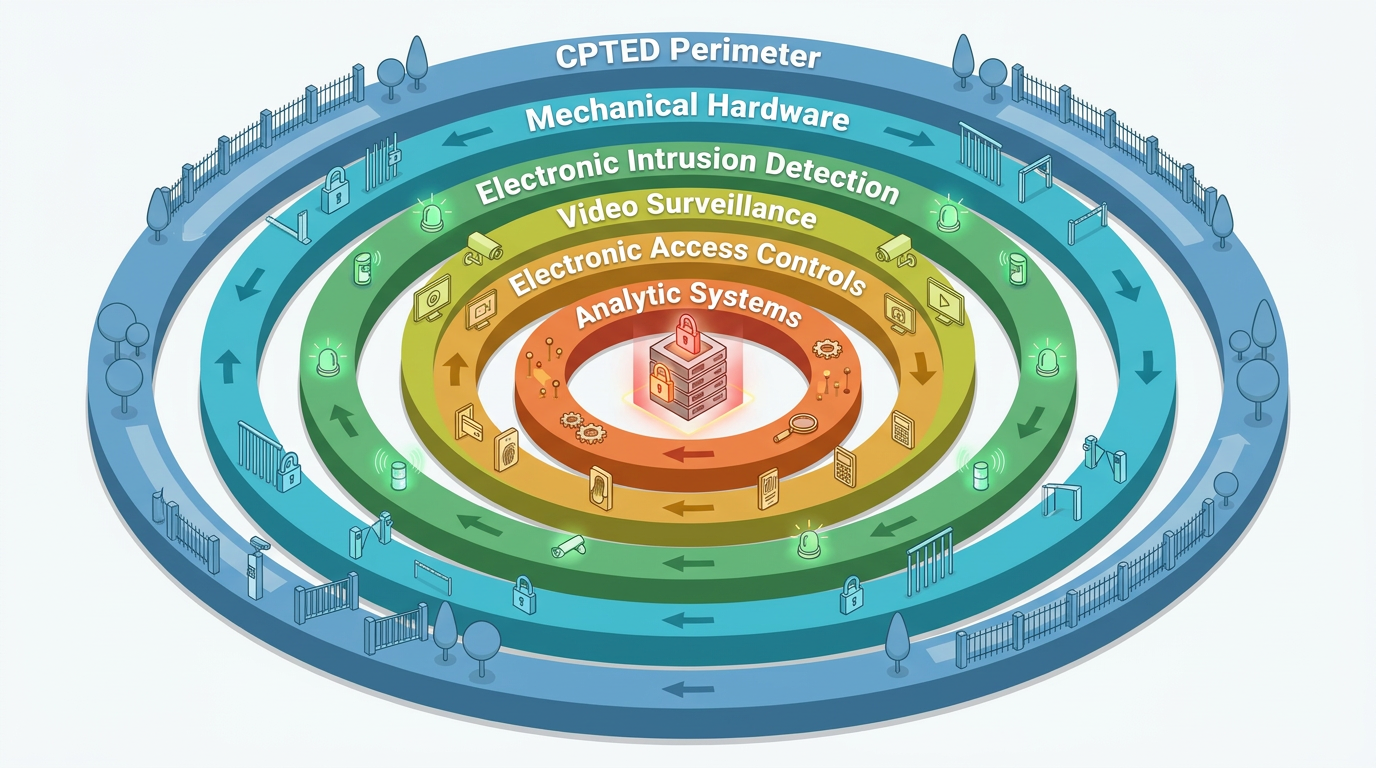
Physical security design uses a layered architecture that starts at the perimeter and works inward toward the most critical protected zones. A layered architecture places multiple physical barriers, both active and passive, around buildings, facilities, rooms, and informational assets. That defensive depth gives administrators more control points and introduces cascading countermeasures.
The layering follows a deliberate sequence. Sound sequencing starts at the perimeter with Crime Prevention Through Environmental Design (CPTED), then mechanical hardware, electronic intrusion detection, video surveillance, and electronic access controls, before adding analytic systems that tie physical design to operational response. CPTED emphasizes territorial reinforcement, surveillance, access control, and maintenance; concentric rings are a separate security-layering concept that can be coordinated with CPTED when considered early in facility design.
PACS design combines physical controls that prevent access with technical controls for hardware and software. Administrative controls establish the policies and procedures that govern both. Effective design treats physical, technical, and administrative controls as interdependent.
Zone Classification and Authentication Levels
Risk-Based Area Tiers
Layered architecture only works when each layer has an explicit protection level. Federal PACS planning uses three security area categories: Exclusion, Limited, and Controlled, and matches authentication mechanisms to each. Written for federal PIV deployments, the three-tier model provides a useful risk-based reference for protection planning.
Authentication factors should increase with zone sensitivity. A Controlled area requires one authentication factor. A Limited area requires two. An Exclusion area, holding the most sensitive assets, requires the strongest access controls, typically including multi-factor authentication and biometric verification. The zone classification drives the authentication requirement.
From Classification to Design Choices
Effective industrial access control begins with a risk assessment and security zoning that identifies critical assets and vulnerabilities, then assigns protection levels. Once each zone carries an explicit classification, downstream decisions about hardware selection, credential strength, and alarm response follow from it.
For regulated organizations, documented zone classification can support a more defensible baseline, especially where an access control system must meet statutory or regulatory compliance requirements.
Least Privilege and Credential Governance
Zone classification defines what protection each area needs. Least privilege defines who gets through. The least privilege principle holds that any user should have only the minimum permissions necessary to perform a specific function.
Least privilege decays without maintenance. Auditing permissions regularly ensures only those with a demonstrated need can enter, and reviewing audit logs more broadly shows who is accessing which areas.
Routine reviews should check for:
- Orphaned accounts
- Shared privileges
- Improperly elevated access levels
- Credentials that were not revoked after role changes or departure
Large deployments should manage identity as a central control point. Enterprise systems call for a long-term plan, including physical identity and access management (PIAM) for large deployments.
Access control systems must also stay flexible, since the need for access depends on shift, employment status, and work assignment. A system that cannot accommodate those variables forces administrators into workarounds that erode the least-privilege model. The same badge event may be routine during an assigned shift and higher-risk after that assignment ends or when it occurs near a more sensitive zone.
Fail-Safe and Fail-Secure Door Hardware
Door hardware behavior during power loss is a design decision with life-safety and liability consequences. A fail-safe lock releases when power is lost. A fail-secure lock stays locked. The safer or more protective choice depends on the door's purpose, the applicable life-safety code, and fire alarm system integration.
Choose lock behavior based on zone function:
- High-traffic paths may emphasize rapid egress.
- Sensitive zones may emphasize protection during an outage.
- Every opening still needs code-compliant egress and coordination with life-safety requirements.
Door-lock behavior must be selected for the opening. Getting this wrong can create liability exposure if a design defect in an access control system results in a loss. Even small gaps in lock hardware can create opportunities for bypass tools.
Hardware planning also needs to account for the surrounding infrastructure, so door, reader, cabling, power, and backup-power choices are coordinated before installation begins. Address outage behavior at the design stage before the first power failure.
Credential Technologies and How They Compare
Credential technology directly affects cloning resistance. RFID is the overarching category. It includes three frequency bands with distinct capabilities.
Proximity Cards
Proximity cards operate at 125 kHz and transmit a fixed, unencrypted ID number when presented to a reader. They offer no encryption, so they are straightforward to clone. The exposure is stark: modest equipment and minimal research are enough to exploit the credential vulnerabilities. These systems are not bound to any official standard. They exist as proprietary or de facto vendor systems.
Their appeal is cost and compatibility. Proximity cards are simple, affordable, and compatible with many legacy systems, which suits low-security environments such as general office buildings or warehouses. For any new installation, 13.56 MHz smart cards are the recommended minimum, with 125 kHz retained only where migration is still underway.
Smart Cards and High-Frequency RFID
High-frequency RFID smart cards operating at 13.56 MHz change the security model. Using MIFARE DESFire or similar technologies, they perform challenge-response authentication: the reader issues a challenge, the card responds using an encryption key, and both sides verify each other. A copied card number is useless without the matching key. ISO/IEC standards 14443 and 15693 are the appropriate standards for these applications.
Smart-card implementations vary. Some smart-card implementations provide stronger protection than older designs, so specifying an encrypted smart credential is itself a design decision.
Smart cards can carry more than a single ID. One credential can hold access control, time and attendance, cashless vending, and parking. That capability comes at a higher price point than proximity cards, so smart cards are often favored in higher-assurance environments where added security and functionality justify the cost.
NFC, Mobile, and Biometric Credentials
Mobile credentials reach the door through Bluetooth Low Energy or through mobile wallets read via NFC at 13.56 MHz. Mobile credentials can be encrypted at rest and biometrically secured so that only the assigned user can invoke them. Long-range ultra-high-frequency credentials operating at 860 to 960 MHz support vehicle access or hands-free pedestrian entry.
Biometric authentication compares a newly collected template against a stored reference, and its behavior differs fundamentally from card-based factors. Biometric authentication is probabilistic, while other factors are deterministic. Biometric template protection schemes can support revocation and renewal of compromised templates, but they remain constrained by the limited number of distinct biometrics available from an individual; ISO/IEC 30136:2018 provides a framework for testing their performance, secrecy, and privacy.
A compromised card can be reissued. A compromised biometric has only limited revocation options. That constraint makes biometrics better suited to high-assurance environments layered with other factors.
Migration Without Rip and Replace
Credential migrations can usually be staged over time. Multi-technology cards combine a 125 kHz proximity chip and a 13.56 MHz smart card chip on one credential, and multi-technology readers accept both frequencies. Existing proximity cardholders keep working while new staff receive encrypted credentials. Once the transition completes, administrators can disable legacy proximity support in the access control software. Organizations can start by deploying encrypted smart cards across sensitive production areas without a full replacement.
Threats a PACS Must Counter and the Design Mitigations
Several well-defined threats drive specific design mitigations:
- Tailgating, also called piggybacking, is an unauthorized person following closely behind an authorized one into a controlled space. Anti-passback prevents a cardholder from passing a credential back to a second person. It tracks each holder as in or out and refuses a second consecutive entry.
- Door Forced Open (DFO) means the door opened without a valid release signal. DFO is detected when the door position switch registers an opening with no corresponding badge swipe or scheduled release. Door Held Open (DHO) occurs when a door stays open past a preset time, which can defeat a credentialed entry when someone props it.
- Credential cloning creates a copy sufficient to pass authentication, which credential encryption addresses directly. Multifactor authentication combining a card, a PIN, or a biometric raises the bar further.
- Reader-to-controller communication also matters. Secure reader-controller protocols help reduce exposure to tapping and tampering, and bidirectional communication can give operators better visibility when reader problems occur.
Security vestibules, formerly called mantraps, use two interlocking doors where one must close before the other opens. This briefly isolates a single person. NIST SP 800-53 Rev. 5 formally replaced the term mantrap with vestibule in control enhancement PE-3(8). Vestibule designs may add technologies that verify only one person and deny access when they detect more. Optical scanners and weight-sensitive floors add tailgating regulation at the portal.
DFO and DHO conditions demand monitoring and response. Configure these events to notify a security monitoring center, so operators can dispatch a security response.
Architecture Types and Enterprise Design Tradeoffs
Wired and IP-Based Topologies
PACS topology shapes cost, scalability, and reliability. A traditional wired system links a master station, site controllers, and input devices by dedicated cabling, with access decisions made locally. This gives high security and strong integration at a higher upfront cost. It remains preferred for classified environments and data sovereignty requirements.
IP-based open-architecture systems use network infrastructure. They scale as organizations add hardware and support wireless locks, smartphone credentials, and biometrics with stronger encryption. Wireless connections often cannot match wired reliability and speed in device-dense environments.
Cloud and Edge-Cloud Deployments
Cloud deployments offer centralized management advantages, while deployment choices still require resilience planning. Decide where access decisions, event visibility, and administrative control should sit. Edge-cloud hybrid architectures place edge devices at the door for local processing and centralized visibility.
This pattern is used where existing cabling cannot support centralized architectures. That local processing matters because door behavior still has to support daily operations during disruption, while centralized visibility helps administrators manage operations consistently.
PACS topology already shapes cost, scalability, and reliability, so evaluate cloud placement as part of that same tradeoff. The same analysis should account for credential type, wireless locks, smartphone credentials, and video integration, since those choices affect how the system supports daily operations.
PACS and VMS Integration
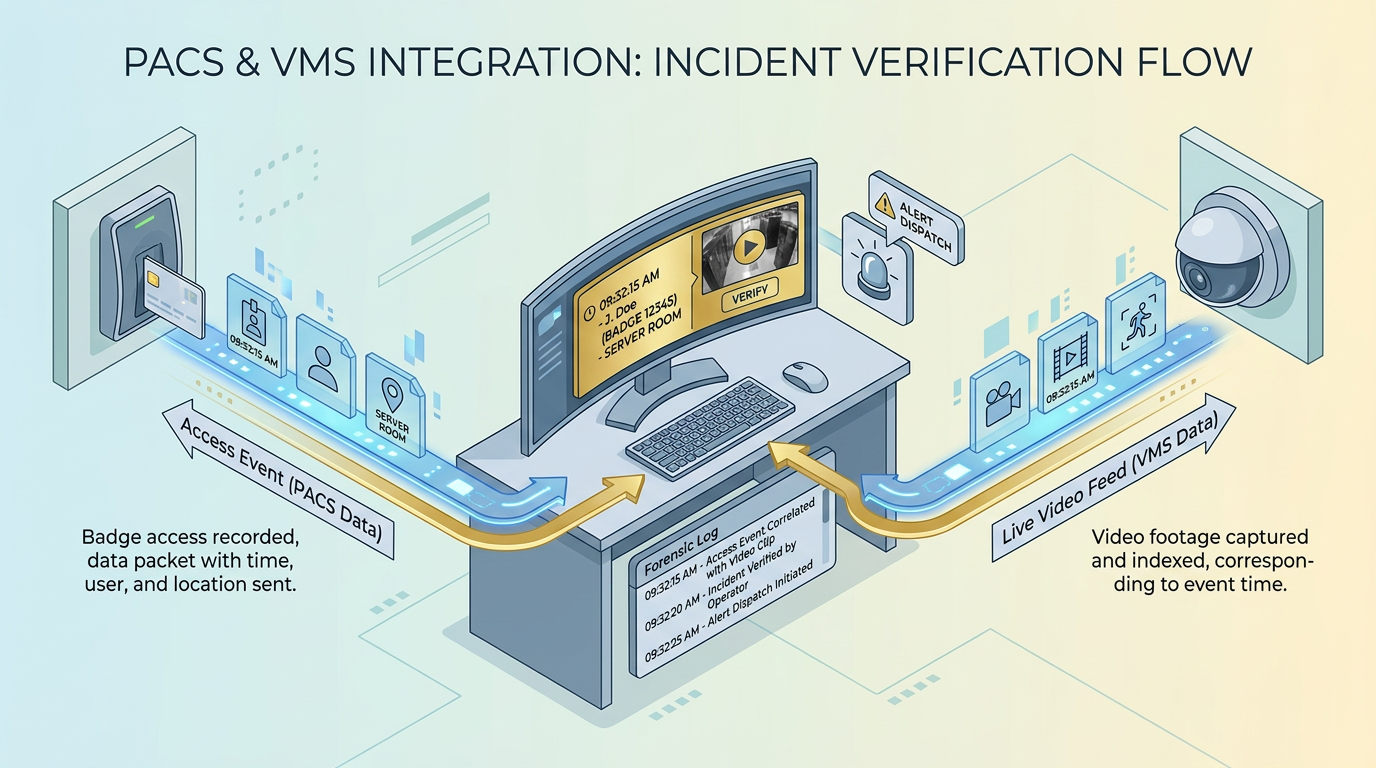
Integrating a PACS with a VMS lets operators turn discrete access events into verifiable incidents. Pairing badge data with live and recorded video gives operators the contextual awareness to confirm identity, spot tailgating, and dismiss false alarms without dispatching a guard.
ONVIF interfaces support integration of physical security equipment with other devices and systems. Profile C handles door control and event management. A video profile can be combined with it for a more secure entry system. When access is denied, video from a nearby camera can appear at the operator's workstation while an alert reaches the facility manager.
That same correlation accelerates forensic investigation after an incident, since access logs and matching footage can be retrieved together rather than reconciled by hand. Operating many standalone systems can make it difficult to correlate logs across the enterprise.
Compliance Frameworks That Constrain PACS Design
Several regulatory frameworks can constrain PACS design, and they often converge on a common set of operational controls. NIST SP 800-53 Rev. 5 organizes physical requirements under its Physical and Environmental Protection family. That family covers access authorizations, vestibule enhancements, monitoring, and visitor records. For any regulated organization, designers should translate applicable obligations into access rules, logs, visitor records, retention requirements, and review routines.
An organization subject to several frameworks can often map those obligations into one well-designed system.
The Governance Gap and Operational Lifecycle
Technical controls remain reliable only when the surrounding process is consistent. Split governance weakens technical controls: employees use tightly managed credentials at readers, while contractors or visitors are handled through short-lived manual processes that receive less review. Closing this gap means applying the same access lifecycle rigor to non-employees as to employees.
Credential Lifecycle
Credential lifecycle management covers identity proofing through issuance and revocation. Credentials must be tied to verified identities, and aligning with NIST SP 800-63 principles improves trustworthiness. Renewal must occur before expiration, otherwise the holder repeats full issuance.
Revocation must remove all associated credentials and accounts when a person is no longer eligible. An asymmetric credential model limits exposure: a compromised private key affects only that single card, not an entire site.
Visitor Lifecycle
Visitor management starts the access-control lifecycle. A workable visitor policy assigns authentication rights to specific personnel and stores information in a secure system that expunges visitor data after a set period. It also needs to stay easy enough that staff actually use it. The same lifecycle discipline used for employees should apply to visitors: access should be tied to a verified purpose, limited to the assigned space or time, logged, and removed when the visit ends.
A visitor system can flag individuals that an organization has pre-determined should not enter and link to physical access controls to maintain accurate logs. Treating visitors as part of the access-control lifecycle also reduces the split-governance failure mode in which badge readers are tightly managed, but temporary entry decisions rely on manual processes with less review.
Sequencing a Defensible PACS
The frameworks that govern this work reward consistency, and security teams understand the threats PACS designs need to counter. Security professionals who close the process gap that undermines otherwise sound systems gain the most durable improvement. A facility that classifies zones deliberately and specifies credentials that resist cloning gives operators stronger evidence when access events are integrated with video.
Frequently Asked Questions
How do you determine whether a door should be fail-safe or fail-secure, and what are the liability risks of choosing the wrong configuration?
Consult the Authority Having Jurisdiction, fire marshal, and building codes for your occupancy type. Wrong configuration can trap occupants during emergencies, exposing the organization to wrongful death claims, or allow unauthorized access during outages, creating liability for preventable losses.
What is the recommended migration strategy for transitioning from 125 kHz proximity cards to 13.56 MHz encrypted smart cards without disrupting daily operations?
Deploy multi-technology readers that accept both frequencies simultaneously, issue dual-chip cards combining both technologies, then disable the legacy frequency in software once all cardholders transition. This staged approach maintains uninterrupted access throughout the migration period.
How should organizations apply the same access lifecycle governance to visitors and contractors as they do to employees to avoid split-governance vulnerabilities?
Organizations should enforce standardized identity proofing, time-bound authorization approval, automated expiration triggers, and synchronized revocation procedures across all user types. Linking visitor and contractor records to the same audit trail and monitoring infrastructure eliminates manual workarounds that bypass technical controls.
