Door Access Control Technologies, Systems, and How to Choose the Right Setup
Learn how door access control systems work, compare credential technologies and architectures, and choose the right setup for your facility's security needs.
A door access control system decides, the moment a credential is presented, whether the person at the reader gets in. The resulting choice shapes a facility's security posture, and weaknesses that remain unnoticed during procurement can persist through the system's service life.
Facilities managers and security directors need to tell the difference between a setup that holds up over time and one that only looks solid on paper.
Key Takeaways
- In conventional panel-based systems, the controller makes the access decision. The reader passes credential data to it, and the wiring between them can undo the security of the strongest credential on the market. Intelligent edge devices may combine reader and controller functions at the door.
- Several widely deployed card families carry published security weaknesses, which makes the migration plan as important as the replacement technology.
- Fail-safe and fail-secure describe what a lock does when power drops; choosing the wrong mode can conflict with life-safety requirements or cause a sensitive area's lock to release during an outage.
- An AI reasoning layer over cameras, controllers, and sensors turns raw door events into contextualized incidents and catches threats, like tailgating and coordinated probing, that door contacts alone miss.
How a Door Access Control System Works
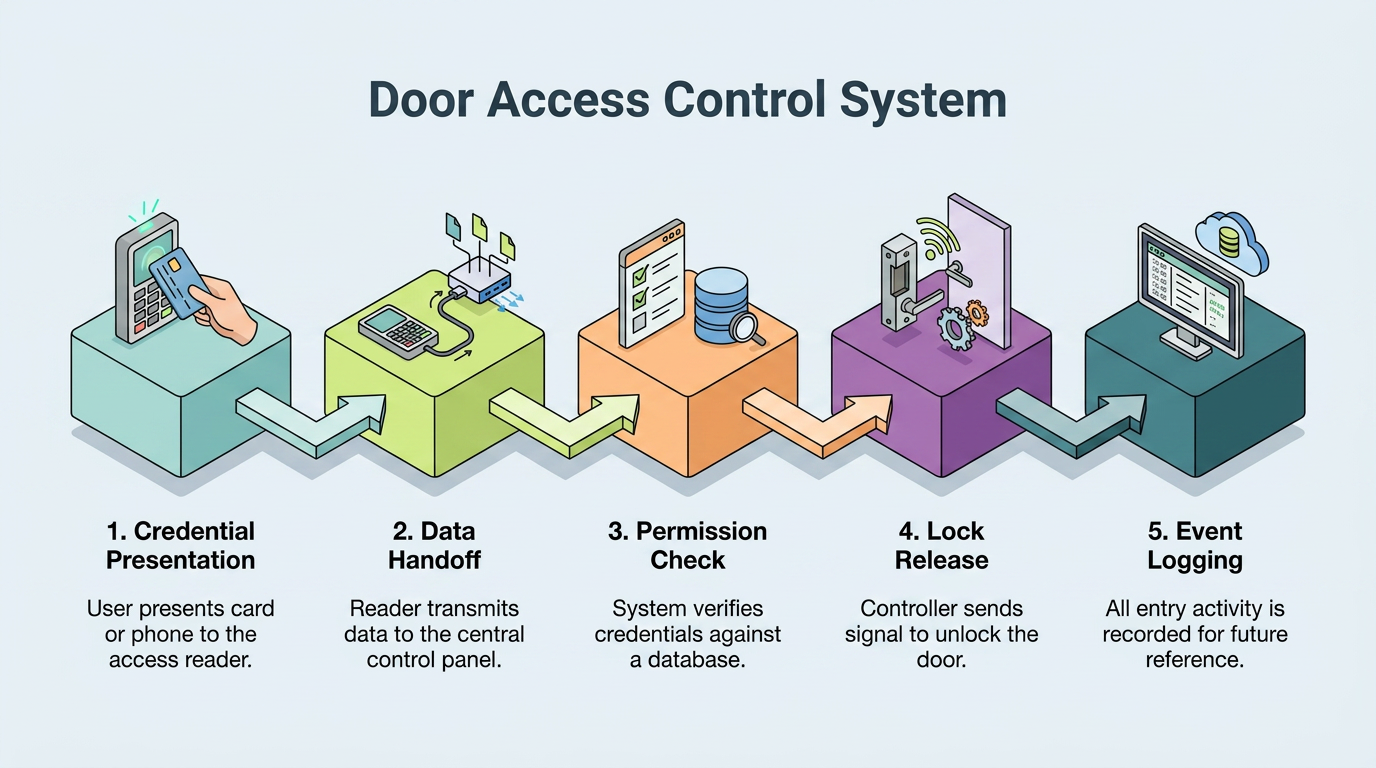
In a conventional panel-based system, a single access decision moves through a short sequence:
- Credential presentation. A cardholder presents a card, phone, personal identification number (PIN), or biometric at the reader.
- Data handoff. The reader passes the credential data to a controller. Intelligent edge systems may combine reader and controller functions at the door.
- Permission check. The controller matches the credential against an access control list in its local database.
- Lock release. On a match, the controller operates a relay that releases the electrified lock.
- Event logging. The system logs the badge ID, door, timestamp, and result, along with the reason for any denial: invalid badge, time restriction, area restriction, or malfunction.
Two design choices decide whether that sequence holds up under real conditions. Controllers should store permissions locally so decisions continue when the head-end server goes down; querying a remote server on each request adds delay and a network dependency.
On the egress side, a door position switch (DPS) reports whether the door is physically open, which makes forced-door detection possible, while a push button, motion sensor, or panic bar can serve as a request-to-exit (REX) device that lets occupants leave without presenting a credential.
Credential Technologies and Their Security Records
Legacy Cards with Published Breaks
Low-frequency proximity cards broadcast an unencrypted number with no cryptographic protection. These cards are a poor fit for new deployments requiring protection against credential cloning and should be sunset, yet 14% of organizations still run them.
MIFARE Classic cards are not much safer. A specific chip used in some of them, the FM11RF08S, ships with a documented hardware backdoor that lets an attacker recover the card's secret keys within minutes of holding the card, effectively cloning it. Affected chips have already turned up in hotel key cards across the US, Europe, and India.
Smart Cards, Mobile Credentials, and Biometrics
Advanced Encryption Standard (AES)-based smart cards provide a baseline for new enterprise deployments when their security features are correctly configured.
Near-field communication (NFC) provides a short-range communication channel, while credential security depends on the cryptography and hardware protections used by the specific implementation. Encryption alone does not stop a relay attack.
PINs are a single knowledge factor. PIN-only authentication may be appropriate for lower-risk applications, while higher-risk areas can require a PIN alongside a card or another factor. Biometrics are a high-assurance factor in multi-factor deployments, but a compromised biometric cannot be revoked the way a card can.
The Wiring Between Reader and Controller
Credential strength means little if the reader-to-controller link is Wiegand: one-way, unencrypted, and unsupervised.
Open Supervised Device Protocol (OSDP), published as an International Electrotechnical Commission standard, replaces that link. It runs bidirectionally over a serial connection, protects traffic through Secure Channel, supports longer cable runs with multiple readers per cable, and supervises devices so the controller detects reader faults and line tampering.
Because Secure Channel is not necessarily active in every installation, security teams should verify activation through a configuration audit or acceptance test. Administrators should also configure controllers to refuse unprotected reader communications and limit temporary commissioning settings to installation windows.
Deployment Architectures and Their Tradeoffs
Once controller communications are secured, system architecture determines where access decisions and management records reside. On-premises panel-based systems can keep every decision and record on the local network, which suits regulated industries with strict data residency needs. Each new site needs its own server hardware and licenses, and the organization owns patching, backups, and recovery.
Internet Protocol (IP) edge controllers move the decision to the door over Power over Ethernet (PoE). This cuts home-run cable costs and maintains local decisions through network interruptions. Cloud-hosted access control as a service (ACaaS) leaves readers and controllers on-site while management moves to a browser; adding a location needs no new server and permission changes reach every site at once, in exchange for per-door subscription fees and dependence on the provider. On-site controllers continue making access decisions when connectivity drops, though administration pauses.
Hybrid deployments link legacy on-premises panels to a cloud platform through a connector, common where enterprises pair air-gapped high-security sites with cloud-managed offices. Battery-powered standalone wireless locks cover openings needing no real-time monitoring; offline models require lock-by-lock audit retrieval and credential updates.
Fail-Safe and Fail-Secure Locking Hardware
Whatever architecture supports the controller, the lock's behavior during a power loss remains a separate design decision. Fail-safe hardware releases when power drops; fail-secure stays locked and needs power to open.
The terms describe only the ingress side: many electrified locking arrangements provide free mechanical egress in either mode. Electromagnetic locks operate only while powered and therefore require a separate release arrangement.
The correct lock mode depends on the opening's function, fire rating, egress design, adopted codes, and authority having jurisdiction. Server rooms, data closets, and pharmacies often prioritize remaining locked from the ingress side during an outage, while other openings may require lock release.
Security, facilities, and life-safety professionals should validate each selection against the requirements applicable to the site and select the mode for each opening individually.
Door Events, Tailgating, and Turnstile Barriers
The lock and door contact together produce the events that operators must interpret. Door Forced Open (DFO) fires when the DPS sees the door open without a valid lock-release command. Door Held Open (DHO) fires when a door stays open past a threshold after a valid entry.
DFO is noisy in practice, since a mechanical key looks identical to a forced entry, and large facilities generate floods of false alarms during business hours. DHO events need context to sort: a loading-dock door held open during a scheduled delivery is routine; the same door after hours is not.
Anti-passback controls card sharing by blocking a badge from entering twice without an intervening exit, but cannot stop physical following. A tailgater walking behind a valid cardholder generates no violation at all. Usage varies, but tailgating commonly means following without the cardholder's knowledge, while piggybacking means the cardholder cooperates.
National Institute of Standards and Technology (NIST) physical access controls address both through access control vestibules: interlocking door pairs where the first set must close before the second opens. Other barrier options include tripod, full-height, and optical turnstiles, security revolving doors, and mantrap portals. Optical turnstiles may warrant guard supervision where site conditions leave them vulnerable to bypass.
The AI Layer: What's Next in Door Access Control
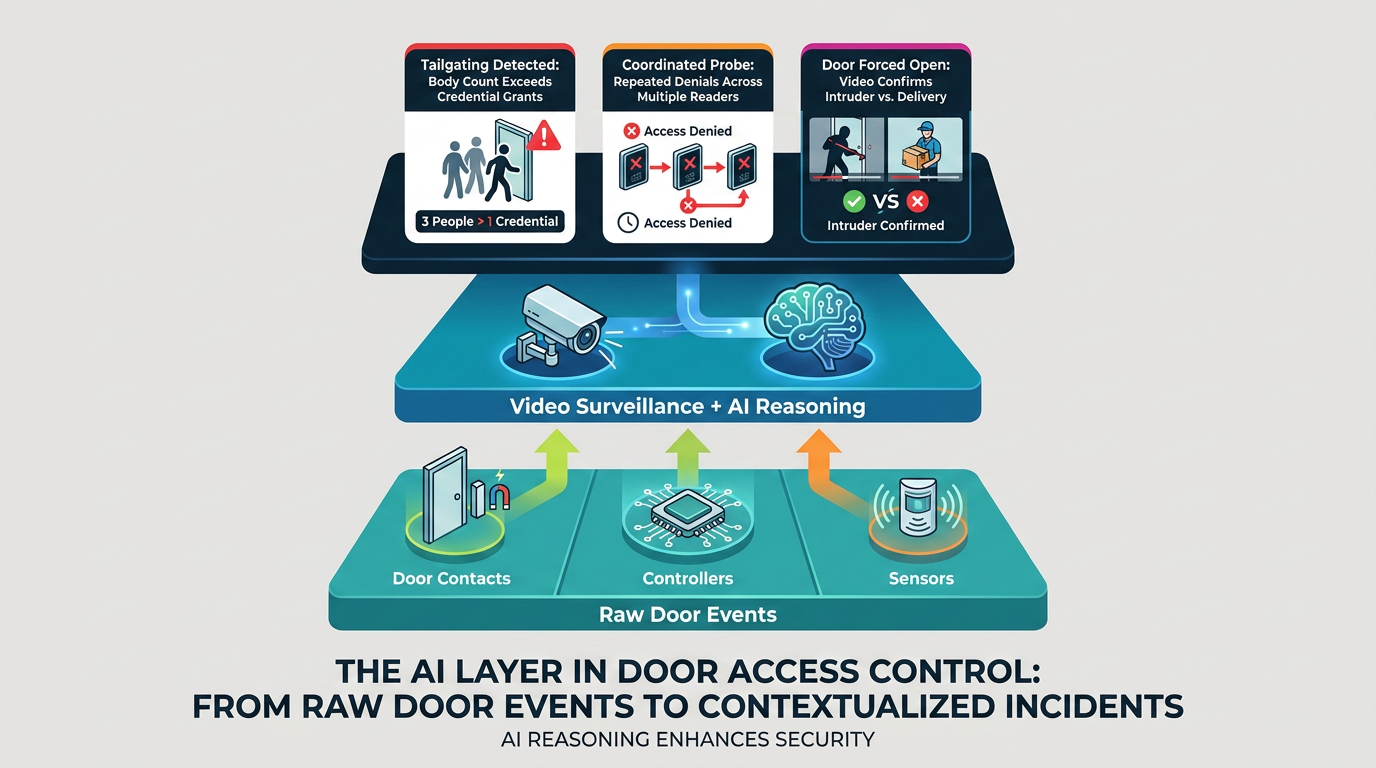
Traditional access control produces two states at each opening: grant or deny. Neither captures whether an authorized entry masks a threat, whether a denied attempt fits a broader pattern, or whether behavior at the door warrants review. An AI reasoning layer applied across existing video surveillance, controllers, and sensors interprets these signals together in real time, distinguishing routine activity from genuine risk.
That reasoning converts isolated door events into contextualized incidents. A DFO paired with live video shows whether a door was propped for a delivery or forced by an intruder. Tailgating that generates no controller violation becomes visible when body counts through the opening exceed valid grants. Repeated denied attempts across multiple readers surface as a coordinated probe rather than isolated errors, shifting operators from alarm triage to verified threats and pre-incident detection.
Compliance Requirements by Sector
Access events become regulated records when a facility falls under sector-specific audit requirements. The Payment Card Industry Data Security Standard (PCI DSS) physical access requirements require visitor logs and physical access monitoring data retained for at least three months.
The North American Electric Reliability Corporation (NERC) physical security standard requires electric utilities to log each entry into a Physical Security Perimeter, retain those logs for at least 90 calendar days, and continuously escort visitors.
How to Choose the Right Setup
Those operating and compliance requirements should shape a long-term plan centered on identity, with the application determining the equipment. Large reader deployments should plan for physical identity and access management (PIAM) from the outset.
Organizations should tier each area by risk and increase authentication strength as area sensitivity rises, consistent with federal ordering guidance.
Against that plan, security teams should weigh the candidates on:
- Credential migration path. Multi-technology readers that accept both smart cards and legacy prox support a phased transition, provided the sunset date is fixed and enforced.
- Open standards. An acceptance test should confirm that OSDP Secure Channel is active and the controller rejects unprotected reader communications.
- Controller security and resilience. Contracts should require update support and a test confirming local decision-making during network interruptions.
- AI-based event reasoning. Verification should confirm that door events, video, and denied-attempt patterns can be correlated in real time, not just logged for after-the-fact review.
- Total cost of ownership. Organizations should compare the installation quote, license fees, per-door subscriptions, and maintenance across the planning horizon.
Weigh the Full Access-Control Chain
Before evaluating anything new, procurement teams should audit what exists: which readers still transmit in plaintext, which card families are clonable, how each lock behaves when power fails, and where door events go unreviewed for lack of context.
The resulting findings can become measurable requirements for credential migration, controller configuration, outage behavior, AI-based event reasoning, and acceptance testing.
Frequently Asked Questions
What is the difference between Wiegand and OSDP protocols for reader-to-controller communication, and why should organizations migrate to OSDP?
Wiegand transmits data one way without encryption or supervision, making tampering invisible to controllers. OSDP operates bidirectionally with encrypted Secure Channel protection, detects line faults, and supports multiple readers per cable over longer runs, closing vulnerabilities inherent to Wiegand's design.
How does an AI reasoning layer detect tailgating and other physical security threats that traditional door access control systems miss?
AI cross-references video analytics with controller logs to count bodies passing through openings, revealing discrepancies when entries exceed credential grants. This spatial-temporal correlation detects coordinated attacks and distinguishes intentional breaches from routine workflow activity that binary systems cannot identify.
What is the difference between fail-safe and fail-secure locks, and how do you determine which mode is appropriate for each door in a facility?
Selection involves coordinating security directors, fire marshals, and facility engineers during the design phase. Each door receives individual evaluation against adopted building codes, occupancy classification, and the specific authority having jurisdiction's interpretation rather than applying facility-wide defaults.
