Hospital Access Control: A Complete Guide for Healthcare Facilities
Learn how hospitals manage access control across pharmacy, behavioral health, and emergency departments while meeting HIPAA, DEA, and Joint Commission standards.
Hospitals face access control challenges unlike almost any other type of building. Security has to work without getting in the way of patient care, and approaches designed for corporate offices simply don't hold up in this environment. Controls need to stay practical during high-pressure moments while still safeguarding people, sensitive information, and the critical operations that keep the facility running.
Key Takeaways
- Medication rooms face overlapping privacy, care-quality, accreditation, and controlled-substance requirements, each of which shapes security controls.
- Gloved hands, infection control, and shift-change speed drive credential choice in clinical space as much as cryptographic strength.
- Propped doors and courtesy holds at shift change undo the most expensive hardware.
- Lockdown planning must account for how each controlled opening behaves during fire alarms and power loss.
Why Hospital Access Control Resists Standard Design
Hospitals must preserve public access for urgent care while separately protecting medications, hazardous materials, quarantine areas, and people arriving under stressful conditions. That mix creates distinctive hospital access complexity.
Designers respond by adding controls, and each one has a cost. As controls multiply, monitoring and compliance become harder for operators and staff. Clinical staff who cannot work a control quickly work around it, which is why propped doors and badge sharing cluster at shift change. Courtesy holds also increase when door traffic is heaviest and the time to badge through is shortest.
The Regulatory Stack Behind Every Locked Door
Health Insurance Portability and Accountability Act (HIPAA) legal requirements, Centers for Medicare & Medicaid Services (CMS) Conditions of Participation, Drug Enforcement Administration (DEA) controlled-substance regulations, and Joint Commission accreditation standards each shape hospital access controls from a different angle, and their requirements and standards overlap.
DEA regulations at § 1301.71 require effective controls against theft and diversion, judged on factors that include key control, alarm adequacy, and unsupervised public access.
HIPAA Physical Safeguards
The Security Rule's facility access standard, § 164.310(a)(1), requires policies limiting physical access to electronic information systems and the facilities housing them while preserving authorized access. Its addressable specifications cover a facility security plan, access control and validation procedures including visitor control, contingency operations, and maintenance records for doors, locks, and walls. Those door-level controls help secure electronic protected health information (ePHI) by limiting physical access to systems and facilities.
CMS and Joint Commission Requirements
CMS Conditions of Participation at § 482.25(b)(2) require drugs and biologicals to be kept in a secure area and locked when appropriate. Schedule II–V controlled substances must be locked within a secure area, accessible only to authorized personnel. The Joint Commission's EC.02.01.01 requires hospitals to control access to security-sensitive areas, keep response procedures for infant and pediatric abductions, and run an annual worksite analysis for workplace violence prevention.
Under the current Joint Commission framework, separate management plans are no longer required for most hospital types, and National Performance Goal (NPG) 11.01.01 now has the access control requirement.
How Requirements Change Zone by Zone
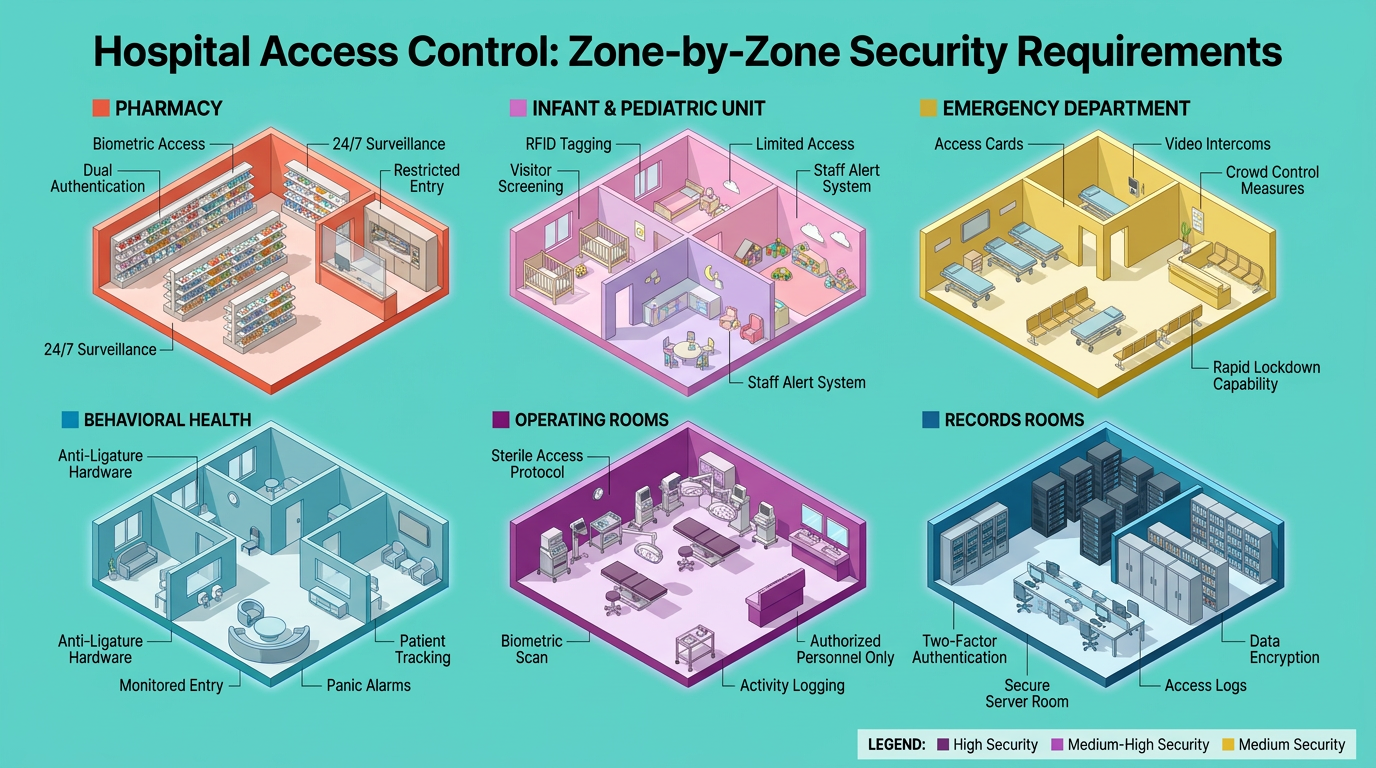
Pharmacy, infant and pediatric units, emergency departments, behavioral health, and records and network spaces present separate design problems. Surgical suites require controlled traffic and sterile boundaries. In each zone, the regulatory stack produces a different combination of authorization, monitoring, and response.
Pharmacy and Medication Storage
Controlled substance storage areas must be accessible only to an absolute minimum number of specifically authorized employees under § 1301.72(d), with any non-authorized person present observed by an authorized employee. Pharmacy controls need to limit both room entry and medication access, preserve event records, and remove privileges promptly when an employee is terminated or suspended.
Department heads and security administrators should review the authorized list together, investigate after-hours entries and denied attempts, and include room credentials and automated dispensing cabinet (ADC) privileges in the same offboarding check. Door and medication-system records should be compared when verifying that access ended on the employee's departure date.
Infant and Pediatric Units
Unlike pharmacy controls focused on diversion, infant and pediatric units require perimeter containment. Access-control teams should restrict every door, elevator, and stairwell serving the unit to authorized personnel and use delayed-egress hardware where codes permit.
Infant abduction is a sentinel event. Security staff should limit visitor credentials to approved unit access zones and route tag and door alarms to the team responsible for immediate on-site response.
Emergency Departments
The emergency department (ED) is a secured buffer between the public and the rest of the hospital. Many emergency departments separate the ambulance entrance from the walk-in entrance, while access controls limit visitors moving into treatment areas and the main hospital.
Security teams should define visitor credential boundaries and response ownership for denied access, held-open doors, and movement beyond approved treatment areas. The current International Association for Healthcare Security and Safety (IAHSS) guidelines include weapons screening guidance naming emergency departments among the priority locations for detection systems.
Behavioral Health Units
Unlike the ED's managed public access, behavioral health controls depend more directly on patient risk and approved egress arrangements. Their fire-alarm interface and fail-safe or fail-secure configuration depend on the patient population, opening, egress arrangement, and approved design.
The Facility Guidelines Institute's design guide for behavioral health crisis units adds security stations, duress alarms, perimeter security, and ligature-resistant features graded by patient risk.
Security leaders should document who may enter each risk area, who receives duress and door alarms, and which team owns immediate response. Access reviews should also confirm that permissions still match staff roles and the approved patient-risk configuration.
Operating Rooms and Surgical Suites
Surgical suites require controlled traffic and sterile boundaries. A common zoning model narrows entry at the semi-restricted line to authorized staff and patients in surgical attire; under this model, the restricted zone, the operating rooms and clean core, is reachable only through semi-restricted corridors. Access controls should reinforce those boundaries without slowing authorized clinical movement, and credential permissions should follow the role and zone rather than grant uniform access across the suite.
Department heads should own role assignments for semi-restricted and restricted zones, while credential administrators apply and remove those permissions. Reviews of denied entries, held-open doors, and after-hours activity can identify boundary problems without broadening access for convenience.
Records Rooms, Wiring Closets, and Data Centers
The facility access standard at § 164.310(a)(1) also covers electronic systems. For areas containing ePHI that are not staffed around the clock, use monitored intrusion alarms plus door-position-switch alarms on breached entry points and doors held open. Those events should enter the same review process as other sensitive-zone alarms so operators can distinguish authorized maintenance from forced entry or prolonged access.
How a Hospital Access Control System Is Assembled
Zone-specific policies become enforceable only when they are translated into readers, controllers, credentials, monitoring rules, and locks. Behind a controlled door sit a reader, an Internet Protocol (IP) door controller, management software, and an electric lock or strike.
Standalone locks control one or a few openings and may store events locally, but they lack the centralized audit trail of networked systems. Networked systems log access events centrally, which is what makes zone access reviews and offboarding verification practical.
Centralized event records also let operators compare denied entries, held-open doors, and unusual after-hours activity across multiple sensitive zones during review. Physical identity and access management (PIAM) platforms sit above that hardware, so one management portal manages several access control systems.
Credential Technologies Under Clinical Constraints
Legacy Wiegand interfaces do not provide the interoperability, cybersecurity, and device-management capabilities available through the Open Supervised Device Protocol (OSDP), an International Electrotechnical Commission (IEC) standard that is replacing them.
Evaluate 125 kHz proximity cards and 13.56 MHz smart cards by verifying how the specific implementation protects identifiers and authentication. Mobile-credential reviews should likewise examine revocation and device binding, along with device authentication and whether a phone-based credential is harder to share than a badge.
Biometric identification reduces the ease of credential sharing but collides with clinical reality: gloves make traditional fingerprint scanning impractical, and infection control pushes facilities toward contactless biometric options. Personal identification number (PIN) codes are comparatively easy to disclose or observe, and slow keypad entry at shift change feeds tailgating behavior.
Visitor and Vendor Access
Temporary visitor and vendor access requires separate credential management. Hospital policy may require visitor badges to carry a photo and an expiration time. The badge may also identify the approved access zones the holder may enter. Screening may run against flagged-individual lists of terminated employees and known violent persons.
Hospital policy can require the vendor credentialing system to verify credentialing prerequisites before issuing a badge, including:
- Immunization records
- Background checks
- HIPAA training
- Insurance
Security staff may escort vendors to designated areas, and credential administrators can distinguish between representatives who must remain outside clinical areas and those who assist providers directly. Under such policies, a lapsed prerequisite ends the badge.
Door Alarms, Tailgating, and Video Verification
Once credential administrators issue credentials, security operators must use the monitoring layer to identify misuse and abnormal door activity. A Door Forced Open (DFO) event is an opening with no release signal from the access-control system, often involving a mechanical key; a Door Held Open (DHO) event occurs when a door remains open beyond a configured time threshold, often indicating a propped door.
Tailgating is an unauthorized person following a badge-holder through; piggybacking is the badge-holder knowingly holding the door. These events remain persistent access-control problems even when credential and locking hardware work as designed.
Optical turnstiles alarm on a second body but require manned response at the site; security revolving doors and mantrap portals enforce single-person passage rather than record violations.
When access control is integrated with a video management system (VMS), DFO, DHO, access denied, and tailgating events can trigger video correlation. The operator sees the time, the user's name, the credential, the door, and whether access was granted or denied overlaid on the video. A held-open alarm at a loading dock may warrant an officer check; the same condition at an infant protection area needs immediate on-site response.
Layering AI Detection Onto Existing Access Control
Video correlation still depends on operators catching what cameras and readers recorded in the moment. An AI physical security layer applied to the same feeds surfaces behavioral patterns that would otherwise sit unnoticed: tailgating at a semi-restricted corridor, loitering along an infant protection perimeter, or a weapon carried through an emergency department entrance.
A hospital monitoring station may cover hundreds of cameras across pharmacy, behavioral health, and the ED, and there are too many feeds for any operator to absorb simultaneously, regardless of skill or dedication. Reasoning AI narrows the review queue to activity tied to each zone's risk profile, so response teams spend time on verified incidents rather than scanning healthy feeds.
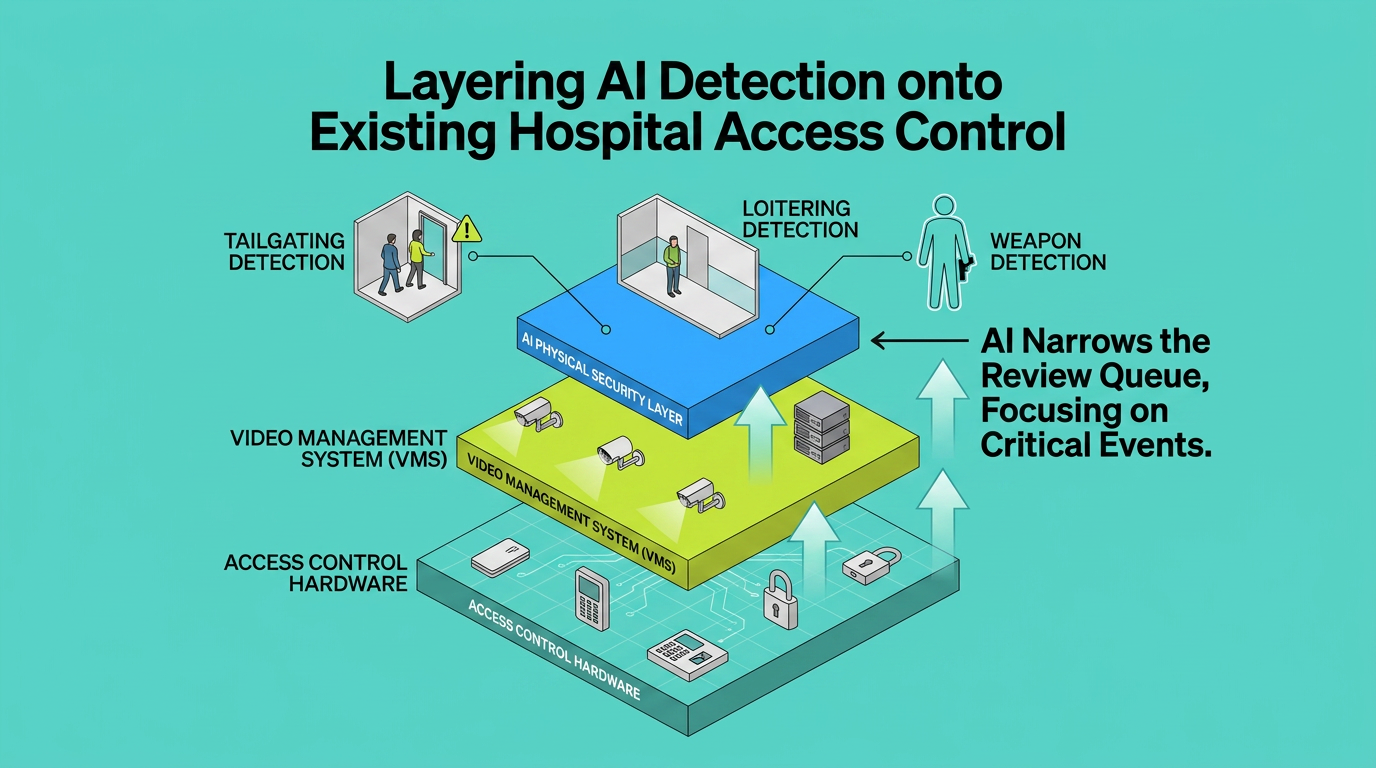
An AI layer also strengthens the connection between an access event and what the camera saw. A denied-badge attempt at a pharmacy door reads differently when it follows a person who has already loitered outside the vestibule, and a held-open alarm on a behavioral health unit reads differently when the same alert coincides with an unfamiliar face in the corridor. Combining door state, credential activity, and image reasoning gives operators a clearer basis for deciding whether to dispatch, hold, or clear the event.
Locking Down Without Trapping Anyone Inside
A controlled lockdown screens everyone entering or exiting while operations continue. A partial lockdown stops entry and exit, while a full lockdown halts patient movement and sends staff to secure locations.
During an active shooter event, staff follow the approved emergency action plan and may evacuate, shelter, or take other protective action based on their location and the immediate threat. Seven percent of U.S. hospitals lack total lockdown capability. In a Code Pink, the approved infant-protection design may initiate configured door and elevator controls while staff run the search protocol. The design must preserve required egress and fire-alarm behavior.
A fail-safe lock releases whenever its locking power is removed. Whether a fire alarm removes that power depends on the opening, free-egress method, adopted code, approved hardware configuration, and authority having jurisdiction. The same factors determine whether a fail-secure arrangement is permitted. Designers resolve part of the conflict through routing. Egress paths should not carry occupants through higher-security areas to reach lower-security ones.
Running the Program After Installation
Access lists age faster than rosters. Security directors review them for pharmacy, neonatal intensive care, the ED, and behavioral health with the department heads who own them.
Offboarding is the quietest failure mode. Security teams collect keys. They also collect badges and access cards, while access-control administrators deactivate facility access codes when employment ends, per National Institute of Standards and Technology (NIST) guidance. ADC credentials belong on the same list. Between audits, centralized logs should alert on after-hours entries into sensitive zones and rapid multi-door attempts.
Closing the Gap Between Departure and Deactivation
Control strength has to match the zone rather than the building. One seam sits between those design decisions and the roster: a badge deactivated while the network login persists, or the reverse. Security leaders can evaluate this seam by reviewing the most recent quarter of terminations and confirming that badge deactivation, dispensing cabinet privileges, and network accounts all closed on the same date.
Frequently Asked Questions
How do hospitals balance fail-safe and fail-secure lock configurations to maintain both lockdown capability and fire code compliance during emergencies?
Hospitals route egress paths to avoid directing occupants through high-security zones toward lower-security exits. Authority having jurisdiction approval and fire alarm integration determine whether fail-secure locks are permitted, with selective power removal based on door function.
What are the best practices for synchronizing badge deactivation, dispensing cabinet access removal, and network account termination during employee offboarding in a hospital?
Create a shared checklist owned by security, IT, and pharmacy, triggered by HR offboarding. Quarterly audits verify simultaneous deactivation across all three systems, identifying gaps before controlled substance diversion or unauthorized access occurs.
How can AI-powered video analytics reduce false alarms and improve response times for tailgating and door-held-open events in high-security hospital zones like pharmacy and neonatal units?
AI correlates behavioral patterns with door states to distinguish shift-change crowding from breaches. By analyzing loitering, movement, and access attempts alongside credential events, the system prioritizes alerts requiring dispatch over routine violations, reducing workload in patient-safety zones.
