Parking Access Control: What AI Adds to Video and Credentials
Credential readers verify identity, but they can't show what happens after the gate opens. Learn how AI video detection closes the gap in parking security.
Parking access control decides which vehicles and people enter a facility, and the credential technologies doing that work keep getting stronger. In a parking facility, however, authorization alone doesn't show what physically happens after access is granted.
Key Takeaways
- A credential reader validates a presented badge, tag, or plate; traditional controlled doors can still admit multiple people during the same open cycle.
- Event-driven context lets operators manage a large camera estate without continuously watching more feeds.
- AI video detection can detect tailgating that credentials alone cannot observe by comparing discrete people and vehicles observed at a threshold with the access event that opened it.
- Parking operators should map state plate-reader rules and, where federal contracting applies, covered-equipment restrictions before selecting cameras.
How the Credential Layer Works
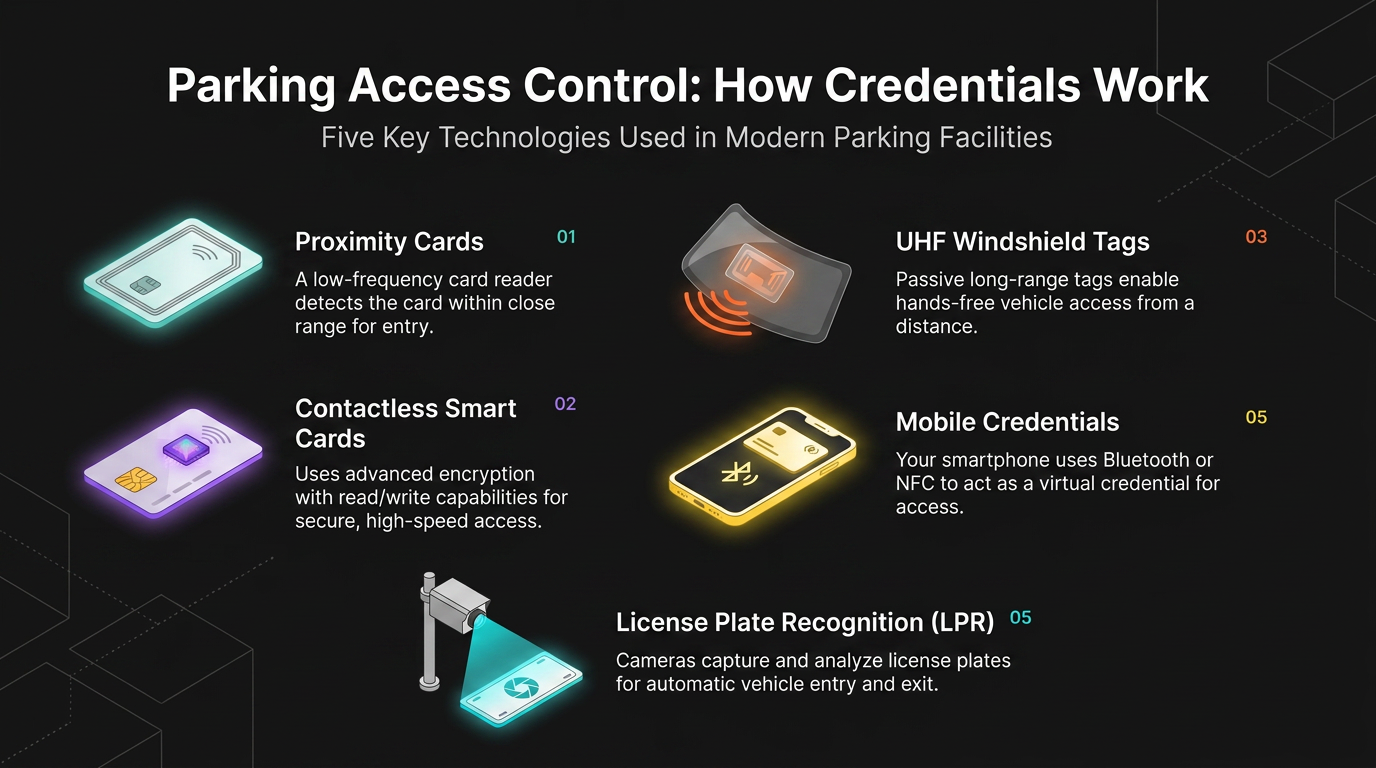
A parking access and revenue control system (PARCS) coordinates entry and payment, credentials, gates, and transaction records. At the lane, an inductive loop cut into the pavement senses vehicle metal and signals presence to the controller. The barrier arm lifts when the credential or payment condition is satisfied, and the controller uses the vehicle-presence signal to manage the barrier cycle. The credential itself takes several forms:
- Proximity cards broadcast a static, unencrypted identifier that can be copied and replayed. Older proximity credentials remain in use partly because migration can require broad hardware and credential replacement.
- Contactless smart cards carry an onboard encryption engine that protects card-to-reader transactions.
- Ultra-high frequency (UHF) windshield tags offer long detection ranges. They can be read while the vehicle is still moving, so the arm can open before the driver stops.
- Mobile credentials can use Bluetooth-based access from a smartphone and eliminate the need for a physical card.
- License plate recognition (LPR) extracts plate characters from a camera image and checks them against an authorization database. LPR also produces a timestamped vehicle-layer record analogous to a badge swipe.
Where Credentials Go Blind
Credential upgrades can harden the check itself, but the credential transaction alone does not establish how many people or vehicles pass during the interval between validation and relatch. Parking facilities are common settings for violent and property crime relative to most other real estate.
Vehicle Tailgating at the Gate
The credential completed its job when the authorized vehicle validated; the controller may not distinguish an additional vehicle passing through the same open cycle. A following car can stay close to an authorized vehicle, and the gate's safety loops can hold the arm up while they still detect vehicle presence through a change in loop inductance. Slow gate speed and long open times widen the window. Thin detection coverage does too, but the deeper problem is in the transaction logic.
Cloned and Shared Credentials
A cloned proximity card presents the panel with the same identifier as the original, and the panel grants access because the presentations appear identical. Credential data may also be captured without taking possession of the card. Anti-passback rules may block sequential reuse at configured readers, but they do not observe physical space. Anti-passback alone may not reveal a clone used at another reader or a badge handed to another driver.
Pedestrian Doors and the Elevator Gap
Garage stairwell and lobby doors log a transaction for each valid read, while multiple people may pass through the controlled opening. Sensor faults and maintenance issues can resemble habitual propping in a log, so door forced open (DFO) and door held open (DHO) alarms still require interpretation. Video supplies the missing context. Elevators can add a further gap: some garage designs allow anyone past the gate to call the elevator from the parking level without presenting anything and ride into the building, even where the cars themselves carry readers.
Why More Cameras Alone Fall Short
Staffed monitoring runs into measured human limits. The standard response to these blind spots is to point cameras at every lane and door and route the feeds to a physical security operations center (PSOC). Detection accuracy declines as operators monitor more simultaneous feeds, and sustained attention declines during continuous viewing. Resource limits cause attention to decline even among diligent operators, and expanding camera estates increases that load.
Alarm-driven monitoring creates a separate reliability problem. Burglar-alarm systems can generate false activations, and high false-alarm volumes can reduce trust in later warnings. Motion-triggered alerts from parking cameras can create the same operational problem when nuisance events dominate the queue while operator attention is already declining.
What AI Adds to the Stack
AI video systems change what those same cameras report. The video layer produces structured events that can be checked against physical access control system (PACS) transactions.
Counting Entries Against Access Events
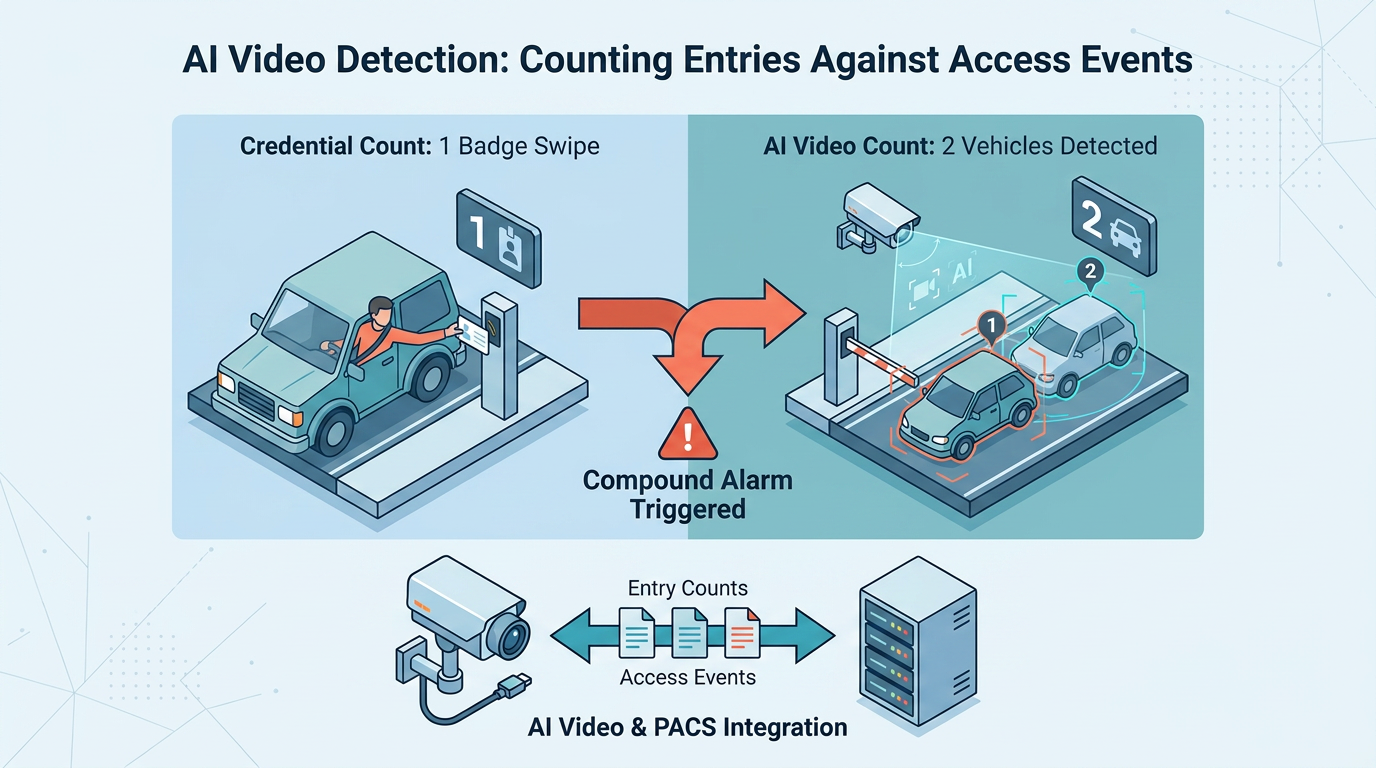
Integrated systems can be configured to classify and count discrete vehicles or people crossing a threshold, then compare that count with the timestamped PACS event that opened it. Multiple cars through a tag read, or multiple people through a badge swipe, can produce a compound alarm neither system could raise alone: the reader never saw the additional entrant, and the camera by itself does not know how many credentials were presented.
Whether the systems connect directly or through a broader platform, the relevant comparison is a body count against a credential count.
Reading Behavior Instead of Motion
Count correlation addresses threshold mismatches, while behavioral detection adds context beyond the crossing itself. Rule-based motion detection triggers on pixel change inside a zone and cannot weigh context. Behavioral detection tracks position and velocity and evaluates dwell time across frames, so the judgment uses trajectory.
An employee circling the same aisle at shift change looking for a space generates as much motion as a person walking the rows overnight and pausing at door handles; dwell-time and path analysis gives the system additional evidence for distinguishing the two that a motion threshold lacks. That distinction has real stakes for parking specifically: national victimization data put 7.0% of violent crime incidents in a parking lot or garage, and 17.0% of robberies occur in the same setting, a disproportionate concentration given how little of the built environment parking facilities occupy.
Trajectory-aware analytics are what let an operator separate a loiter-and-try-handles pattern from ordinary aisle traffic before it escalates. Recognizing detailed behaviors can lower both false-alarm volume and the review burden on any single operator.
Video-Verified Access Alarms
That context becomes more useful operationally when access alarms arrive with matching video. When a DFO alarm includes the relevant footage, attached video can shorten review by eliminating the need to open a separate video system, find the right camera, and scrub to a timestamp.
That same correlation can expose sensor misfires. Operators can then create tickets for maintenance faults and reserve dispatches for other alerts. Adding corroborating PACS, video, and sensor context can also help operators assess an alert before escalating it.
Honest Expectations for LPR
The same need for context applies to LPR, whose field accuracy swings widely with weather, camera angle, lighting, and plate condition. Controlled-benchmark figures do not transfer to unconstrained parking lanes.
Documented failure modes in a DHS market survey include phantom reads of bumper stickers and duplicate reads of the same plate, along with degraded performance on specialty and out-of-state tags. Where vehicle spoofing is a credible threat, a site may use a supplementary credential alongside LPR; hybrid designs may assign tags to staff and LPR to visitors.
Integration Checks Before Deployment
None of this works unless the video system and the PACS exchange events cleanly. At the wiring layer, the Open Supervised Device Protocol (OSDP), approved by the International Electrotechnical Commission through an IEC standard, replaces Wiegand's plain-text signal lines, which pocket-sized sniffers can capture, with supervised reader-to-panel communication and supports encryption when OSDP Secure Channel is active.
Deployment plans should also account for the following before go-live:
- Bandwidth headroom. Verify capacity for the added video traffic so streams and event payloads do not compete with existing loads.
- Network segmentation. Isolate cameras and controllers from general business traffic to limit lateral exposure.
- Firmware compatibility. Ask whether the required application programming interface (API) is included with the firmware tier being purchased before the contract is signed.
- Clock synchronization. Synchronize system clocks so event-to-clip correlation lands on the right footage.
Compliance Duties That Arrive with the Cameras
The same equipment that detects tailgating beyond the credential layer creates legal obligations. California Senate Bill 34 (SB 34) reaches any person or entity operating plate readers, private parking operators included.
Federal contractors face a further layer under the Federal Acquisition Regulation (FAR): FAR 52.204-25 restricts contracting for certain covered telecommunications and video surveillance equipment or services, including equipment from Hikvision, Dahua, and Hytera, subject to the clause's definitions and exceptions. Operators should document applicable state plate-reader rules and federal procurement restrictions before selecting cameras.
Watching the Interval the Badge Cannot See
Judge a parking deployment by how reliably it correlates physical passage with credential events. It should also provide operator-ready video context. Test, against a facility's own lanes and doors, whether the system ties vehicle and people counts to access events. Also test its trajectory analysis and verified alerts. Map the legal duties first, then run that test.
Frequently Asked Questions
How does AI video analytics detect vehicle tailgating at parking gates when the access control system only registers one valid credential?
AI video analytics classify and count vehicles crossing the gate threshold, then compare that count to timestamped access events. When two vehicles pass but only one credential validated, the mismatch triggers an alarm neither system generates independently.
What are the key legal compliance requirements for deploying license plate recognition cameras in parking facilities?
Operators must verify state-specific data retention limits, notice posting requirements, and permissible sharing restrictions. Federal contractors face procurement bans on specified equipment manufacturers. Multi-state operators should audit jurisdictional variance in authorized-use definitions before installation.
What integration steps are needed to connect AI video systems with physical access control systems (PACS) in parking facilities?
Beyond the wiring and API checks mentioned, ensure timestamp formats align between systems, configure alarm-routing rules to direct alerts to the correct PSOC workstation, and test failover behavior when either system experiences network loss or requires scheduled maintenance.
