What Is Video Evidence Management in Physical Security?
Learn how video evidence management differs from VMS recording, how chain of custody works, and what courts require to authenticate surveillance footage.
Video evidence management prepares surveillance footage for use in court. Cameras record around the clock, yet whether the footage survives legal scrutiny depends largely on whether the organization can establish its trustworthiness after the incident. Without that foundation, the footage may carry little or no evidentiary value.
Key Takeaways
- Video evidence management is a forensic layer on top of video management system recording. It adds chain-of-custody logs and hash-verified exports. These controls document handling beyond routine surveillance operations.
- Incomplete custody records can prevent authentication or reduce the evidentiary weight assigned to surveillance footage. The organization must show who handled the file and whether it changed. It must also establish that the recording system worked reliably.
- Native-format exports, compatible playback software, contemporaneous custody records, and hash values recorded throughout handling give investigators stronger grounds to authenticate a clip.
- Where no retention mandate applies, security teams should avoid retention windows so short that evidence disappears before it can support later action.
What Sets Video Evidence Management Apart from VMS Recording
A video management system (VMS) handles live viewing, recording, and event search across a camera network. It is built for operational monitoring: an operator in a physical security operations center (PSOC) watches feeds and retrieves incidents as part of a broader response workflow. Video evidence management builds on that recording infrastructure. It adds chain-of-custody logs, hash-verified exports, controlled access to case files, and redacted copies for lawful release.
Recording footage and acquiring it as evidence are distinct functions. Forensic video analysis, digital video recorder acquisition, and cloud acquisition require separate practices because collection must preserve the data's integrity and custody history. Some enterprise teams run this layer through a digital evidence management system (DEMS), which stores case files and documents evidence interactions to support a secure chain of custody and audit trail.
The Video Evidence Lifecycle
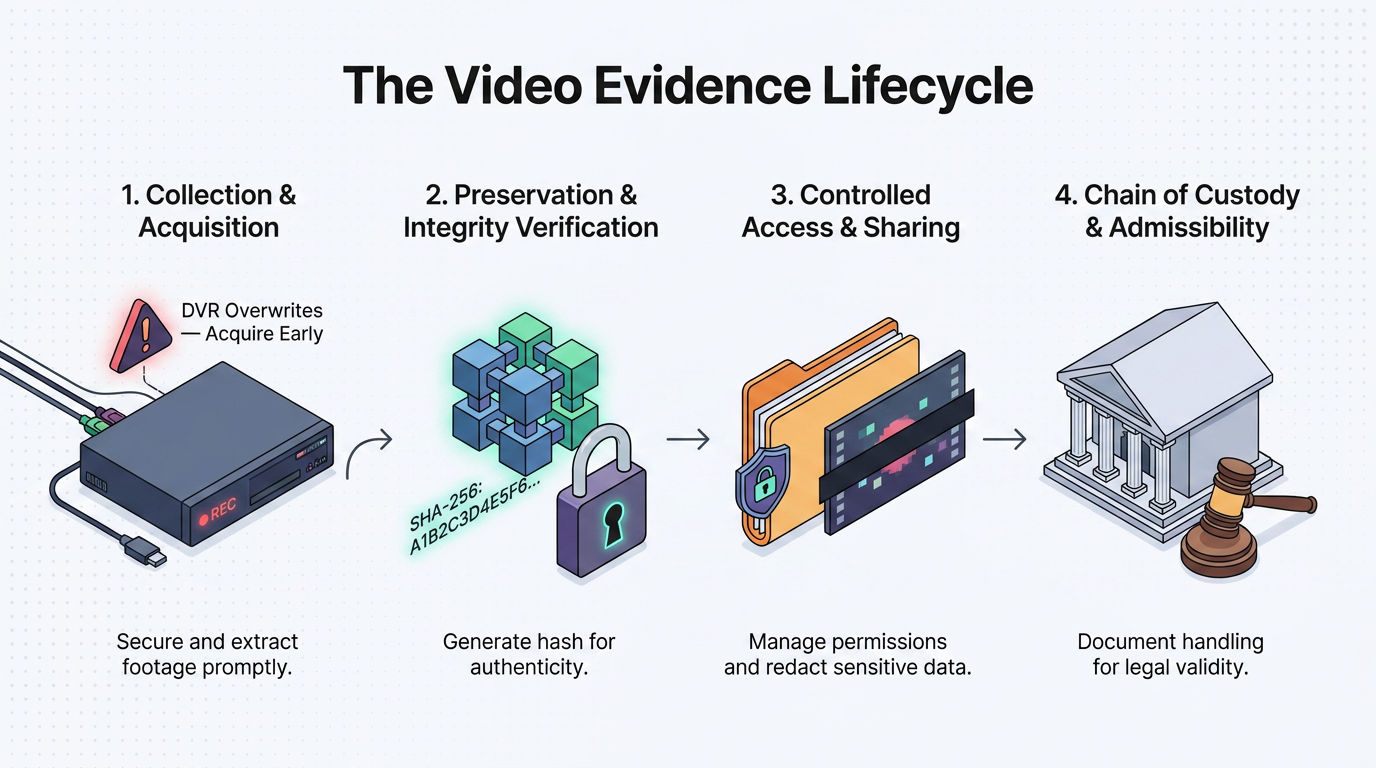
A recorder can overwrite an incident before an investigator receives the request, so teams must identify, collect, acquire, and preserve relevant footage early. Each stage has failure modes that can surface months later in a deposition or hearing.
Collection and Acquisition
Video evidence on a digital video recorder (DVR) is perishable; the system overwrites it on a set cycle, so acquisition should happen as soon as possible after an incident. The investigator should preserve the native export because conversion can strip critical metadata or secondary streams. The investigator should collect the player or codec directly from the device or the manufacturer and create a secondary open-format export when time allows.
Before the operator closes out the acquisition, the team should:
- Verify the export plays back on a separate computer.
- Confirm the dates and times retrieved.
- Document recorder settings and overwrite patterns.
- Initiate chain of custody.
Preservation and Integrity Verification
The investigator records a cryptographic hash for the acquired data and documents later hash verifications.
Format conversion can affect what an investigator can validate. Changing the container can remove metadata or secondary streams, so analysis of a non-native file should document missing metadata and frame-timing limitations.
Correlating Video with Access Control Records
Investigators build the timeline by pairing exported video with physical access control system (PACS) records. A door-forced-open or door-held-open alarm, plus the badge reads around it, marks which video segments matter. Pairing the alarm event with its corresponding clip avoids relying solely on manual clock matching; synchronized device clocks improve timeline correlation.
The package that goes to HR or outside counsel should hold the incident report, the correlated badge and alarm log, the native export with its hash values, and the custody record.
Controlled Access and Sharing
Case materials sit behind restricted access, and the restriction has to be provable. The evidence administrator should track access to stored images physically or electronically and document every release under chain-of-custody policy. Each video's full audit log should identify the operator and the file's hash value. It should also record every review. File movements and exports must be recorded as well.
Before footage leaves the organization, operators should assess the authority and purpose for disclosure. Common redactions include masking faces, blurring license plates, and muting sensitive audio, with the unmodified original preserved alongside any redacted copy.
A recording that is an education record for several students cannot be released until the other students' images are redacted; where that is not reasonable, only the parents of each student it directly relates to may view it.
Illinois's biometric privacy statute generally bars private entities from disclosing biometric identifiers unless the subject consents or another statutory exception applies, including a financial transaction authorized by the subject, disclosure required by law, or a valid warrant or subpoena. That limits sharing footage run through biometric identification. Redaction workflows also require integrity controls because a redacted copy is a derivative file whose provenance must be documented.
Chain of Custody and Courtroom Admissibility
Custody and integrity records help establish whether the footage is what its proponent claims.
What the Custody Record Must Contain
A chain-of-custody record documents who possessed the evidence and when, from collection through presentation, and investigators create it contemporaneously rather than reconstructing it afterward. The acquisition record has to capture:
- Unique identifiers for the evidence and the investigation.
- The collection tool and version.
- Hash values of the acquired data.
- The acquiring person's name, title, and the date.
- Any errors encountered.
Every transfer gets logged with identification of each person taking possession, plus the date and time. The custodian should record each hash verification at multiple points in the lifecycle, including the date, time, file name, and hash value. Depending on the jurisdiction and circumstances, unexplained custody gaps can lead a court to exclude footage or give it less weight.
How Courts Authenticate Surveillance Video
Rule of Evidence 901 requires the proponent to show that footage is what they claim. A witness with personal knowledge can testify that the video reflects what they observed. Where no one watched the event, the silent witness theory lets the recording speak for itself when the proponent establishes that the recording system was reliable and working at the relevant time and that custodians handled and safeguarded the recording properly. Rule 902(14) allows certified data copied from a device to self-authenticate through a process of digital identification certified by a qualified person.
The Judicial Conference's Advisory Committee on Evidence Rules is studying proposed amendments for AI-generated material, including a deepfake-challenge procedure and a reliability standard that would apply Rule 702-style expert requirements to machine-generated output. At its May 2026 meeting, the committee had not finalized either amendment. Until then, teams handing off AI-flagged footage should keep the original unprocessed recording alongside any annotated export and document how the analysis was produced.
Retention Requirements Vary by Industry
Safeguarding footage until trial presumes the footage still exists, and how long that must be depends on the sector. The Health Insurance Portability and Accountability Act (HIPAA) does not set a mandatory retention period for routine surveillance footage. The HIPAA documentation retention rule covers Security Rule documentation such as policies and risk assessments, not camera footage.
Where regulators do specify periods, they are precise. Tribal gaming operations under Title 25 of the Code of Federal Regulations (25 CFR), section 543.21 must keep routine surveillance recordings for at least 7 days and recordings of suspected crimes or detentions for at least 1 year. These rules illustrate why incident footage can carry a far longer minimum than routine recordings.
For teams without a mandate, discovery timing is the constraint. Litigation holds and insurance claims can arise after an incident. Internal investigations can also begin later, so a retention window sized only to storage defaults can delete evidence before it is requested.
Where Video Evidence Programs Break Down
Recorder overwrites can erase footage, and metadata may disappear during export. Broad access can expose a case file. Each failure calls for a control tailored to the specific risk.
DVR malfunctions can leave only partial coverage of an incident when maintenance and escalation processes fail to resolve the underlying problem in time. Municipal and large-scale deployments also face ongoing availability issues, with camera uptime varying significantly across sites and over time.
Proprietary Formats and Timestamp Drift
Surveillance systems may export in proprietary containers, which restrict validation and can strip critical metadata or secondary streams during export. Compatibility planning should include testing review workstations and archiving legacy software versions needed for older recorders.
Power outages and ordinary clock errors can cause on-screen timestamps to drift. Daylight saving changes create another source of mismatch. Devices at a single site can each be out of sync with real time, which corrupts any timeline built across cameras. Every device, including recorders and log servers, should run Network Time Protocol (NTP) synchronization with deviation alerts configured.
Unauthorized Access to Video Systems
A 2024 Federal Trade Commission enforcement action against a cloud camera provider followed breaches in which a hacker reached live customer camera feeds and viewed patients in psychiatric hospitals and children inside rooms. The agency alleged failures in basic practices such as password requirements and encryption.
Inside an evidence workflow, broad file access creates an integrity challenge because the organization may be unable to show that administrators tracked access. Use role-based permissions and log every access with the operator identity and timestamp. Audit those records periodically.
Treat Every Export like an Exhibit
A security team can test its workflow by reviewing last quarter's most significant clip and determining whether its handling would survive cross-examination. If the answer is uncertain, the evidence workflow requires attention before the organization invests in additional cameras.
Frequently Asked Questions
What steps should security teams take to prevent timestamp drift across multiple cameras and ensure accurate timeline correlation for video evidence?
Security teams should deploy Network Time Protocol synchronization across all recording devices and configure deviation alerts to flag when cameras drift beyond acceptable thresholds. Regular audits verify synchronization remains active and backup power maintains clock accuracy during outages.
Why should investigators preserve native-format exports instead of relying on converted video files when acquiring surveillance footage as evidence?
Native-format exports retain original metadata, frame timing, and secondary streams that conversion to open formats can strip away. Investigators should capture the native file first, obtain the manufacturer's player or codec, and create a secondary open-format export only as a supplemental copy for easier review.
How long should organizations retain surveillance footage when no specific regulatory retention period applies to their industry?
Retention windows should account for litigation holds, insurance claims, and internal investigations that may begin weeks or months after an incident rather than defaulting to storage-driven cycles. Teams should set minimums that preserve incident footage well beyond routine recordings, mirroring the tiered approach used in regulated sectors where suspected-crime recordings are held far longer than day-to-day surveillance.
