9 Ways AI Is Changing How Security Teams Use Surveillance Video
From real-time threat detection to privacy-conscious monitoring, explore 9 ways AI is reshaping how enterprise security teams use surveillance video.
Camera fleets have outgrown the operators watching them, and the gap between an event on screen and a response on the ground decides outcomes. AI video surveillance is closing that gap, turning passive recorded footage into real-time detection, faster investigations, and verified access alarms. The nine shifts below show how AI is reshaping surveillance video use, from behavioral precursor alerts to privacy-conscious monitoring that keeps human judgment at the center of consequential decisions.
Key Takeaways
- AI live-stream analysis lets operators act on incidents as they unfold rather than reconstruct them afterward.
- Pairing door events with matching video helps security teams distinguish breaches from maintenance problems.
- Pose-based fall detection can alert operators without facial recognition or biometric profiling, helping reduce privacy concerns.
- Analytics can layer onto existing cameras through standard streaming protocols, avoiding wholesale replacement.
What AI Video Surveillance Means for Enterprise Security Teams
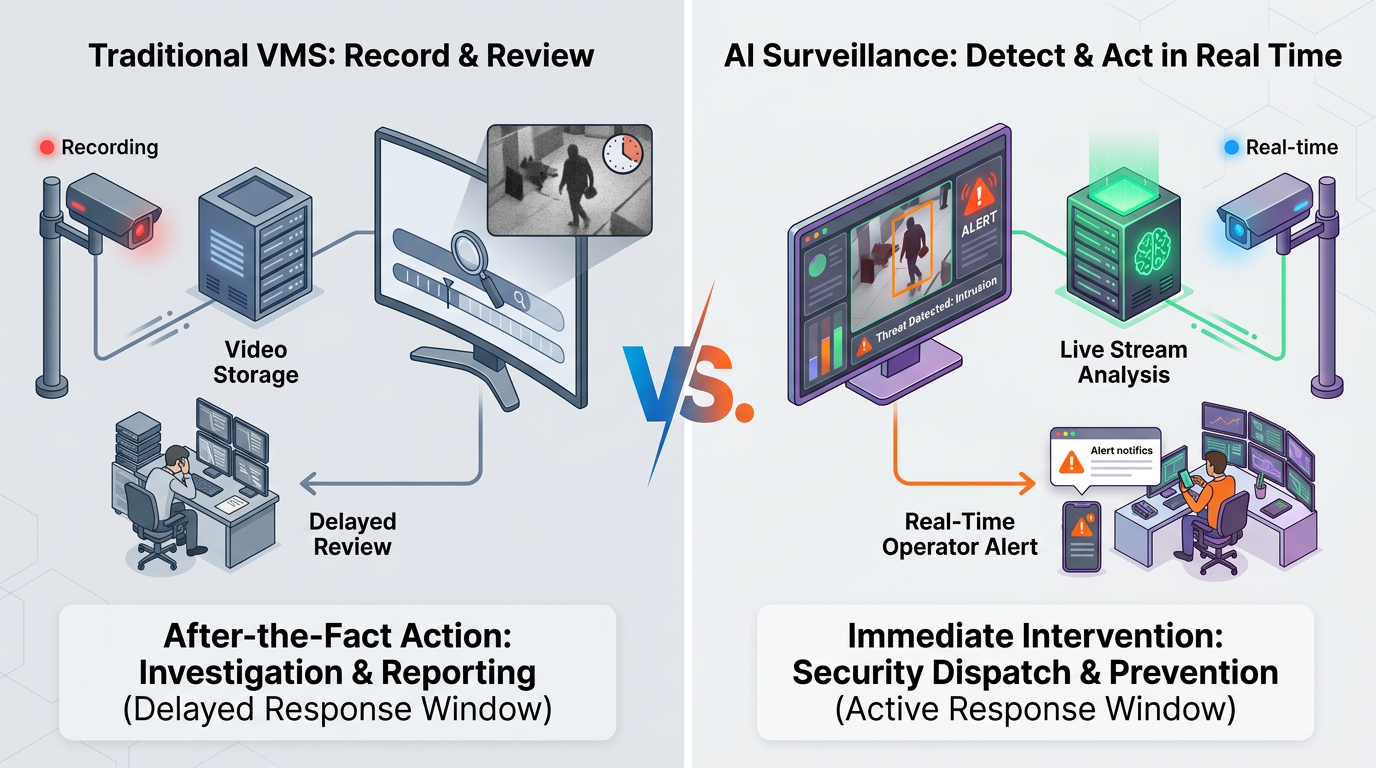
AI video surveillance applies machine learning models to live and recorded camera streams, detecting security-relevant objects and interpreting behaviors or events before an alert reaches an operator. It differs from the older model in what happens between the camera and the human.
A conventional video management system (VMS) records everything and depends on a person to watch the live view or scrub the archive afterward. Rule-based motion detection added a first layer of automation by triggering on pixel changes inside a drawn zone, with an integrator's threshold determining when it fires.
Frame differencing and background subtraction break down when lighting shifts or weather and occlusion interfere. Neural networks learn from examples, so they can classify a person or vehicle they have never seen before.
9 Ways AI Is Reshaping Enterprise Surveillance Video
Each shift below tackles a distinct choke point in the traditional workflow, from live detection through investigation, escalation, and privacy. Read them as a progression: earlier shifts feed the queue, later shifts route and constrain what leaves it.
1. Real-Time Threat Detection Replaces After-the-Fact Footage Review
When models run on live streams, the system alerts operators during events. Operators can act on defined events:
- A person crosses into a fenced substation yard at night or forces open a door after hours.
- A body lies on a parking garage floor and stops moving.
Fall detection models classify the sequence as standing, falling, fallen and alert on the transition. For decades, the review room was where surveillance video earned its budget. An incident happened, someone reported it, and an investigator pulled the recording to reconstruct events. Recorded footage still serves an evidentiary role, but its primary value shifts from reconstruction to intervention.
2. Behavioral Precursor Detection Gives Teams Time to Intervene
Real-time alerts help most when they fire before the incident peaks. Pre-incident activity often unfolds on camera during an incident's lead-up. Spatial-temporal reasoning, which tracks how objects relate across frames and over time, helps a model identify that phase. The system registers loitering only when it integrates presence over time.
In practice that might be a scuffle beginning near a retail exit. Or it might be a person who lingered at a data center's rear door and then stepped into a restricted zone. An early alert gives a guard time to walk over or an operator time to issue a talk-down over a speaker.
3. Contextual Analysis Cuts False Alarms from AI Security Cameras
Catching lead-ups early only helps if the alerts are real. Context turns a motion trigger into a useful alert. A shopper carrying a large bag toward the front registers at two in the afternoon is a retail store working as intended. The same shopper with the same bag pushing through an emergency exit toward the loading dock at eleven at night, while the access control system shows that door held open, is a theft in progress. A motion sensor sees identical events. A model checks the person and scene against the door-controller report, with time as another input, and distinguishes them.
Environmental movement can also trigger conventional motion detection without producing a person:
- Paper blowing across a fence line produces motion without a human presence, while a shadow moving with the sun changes pixels without creating a security event.
- A fox crossing a compound at dawn belongs to a different object class than a person.
Models trained to distinguish object classes reduce some false triggers, while reasoning AI helps suppress environmental noise.
4. Natural-Language Video Search Turns Investigations from Days into Minutes
Filtering live alerts helps in the moment. After the fact, investigators still need to find the right clip. A laptop disappears from a third-floor engineering lab sometime between Friday evening and Monday morning. Under the traditional model, an investigator exports the weekend from the four cameras covering that floor and scrubs it at speed, pausing on anything that looks like a person with a bag. Natural-language search replaces the scrub with a query: a person carrying a backpack leaving the third-floor stairwell after 8 p.m. on Friday. The system returns ranked clips, and the investigator reviews a short list of candidates already narrowed from the weekend of footage.
Modern search systems encode text and frames into a shared representation using vision-language models, so a plain-language description can be matched directly against video.
5. AI Security Monitoring Helps GSOC Operators Handle More Cameras
Faster search and fewer false alarms matter most at the video wall. A Global Security Operations Center (GSOC) can put more feeds on that wall than any operator can absorb simultaneously, regardless of skill or dedication. Multi-site enterprises run large camera fleets against a handful of seats.
Models analyze live streams continuously and surface only the events that meet detection criteria, so the operator's screen shows a short queue of clips to verify rather than a grid of feeds to scan. The role shifts from watcher to validator. The operator confirms the detection or dismisses the false positive, then decides the response. Validating a short queue better matches the limits of sustained human attention than continuous watching.
6. Video-Verified Access Control Alarms Expose Tailgating and Forced Entry
Door alarms feed that same queue. A physical access control system (PACS) logs Door Forced Open (DFO) and Door Held Open (DHO) events, and on a loading dock a DHO can fire repeatedly when someone props the door for deliveries. At that volume, no operator can treat every DHO as a potential breach. In tailgating, a standard reader logs no event for the follower who walks in behind a valid badge.
Pairing each PACS alarm with video changes what the alarm means. A DFO with video showing a pry bar is a break-in; a DFO with video showing a mis-latched door is a maintenance ticket. Comparing the badge count with the camera's occupant count exposes tailgating that readers cannot see on their own.
7. Existing Camera Infrastructure Becomes Intelligent Without Replacement
Existing cameras can support these functions. IP cameras compliant with ONVIF profiles for streaming and analytics metadata can feed an AI layer while remaining in place. Conformant cameras expose their streams over the Real-Time Streaming Protocol (RTSP), so any analytics platform that can ingest an RTSP stream can analyze footage from cameras installed years ago.
The VMS remains the recording and playback system of record, while the AI layer subscribes to the same streams. Architects can run inference on edge appliances or in private clusters, or use the cloud while keeping bandwidth-heavy streams local.
8. Automated Escalation Speeds Response from Detection to Action
An alarm must reach the right responder after verification, and that handoff creates the next delay. Verified alarms can be scored automatically for dispatch priority, from no call for service through an apparent threat to life, so that the response matches the severity without a human intermediary at every step.
Inside an enterprise, each verified event goes to its owner with context. A forced door goes straight to the on-site guard's phone. Facilities gets propped doors, while the badge holder's manager hears about a tailgating event. High-consequence actions such as a lockdown stay with a human, in line with the human-oversight requirement the EU AI Act sets for high-risk systems.
9. Privacy-Conscious AI Surveillance Monitors Behavior Without Identifying Individuals
Escalation spreads footage to more people and raises privacy concerns. Pose-estimation models typically output skeletal key points for each person in a frame, but that does not necessarily mean the underlying system discards face, clothing, skin tone, or other visual information. A model can read joint positions to detect a fight or fall. The same data can show a body crossing a fence line. Detection built on that representation, or on optical flow, analyzes movement alone.
Behavior-based detection lets a security team show its works council or general counsel a system whose detection output is framed around actions and context rather than facial recognition or biometric identity.
Top AI Video Surveillance Use Cases Across Industries
Corporate Campus: Loitering and Perimeter Intrusion Detection
Corporate campuses can place loitering detection and perimeter intrusion detection at building approaches and executive parking, flagging unauthorized presence before someone reaches an entrance.
Retail: Loitering and Crowding Near High-Value Displays
Retail environments can flag loitering and crowding near high-value displays so staff can approach before merchandise leaves the floor. The same live-analysis models that identify perimeter events at a campus can identify dwell time at a shelf.
Healthcare: Violence and Fall Detection in Waiting Rooms
Hospitals can apply violence detection and fall detection in emergency department waiting rooms, where escalating altercations and patient falls both demand a fast response.
Education Campuses: Perimeter Intrusion and Weapon Detection
Education campuses can run perimeter intrusion detection on fields and lots after hours, with alerts routed to campus security officers. Campuses can also test weapon detection at entrances where it proves reliable.
Data Centers: Tailgating Detection at Mantraps and Cage Doors
Data centers can compare badge and occupant counts at mantraps and cage doors to catch tailgating into server halls, closing a gap that standard readers cannot see on their own.
Utilities: Filtering Wildlife and Weather from Perimeter Alarms
Utilities can filter wildlife and weather out of perimeter alarms at substations, keeping operator attention on people and vehicles crossing the fence line rather than on foxes, wind, or blowing debris.
How to Choose AI Video Surveillance Software for Enterprise Security
Security teams should test candidate software against their own cameras and footage. A pilot should use live feeds and past cases from the deployment environment.
- Confirm camera and VMS compatibility before deployment. Verify ONVIF conformance for streaming and analytics metadata against the installed base.
- Determine detection breadth and false alarm performance in live testing on real feeds, not vendor demo reels.
- Test search with real past cases. Rerun those cases as natural-language queries and time the result.
- Favor behavior-based detection that creates no biometric record, and confirm the vendor can document how models are managed and how risk is assessed.
- Route PACS events into the tools responders already carry. The architecture should support large camera fleets across sites and avoid per-site rebuilds.
From Detection to Agentic Physical Security
When cameras and access systems share context, responders get the information they need to decide, and routine monitoring shifts from the operator to the platform. That division of labor, automation on continuous observation and triage, operators on consequential action, is a practical standard for evaluating any new tool. It reframes what to buy and how to run it: the value is not in a richer feed grid or a longer feature list, but in fewer irrelevant alerts, faster verified escalations, and a shorter path from event to action. Security leaders should start with a pilot, measure detection breadth and response time against real cases, and expand only after performance is documented under clear oversight and escalation rules.
Frequently Asked Questions About AI Video Surveillance
How does pose-based fall detection work technically, and what are its limitations compared to traditional camera-based detection methods?
Pose-based fall detection extracts skeletal joint coordinates from video frames and classifies joint angle changes and body orientation shifts as standing, falling, or fallen states. Limitations include occlusion failures, missed detections outside camera view angles, and reduced accuracy in low-light conditions.
What infrastructure requirements (hardware, network bandwidth, compute resources) are needed to add an AI analytics layer to an existing camera fleet without replacing cameras?
You typically need cameras or a VMS that can provide standards-based video streams such as ONVIF or RTSP, an edge, cloud, hybrid, or private-cluster environment for inference processing, sufficient network bandwidth between cameras and analytics, stable connectivity linking your VMS, cameras, and compute nodes, plus storage scaled to bitrate, resolution, frame rate, and retention policy.
How should enterprise security teams structure a pilot program to accurately measure AI video surveillance performance against real-world detection and false alarm benchmarks?
Run pilots on live production feeds from high-activity zones with documented incidents. Establish baseline false alarm rates from current motion detection over two weeks, then compare AI performance against that measured floor during actual operations.
